The law of the sea, a series of traditions by which sailors worldwide have been governed throughout history. Like the captain, unless you are Francesco Schettino, should be the last to leave the ship. Like women and children first. And then others, more interesting, macabre, and fortunately less popular. Such as in the event of a shipwreck, we can draw lots to decide whom to kill and eat to survive.
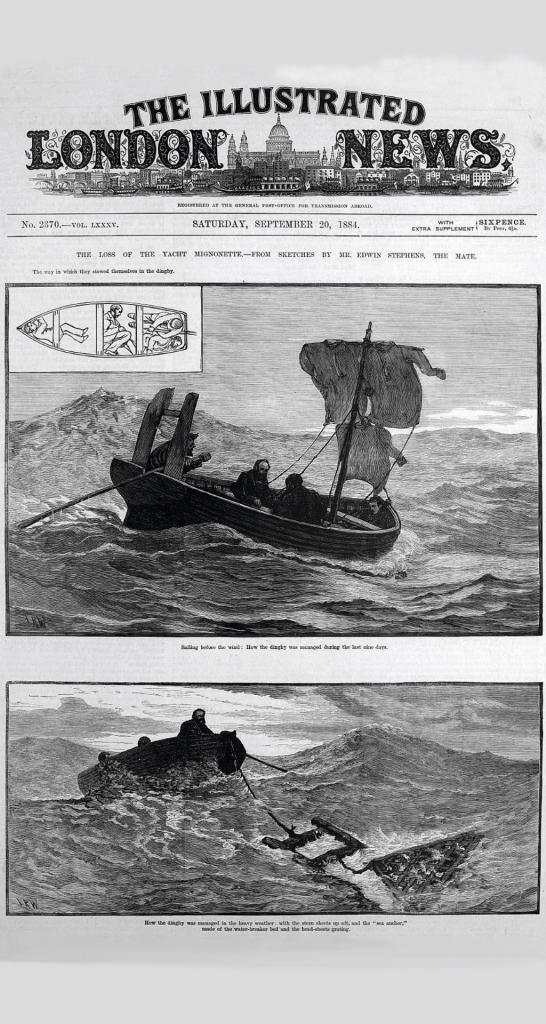
On July 5, 1884, the British yacht Mignonette was sailing in the South Atlantic towards Australia when a squall hit it between the islands of St. Helena and Tristan da Cunha, causing it to shipwreck. Its crew were Captain Tom Dudley, Edwin Stephens, Edmund Brooks, and the 17-year-old cabin boy Richard Parker (like the tiger in Life of Pi).
The four survived in a lifeboat for over three weeks. After drinking their own urine to fight dehydration, Parker could not resist drinking seawater and fell ill. Faced with the idea that he would soon die, Dudley and Stephens decided to take a very liberal interpretation of the law of the sea and kill him to feed on his body.
On July 29, after 24 days at sea, the German ship Moctezuma rescued the three survivors and the remains of Parker's body, about 990 miles east of Rio de Janeiro. But upon their return to Great Britain, far from being hailed as heroes, the death of the cabin boy Richard Parker at the hands of Dudley and Stephens without a draw being made, was tried by a military court as murder. The accused were found guilty and sentenced to death, although the sentence was commuted to six months in prison.
American journalist, writer, and lawyer Adam Cohen reconstructs that episode in The Captain's Dinner (Ed. Arpa) and brings it to present-day scenarios such as health screening, torture of terrorists as a method to save lives, or a simple budget to fix a road.
In Parker's case, the absence of a draw changed the nature of the dilemma. It was no longer just a question of whether it is justified to kill one person to save others. It was also necessary to ask who decides who should die and on what criteria, because Parker was not chosen at random.
"At a certain level, drawing lots seems much fairer. That meant everyone had an equal chance. And, for religious people, it could be said that it was God who was choosing. It's democratic. No one is chosen for being sicker, younger, weaker, or poorer," explains Cohen. "The problem is that it was an open secret that those draws were almost always rigged. It was pretended that the choice was fair, but almost always a cabin boy, a slave, the only black person, or the only Italian on an English ship would lose. Drawing lots was nothing more than giving the appearance of justice to a fundamentally unjust decision about whom to eat."
During the trial, the defense argued tirelessly that if they did not kill Parker, all four would die. The calculation seemed simple: one life versus three. However, the court refused to apply arithmetic. So when does survival stop and murder begin? "I am inclined to say that intentionally killing is always murder, except in self-defense, war, or death penalty ordered by a court," states Cohen. "Therefore, even if the draw was done fairly, no one has the right to take another person's life for their own purposes. That said, the issue becomes more interesting if all those participating in a fair draw have voluntarily decided to participate; that is, if they prefer to risk being killed rather than facing the possibility of dying of thirst or hunger."
"No one has the right to take another person's life for their own purposes"
And if it is wrong to kill one person to save three, what if we are talking about saving 100, 1,000, or a million? "The principle should be the same. If a terrorist threatens to kill an innocent person or else will detonate a bomb that will kill many more, the response of a civilized society should be to do everything possible to prevent the attack, and not accept killing an innocent person. Civilized societies do not kill innocents."
In his ruling, the tribunal president, Lord Coleridge, was particularly disturbed by the fact that two adult men decided to kill the young man. Cohen interprets this as a defense of the weak against the strong and as a rejection of the idea that a society - even one improvised on a lifeboat - should be organized according to the logic that the weakest must be sacrificed for the strongest to survive.
And yet, the author acknowledges that in our society, we constantly apply utilitarianism at the expense of human lives in our daily lives. "Because we could build safer roads if we spent more money on them. But there comes a point where we decide that the additional expense is not worth it in relation to the number of lives it would save. Or spending on free sunscreen distribution on beaches or buying a new and safer car for everyone with an old and unsafe vehicle. But in all those cases we make decisions about whether the additional expense is worth it based on the lives that would be saved. We are all, to some extent, utilitarians; just to varying degrees."
It is true that drawing lots does not make death disappear or magically turn murder into something good. What changes is the distribution of power. No one can decide that another should die because they consider their life less valuable or because they are the least able to defend themselves. "The captain said they killed him because he was the sickest, which is already a form of social hierarchy," explains Cohen. But it also seems likely that the captain chose Parker because he was the cabin boy, the youngest, the lowest paid, the lowest in rank, the orphan, the illiterate. For the captain, Parker seemed to be the least valuable life on the ship.
Furthermore, the trial took place in a society deeply concerned about the relationships between power, class, and vulnerability. Cohen finds in the sentence a defense of individual dignity against dehumanization. Parker had ceased to be seen as a person and had literally become food. The paradox is brutal: to preserve their humanity, the survivors had to deny the humanity of another. And then there is the problem that no one knew when the shipwreck would end. Dudley acted convinced that the death of the four was imminent. But he could not know when a ship would appear to rescue them. It could be the next day. It could be hours later. The decision to kill was based on a prediction of the future.
"We can demand moral standards even if we do not understand how they felt when they committed their terrible acts"
Cohen argues that the principle derived from the case questions whether a hospital can withdraw a patient from an ICU simply because another may benefit more from it; whether an expensive life-saving drug can be denied because someone believes the money could be used more efficiently elsewhere. Who says that when we start sacrificing people, we should start with the sick? Cohen wonders. "Perhaps we should especially protect the sick, who are the ones who need our help the most."
It is tempting to bring a ship from 1884 to the 2020 coronavirus health screening. "These are some of the most difficult ethical questions, and I don't think they admit easy or absolute answers. Like it or not, in healthcare there is always a certain degree of triage. Resources are limited, and not everyone will receive an unlimited amount of medical attention. In a war, triage is common. When two wounded arrive at the medical post, you start with the one you think has the best chance of survival thanks to your efforts. But it is essential that we maintain the idea that all lives have the same value and we should not direct medical attention towards categories of people we like at the expense of those we like less."
And even more difficult: Would it be legitimate to torture a terrorist to make him tell us where the bomb is? "No, I don't think so. Torture is wrong, and once you allow governments to resort to it, it quickly becomes something they use on a large scale. That said, in the scenario you describe, the temptation to use it just once would be considerable."
The Mignonette debate didn't end in court or with the 19th century either. British society was divided. Some newspapers considered it necessary to punish Dudley and Stephens to prevent extreme necessity from becoming an excuse for future acts of violence. Others felt it was absurd to judge men from the safety of a courtroom for something they had done after weeks of starving and thirsting on a lifeboat. The Daily Telegraph went so far as to ask the judges to imagine what they would do if they were denied breakfast, lunch, and dinner—even just for the duration of the trial. "We must maintain a certain modesty and not simply assume that we would have done the right thing under the same circumstances," Cohen states. "That said, the law does this constantly. We convict a person for killing their unfaithful lover, even though we have never experienced such a situation; or someone who grew up without a father, without money, and without an education for having committed murder, even though we grew up with far greater advantages. There is an old French saying: Tout comprendre c'est tout pardonner (To understand everything is to forgive everything). "I don't think so. I believe we can hold people to certain moral standards even if we can't fully understand how they felt when they committed their terrible acts."
That's why *The Mignonette* doesn't just force us to ask ourselves what we would have done on the boat. It forces us to ask ourselves what rules we want to be in place before we even get there. The measure of a civilized society isn't what it does when everything is going well, but what it refuses to do when doing so seems like the most efficient option.
So, after writing the book, do you now know what you would have done on the raft? We asked Cohen. "I like to think that I would argue that we should wait and trust that we'll be rescued or that we'll see land. And if it seemed like the only option, I'd try to get everyone to agree to a fair lottery. It may sound idealistic, but it is possible to act above the law of the jungle. Edward Brooks said he'd rather die than take part in the murder. He tried to convince the others not to kill the ship's boy and refused to participate. He moved to the other side of the lifeboat and covered his head with his raincoat. He is the hero of this story."