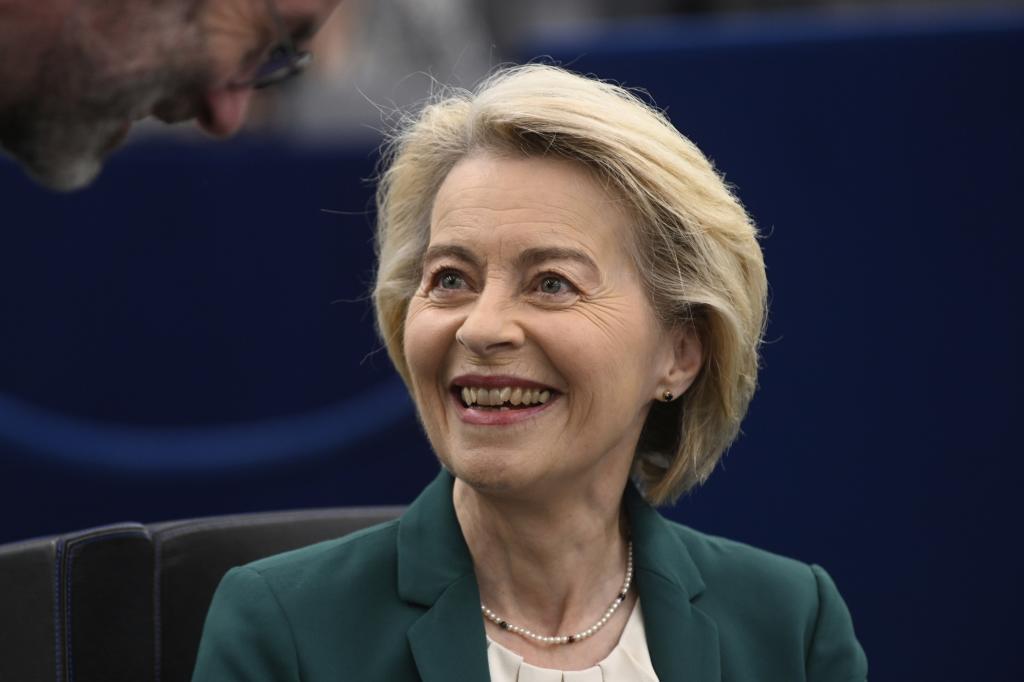
"Our security depends on security in space," warned the President of the European Commission, Ursula von der Leyen, during the space summit at the Grand Palais in Paris, where she advocated for the creation of "a European space shield" to strengthen surveillance and protection of the Old Continent from the skies.
Von der Leyen justified its creation in light of the repeated security incidents and cyberattacks that Europe faces, although she did not provide further details on the initiative. Earlier this year, the French aerospace company Thales actually presented its Sky Defender system, capable of detecting aerial threats within a coverage radius of 5,000 kilometers.
The President of the European Commission drew a stronger link than ever before between space and defense. Von der Leyen announced the allocation of 2 billion euros in venture capital for the benefit of European space companies and her intention to quintuple (up to 130 billion euros) the amount allocated to space in the European Competitiveness Fund.
"We are at a critical moment, like 25 years ago, when we decided to launch the Galileo program that has allowed Europe to have its own GPS system," warned the President of the European Commission. "We start from a position of strength, with the IRIS program that will enable us to have a constellation of over 350 satellites to reinforce our autonomy and communications starting in 2029, but we need a new European vision for access to space."
"Europe must fly with its own luggage," declared Emmanuel Macron, host of the summit that brought together 90 countries and aims to conclude with around fifty contracts valued at 20 billion euros and three joint statements on security, cooperation, and space exploration.
"We want Europe to assert its ambition with its own manned flights," added the French President. "I want to see the first European cargo ship, Nyx, docked at the International Space Station within two years. In five years, we will witness the first moon landing of a European spacecraft, Argonaut. And in ten years, we will have the first 100% European manned spacecraft taking off from the spaceport of Kourou (in French Guiana) with astronauts not only from Europe but from other nations."
"But Europe remains fragile in the global context and we must accelerate," added the French President, who favored a "European preference" to enhance the competitiveness and sovereignty of the aerospace industry in the Old Continent in the face of challenges from the United States and China.
"France will be a natural partner in the new space era," concluded Macron, in a direct line and on a giant screen before an audience of around five hundred spectators with French astronaut Sophie Adenot, after completing her third spacewalk at the international station.