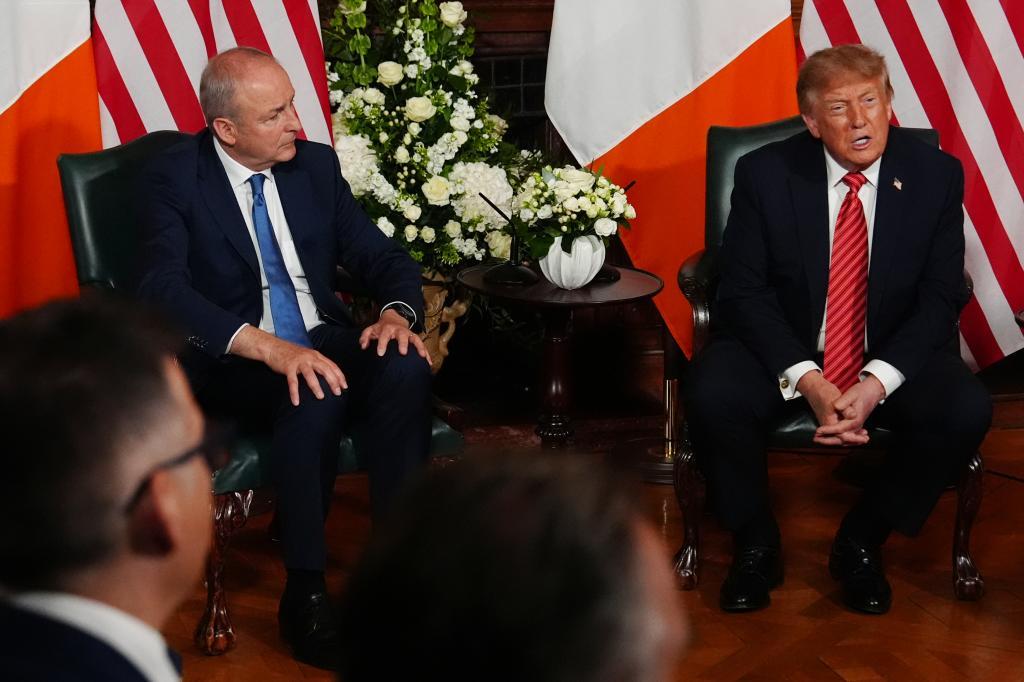
Donald Trump has landed in Ireland for a weekend of golf and has stirred things up. Not with that country, but with what is supposed to be the United States' biggest ally in Europe: the United Kingdom.
The U.S. President has indirectly questioned British sovereignty over the Falkland Islands, claimed by Argentina, and has openly supported the reunification of Northern Ireland - which is part of the United Kingdom - with Ireland. If he wanted to slap the British, he couldn't have done it better. He openly slapped his political allies on the islands - the Conservative and Reform Party - and in Northern Ireland - the unionists.
With his press conference in Dublin, Trump has become the first U.S. president to support the reunification of Ireland. It was during a media appearance that the main Irish newspaper, the Irish Times, described as "unleashed" and "extraordinary". Trump's words represent, on one hand, a further rupture in relations between the U.S. and its European allies - and, most notably, its closest one, the United Kingdom - and, on the other hand, an evident desire to court the huge American Irish vote ahead of his country's legislative elections in eight weeks.
Trump was very clear, stating, alongside Irish Prime Minister Micheál Martin, that "I would love to see" a unified Ireland, and that the current head of government of that country "is the right person" to achieve it. Trump said that the integration of Northern Ireland, which is under British sovereignty, "is going to happen. It might happen now," which would be "a pride for all".
The Irish reunification is one of the major unresolved issues in the future of the United Kingdom and Ireland. In the Good Friday Agreement of 1998, London accepts the idea, provided it is approved in a referendum. For this to happen, the British Minister for Northern Ireland must call the consultation, but only if they believe there is a majority of the population in favor of reunification. Currently, that circumstance does not exist. In general, Northern Irish Protestants would vote in favor of remaining in the United Kingdom; Catholics, for reunification with Ireland.
For that reason, the office of the British Prime Minister, the Labour leader Andy Burnham, responded to Trump by referring the press to statements made by the head of government last month in the Northern Ireland Parliament, where he stated that "the Good Friday agreements remain in force". In other words, there is no reunification for now.
Raising the idea could trigger a return to the sectarian violence that ravaged the region between 1968 and 1999, resulting in the deaths of between 3,500 and 3,800 people, mostly Catholics. Protestants had the decisive support of the British government and, since 1981, that of the U.S. Catholics had the support of a strange mix of Irish descendants living in the U.S., Libya, the Palestine Liberation Organization (PLO), and collaborated with European terrorist groups such as the Spanish ETA, the Colombian FARC, and the MK, the armed wing of the African National Congress of South Africa, led by Nelson Mandela.
Even today, both communities are separated in central Belfast by long kilometers of double walls, closed with metal gates at night. Each side of the walls is covered with militant slogans and images of the victims of the communities living opposite them. It is a kind of 'Berlin Wall' between two religions where war has been replaced by 'tense peace'.
Trump's entry into the issue further strains relations between Washington and London. And it is a blow to the two British parties closest ideologically to the U.S. President: Reform and the Conservative Party. Both accept the referendum. But if it were to take place, they would unequivocally vote no. The number two of Reform - which is, in practice, the British version of 'trumpism', Richard Tice, declared a year ago his intention, in the event the party comes to power, to reform the Good Friday Agreements, although he did not specify which ones.
The Tories, on the other hand, managed to stay in power in 2017 thanks to the support of the main Protestant group, the Democratic Unionist Party (DUP), founded by one of the leaders of that religion during the conflict years, Reverend Ian Paisley, whose inflexibility was such that even the rock group Pink Floyd dedicated some lyrics to him in a 1983 album 'The Final Cut'. Paradoxically, Protestant unionists tend to sympathize with Trump for his stance on immigration.
The Labour Party, in power, also opposes reunification, although it tries not to make a flag of the issue, perhaps not to alienate a part of its working-class voters, some of whom have defected to Reform.
Equally surprising was Trump's position on the Falkland Islands, where he described the British position of maintaining sovereignty as "a potential disaster" and drew an equivalence between London's stance and that of Buenos Aires, stating that "neither of the two is happy". Traditionally, the U.S. has supported British sovereignty over the archipelago, which, like in the case of Gibraltar and Northern Ireland, is based on the inhabitants' opposition to changing nationality. In 1981, Argentina and the UK went to war over the islands, a conflict won by London with the support of the U.S. under Ronald Reagan. Since then, both countries have dismantled much of their naval forces, so it is unclear how a military conflict would unfold today.
In recent weeks, the U.S. has declared that it is "reviewing" its official position regarding the Falklands. The Israeli Security Minister, the Jewish ultranationalist Itamar Ben Gvir, tweeted this week in Spanish calling for his country to recognize Argentine sovereignty over the islands, after the British government announced an embargo on goods and services produced in Jewish settlements in the West Bank, where the Foreign Minister, Ed Miliband, accused the Tel Aviv government of "carrying out ethnic cleansing".