The volumes of Nexus or Sapiens, or the biography of Michelle Obama - the wife of the former U.S. President - displayed at the Bookchef booth could be considered a rarity despite having sold millions worldwide.
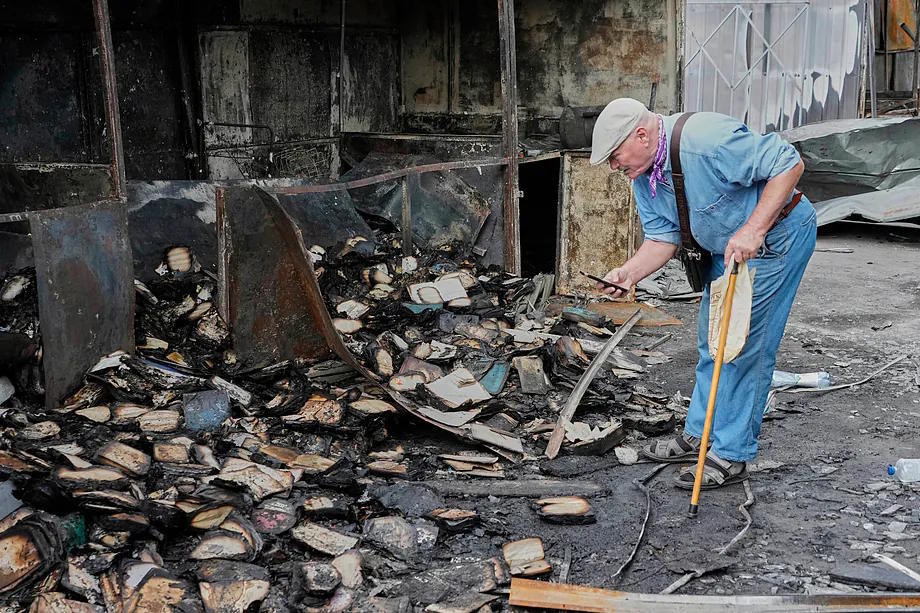
Not because the translation of these works into Ukrainian did not resonate with local readers, but due to a more unusual fact: all copies held by the company burned this summer in separate Russian drone attacks.
"We have lost 900,000 books (of all types). All our stock. We were only able to send about 100 copies of Nexus and Sapiens to Lviv because we had to reprint our entire catalog in less than a month," says Yevhen Shyrynos, director of the company located in Kiev.
In any fair in this sector, authors and industry figures would be discussing the number of works published, but among the participants of the International Book Forum in Lviv (known as BookForum), the more common discussion is about the number of texts lost.
Writer Andriy Kokotyukha, author of dozens of detective novels and others dedicated to the children's market, doesn't even know how many of his creations have disappeared.
"The publishing house that published my works was set on fire, along with my books. I don't know how many. It could be 50, 100, or 1,000. My children's books and titles like Gymnast or The Black Hand, which are part of the seventh-grade curriculum, were burned," he explained during the meeting.
Kokotyukha is one of the ten authors who have gathered since the 10th in this city in western Ukraine to attend the renowned Literature Forum, which this year is held under the shadow of the unique aerial offensive that Moscow has launched against local printing presses and publishers, described by a local media outlet as a new attempt to "assassinate Ukrainian culture."
During this past summer, Russian UAVs and missiles have attacked editorial offices, printing presses, and book warehouses in Ukraine on more than 20 occasions. On July 2, nearly 800,000 texts went up in flames in a terrible bonfire caused by a Russian drone. Another 250,000 suffered the same fate on July 19.
The offensive intensified in August, and on the first day of that month, two of these unmanned aircraft razed a warehouse in Kharkiv that housed 8 million written volumes. On August 16, another similar device destroyed the book market in Pochaina, Kiev, one of the largest in the nation.
According to Oleksandr Krasovytskyi from Folio, self-proclaimed as the oldest private publisher in Ukraine, "the enemy has the publishers in its sights. Unfortunately, in general terms, we can talk about between 15 and 16 million lost books. It is clear that most publishers completely lack the funds to continue their activities simply because they have nothing to sell."
According to the newspaper Pravda Ukraine, among the losses is 9% of the school textbooks that Ukrainian students who have already returned to school were supposed to use. At a recent meeting in this sector in Kharkiv —a city considered the "capital" of the Ukrainian printing industry— in the north of the country, the Minister of Culture, Tetiana Berezhna, estimated that the losses of local printing houses due to Russian bombings exceed 1.2 billion hryvnias (about 23 million euros).
"Russia is deliberately attacking our culture, our books, trying to erase our identity and us as a nation," declared the Vice Prime Minister during one of the conferences in Lviv, which precisely discussed what was defined as "Bookcide." Analyst Yevhen Hlibovytskyi opined that the Russian intentionality —Moscow is also hitting many other sectors of the local economy— "is irrelevant because the result is that they have caused a deep crisis in Ukrainian culture."
Yevhen Shyrynos from BookChef admits that the situation is "critical." "This year, the volume of texts to be printed in Ukraine will experience a drop of between 10 and 15 percent. For next year, we estimate that between 20 and 30 percent of publishers will be forced to close," he argues.
Established in 1994, BookForum became not only the largest book fair in the country but also one of the most significant in Eastern Europe. Before the start of the war in 2014, tens of thousands of people attended this event.
This year, the cultural event has brought together around 90 publishers and dozens of writers and intellectuals from over half a dozen countries, who have enlivened nearly 300 conferences, debates, new title presentations, or poetry readings over four days, defying the escalating violence sponsored by Moscow.
The war has permeated all social fabric of this country, and BookForum has not been an exception. Alongside the publishers' booths, there were booths from different military units, taking the opportunity to recruit volunteers.
The same event dedicated space to what it called "military literature," works written by soldiers on the battlefield. The figure of the renowned writer and singer Serhiy Zhadan, one of the country's most popular intellectuals, who enlisted as a combatant in 2024, adorned several of the stands at the main convention center.
The serious crisis caused by the Russian aerial onslaught has added to the stagnation already experienced by Ukrainian publishers, who agree that the sales boom seen in recent years due to the growing local interest in Ukrainian-language texts has come to an end.
Russia's general offensive in 2022 was the main driver of the cultural change that this country has experienced since then. If Vladimir Putin's goal was to influence the symbiosis of both nations, the military onslaught has had a radically opposite effect, which has translated into the use of the local language and literary production.
A survey released during the Lviv meeting confirmed that now 66% of Ukrainians use the national language to communicate compared to 7% who still resort to Russian. Before 2014, it was over 30%. The decline of that language accelerated in 2022 when still 15% of Ukrainian citizens used Russian as their main language.
Under this spirit, President Volodymyr Zelensky ratified in 2023 the parliamentary decision to end the printing of books in Russian. Millions of texts in that language were removed from bookstores in a widespread effort that spread throughout the local geography.
"Ukrainian books quickly filled the void left by Russian domination: dozens of new publishers and authors emerged, as well as thousands of titles in Ukrainian that had not been previously published," but that situation "has come to an end," indicated Oleksiy Erinchak, founder of Kiev's main bookstore, Sens, to a local media outlet.
"At the beginning of 2025, sales stopped showing significant growth, and competition intensified," he added. According to Hanna Bulhakova from the Ranok publishing house, "the Russians have had some success in harming our culture (with these bombings), but we also thought it was impossible to stop speaking Russian, and we have achieved it."
For Svitlana Paveletska from the Knyholav publishing house, the motto of her company could be the hashtag to use during this complex situation: "a nation that reads always prevails."