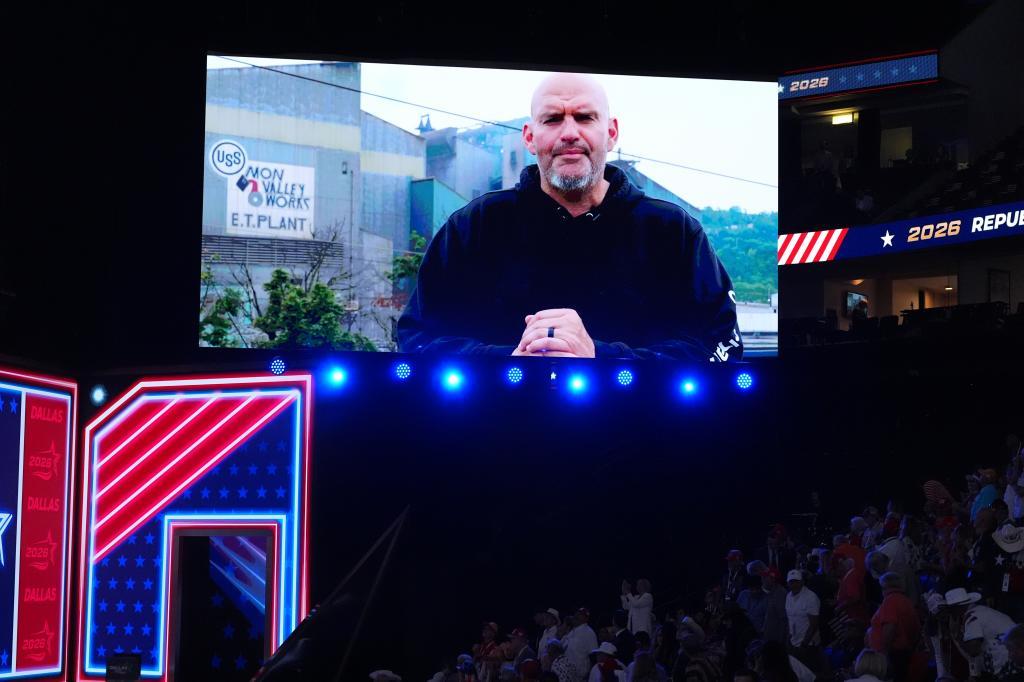
The senator John Fetterman, 57, is one of the most unique, controversial, and difficult-to-explain figures in current American politics. An independent, theoretically progressive and aligned with the Democrats in theory, who in recent years has taken a pronounced turn, increasingly aligning himself with the Republicans and Trump, to the point of sending an unexpected video message of support to his rivals this Wednesday, just 55 days before the elections, to be broadcast at the Dallas Convention (Texas), angering many of his voters, irritating his colleagues, and prompting an urgent review of the electoral math for the November elections and the now less likely Senate takeover.
Fetterman has always been unique, and that is precisely what launched his career. He is a tall, large man, covered in tattoos, with a biker or metal enthusiast look, in shorts, hoodies, and Carhartt work clothes in a world of suits, ties, and formality. Someone who appeared as a breath of fresh air in a constrained circuit. Popular for speaking his mind and breaking from the conventional. For being an ordinary American in an aristocratic business like politics.
Before entering politics, he was educated at Harvard and settled in Braddock, an industrial town in Pennsylvania devastated by deindustrialization, where he worked as a social volunteer. In 2006, he became its mayor and brought to national television a speech about the abandonment of the America that had built the country in factories, towns, and small cities, becoming a media figure with resources and fundraising capacity, crucial to defeating the much more well-known Mehmet Oz in 2022.
That campaign was already marked by a stroke he suffered weeks before the primaries, from which he miraculously recovered. But it left him with hearing impairments that required him to use live subtitles during debates. Shortly after, as an elected senator in 2023, he voluntarily checked into Walter Reed Hospital for severe clinical depression, an episode he addressed with unusual frankness and earned recognition for raising awareness about mental health in politics. However, and this is where it becomes crucial, those who know him and worked with him claim that he has not been the same since then.
Formally, he remains a Democrat, but he has distanced himself so much from his party—supporting the controversial Kristi Noem as Secretary of Homeland Security, refusing to block government funding despite protests over ICE operations, and threatening to leave the party if it takes a critical stance on Israel—that many describe him as a Democrat in name only. But his vote is crucial and could shape American politics until 2028, giving a boost to Trump's administration in its lowest moments.
Surveys indicate that Democrats have a good chance of regaining control of the House in November, but they need to win four Republican-held seats to also regain the Senate majority. If Fetterman were to switch to the Republican Party, as is constantly speculated, or if he simply decides to align with them regularly, Democrats would need an additional seat to control the House, which is very challenging. A hypothetical 51-49 majority (which would require total unity among progressives to legislate) would give Fetterman disproportionate power for 24 months.
He has repeatedly stated that he will not switch parties because his support for unions, LGBTQ rights, abortion, and other causes of the left and the working class make his move to the Republicans incompatible. But if he continues to vote with them as he has been doing (to avoid a federal government shutdown, supporting Trump's nominees, or resisting calls to end the war with Iran), the outcome will be the same.
In May 2024, the Senate chief of staff, Adam Jentleson, sent a long letter to the chief medical officer of the brain injury and neuropsychiatry unit at Walter Reed—the same hospital where Fetterman had been treated for his depression—expressing concern about his boss's mental health. In it, he stated that Fetterman had developed "conspiratorial thinking," "megalomania," and constant ramblings. New York Magazine revealed the letter in 2025, in a much broader report that detailed instances such as Fetterman saying "kill them all" in a meeting with a progressive Jewish group discussing Gaza. Or arguing with his wife Gisele over his stance on Israel, skipping medical check-ups, driving recklessly causing accidents, and purchasing a firearm.
Fetterman responded, as he has since then, dismissing everything as "ex-employees' disgruntled lies." But the past few weeks have brought his worst crisis. An article in the Wall Street Journal, supported by testimony from over a dozen of his staff members and hundreds of internal text messages and emails, accuses him of consistently missing meetings with constituents, victims, and vulnerable groups, neglecting his legislative work while cultivating his presence in conservative media. "I'll pass," he would say on many occasions. "I'm not feeling well," only to appear live shortly after.
Similarly, the media has reported on the senator's strange relationship with DavidDovi Safier, a fundraiser for Orthodox Jewish causes who became a close unofficial advisor to Fetterman. As New York Magazine revealed a few months ago, Safier has an "unusually large" influence on the senator as he isolated himself from his colleagues and official advisors, even participating in sensitive meetings, including calls with Israeli Prime Minister Benjamin Netanyahu—despite having no formal role in his office. The publication of that report coincided with the resignation of Fetterman's chief of staff, Cabelle St. John, who had been in the position since June.
His former collaborators, those who have gone to the press, have created an anonymous social media account promising more juicy revelations, such as having to discard a briefing sent by the Israeli embassy, with which the senator intended to write an opinion piece, considering that it could violate federal laws on foreign interference. Fetterman has responded by calling everything "slander" from "disgruntled employees," while insisting that he is considering running for reelection in 2028.