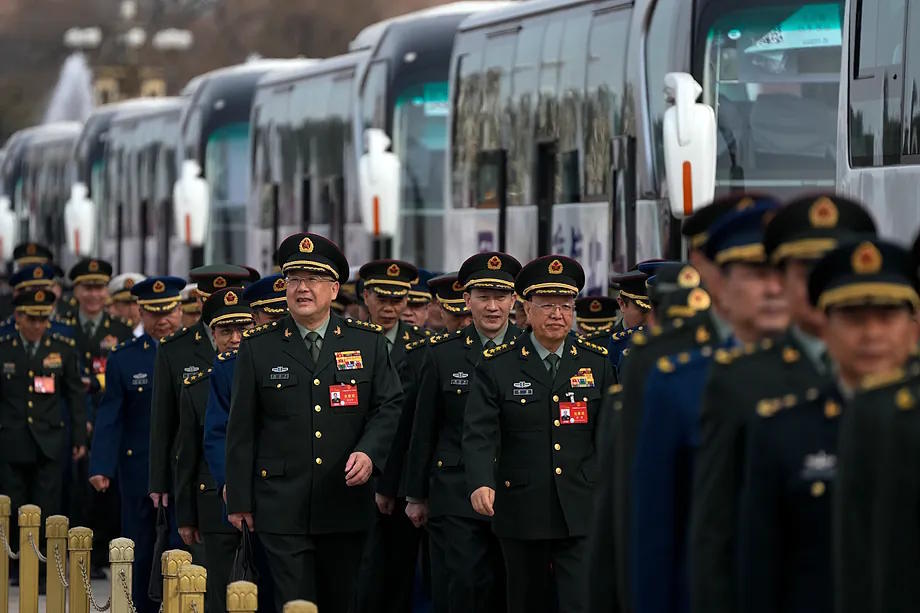
The officers remain seated in silence, with their backs straight and an open notebook on their knees. No one speaks until an official from the Political Work Department of the Central Military Commission enters the classroom. She does not carry weapons or give instructions on combat maneuvers. Over the next few hours, she talks about discipline, absolute loyalty to the Communist Party (CCP), and Xi Jinping's speeches.
One by one, the military personnel read aloud excerpts from the Chinese president's ideological work, take notes on underlined passages, and then discuss the red lines that should never be crossed. They review the disciplinary rules that, according to doctrine, should immunize the army against the enemy that concerns the Chinese president the most: corruption.
"This year, we have already traveled to several provinces conducting courses on political discipline and loyalty to the Party," explained one of the officials from the department who serves as the ideological guardian of the armed forces to this newspaper. Her job is to supervise the political education of the military, control internal propaganda, manage the network of political commissars, and ensure that the People's Liberation Army (PLA) maintains absolute loyalty to the Party above any other state institution.
The scene may seem inherited from Mao Zedong's old China. However, it belongs to Xi Jinping's more technological and militarized China, a country that invests billions in aircraft carriers, stealth fighters, hypersonic missiles, and artificial intelligence, while reviving classic political indoctrination methods to try to eradicate a problem that has been plaguing its armed forces for decades: entrenched corruption among its top ranks.
The Chinese president has been repeating for years that a corrupt army will never win a war, no matter how sophisticated its weapons are. This message took on greater significance this year with the launch of a massive political reeducation camp aimed at hundreds of generals and senior officers of the PLA. The initiative, personally promoted by Xi, began on April 8 and lasted for ten weeks.
As later revealed by the People's Liberation Army Daily, the official newspaper of the PLA, the Chinese leader himself inaugurated the course by urging the officers to create an environment to "combat injustices within the army."
The daily routine of the camp resembled more a mix between a military academy and a CCP school than conventional maneuvers. Each day started with physical exercises and formation marches. Then came the oaths of loyalty to the Party and chants about military discipline.
The bulk of the day was spent in classrooms, where participants attended over 40 theoretical classes and about ten intensive seminars dedicated to Xi Jinping Thought - the official political doctrine - on strengthening the army, the main disciplinary rules, and the speeches given by the president.
During the program, instructors distributed written confessions from former leaders who had fallen due to corruption and organized specialized groups to analyze real cases, draw up risk lists, and propose mechanisms to prevent new scandals.
This ideological offensive coincides with one of the largest military purges since Xi came to power in 2012. Dozens of generals, military industry officials, and high-ranking leaders linked to armament programs have disappeared from the public scene since 2023.
Among them are several members of the powerful Central Military Commission, the body that exercises supreme command over the Chinese armed forces. Of the seven members appointed during the 2022 Party Congress, only Xi and Zhang Shengmin remain, responsible for internal military discipline.
The most spectacular fall came this year. Beijing announced the investigation of veteran general Zhang Youxia, vice chairman of the Central Military Commission and for years one of the most influential military figures in the country, accused of "serious violations of Party discipline and state laws," the usual formula used before a corruption conviction.
Almost simultaneously, General Liu Zhenli, Chief of the Joint Staff, and considered one of the few Chinese commanders with real combat experience, was removed from his position. Both had played a key role in the ambitious modernization of the People's Liberation Army and in preparations for a potential conflict around Taiwan or the South China Sea.
Previously, former military vice president He Weidong, General Miao Hua, and former Defense Ministers Li Shangfu and Wei Fenghe had also fallen. The latter two were sentenced in May to a suspended death penalty - which will be converted to life imprisonment without the possibility of sentence reduction - in an extraordinarily harsh sentence even by Chinese justice standards.
Xi emphasizes in his speeches that corruption poses an existential threat to the army. During the last annual political conclave held in March, the leader reminded that "the armed forces are the ones wielding weapons" and warned that there is no place "for those who are lukewarm towards the Party or any refuge for the corrupt."
This anti-corruption campaign unfolds as the country accelerates its armament production with the declared goal of completing the modernization of the PLA by 2027, coinciding with the centenary of the armed forces. Therefore, while the rest of the world observes the new stealth fighters or the destroyers coming out of Chinese shipyards, within the barracks, the regime continues to resort to a much older tactic: the conviction that ideological loyalty is the primary weapon system of any communist army.