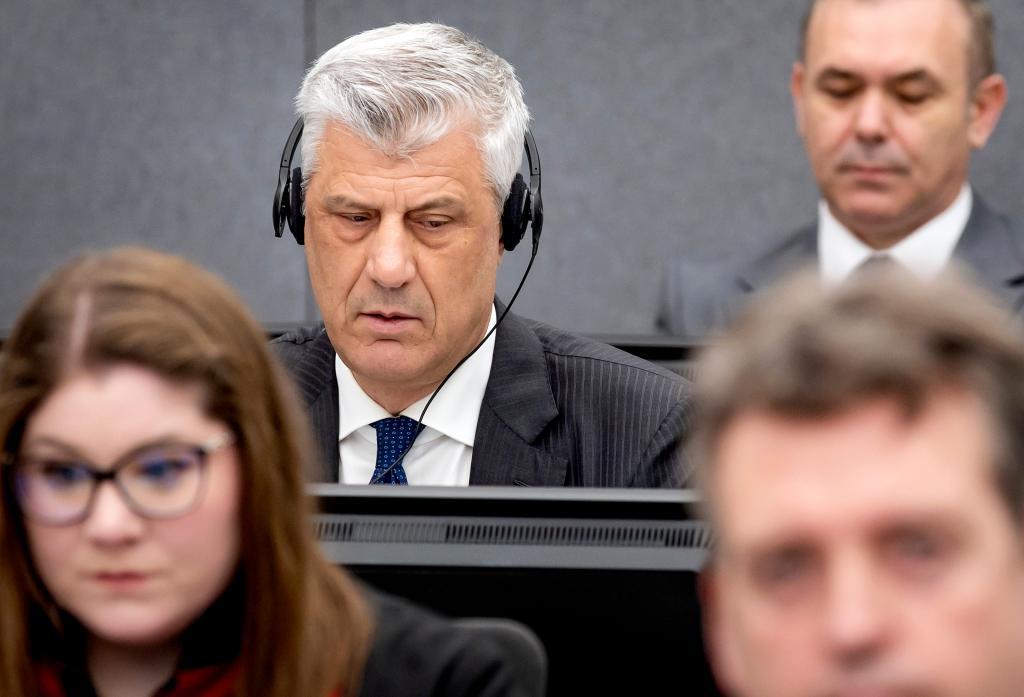
The Albanian-Kosovar Hashim Thaçi (1968) was living as a refugee in Zurich in the late 90s, where he was studying History and Political Science at the university. A graduate in Philosophy in Pristina, he had fled from Yugoslavia a few years earlier, after leading student protests against the loss of autonomy for Kosovo decided by Slobodan Milosevic. In March 1998, Thaçi returned home clandestinely to fight in the war between Serbs and Kosovars. Nicknamed The Snake for his ability to evade Serbian forces, he became the leader of the Kosovo Liberation Army (KLA). After the declaration of independence in 2008, not recognized by Serbia - nor by Spain - he served as prime minister (2008-2014) and president (2016-2020). His next destination was a prison in The Hague.
Today, in the Dutch city, one of the last major sentences related to the 90s Balkan wars is being read since early this morning. The former Kosovar president has been found guilty of war crimes and sentenced to 25 years in prison for offenses including murder, torture, and illegal detention committed while serving as the supreme commander of the KLA.
The court has found Thaçi guilty of the murder of 96 political opponents and individuals they deemed collaborators with Serbian security forces by KLA forces during the conflict.
His associates Kadri Veseli, Rexhep Selimi, and Jakup Krasniqi will also receive their verdicts, accused of war crimes and crimes against humanity (including murder, torture, and persecution).
Prosecutors at the Kosovo Specialist Chambers in The Hague had requested a maximum sentence of 45 years in prison for the four accused, who deny the charges against them. According to the prosecution, during their time in the KLA, the accused targeted political rivals and civilians they considered collaborators and traitors.
"Throughout my life, I stood by the people of Kosovo defending freedom, life, and dignity. I was always guided by Western ideals of democracy, equality, and justice," Thaçi declared before the judges last February, as reported by Afp, when the trial that lasted three years concluded. Thaçi faces another trial on charges of witness intimidation, scheduled to begin later this month.
On Saturday, around 100,000 people rallied in the Kosovar capital—mobilized by a civic platform—to demand a verdict of innocence, and vigils were held last night. Portraits of the four former KLA fighters plaster the city alongside a huge digital clock counting down to the verdicts. "In the name of the people, declare them innocent," read one banner, according to the same news agency. The platform announced that a similar gathering would take place today, Efe reported.
It was in 2020 that the Specialist Prosecutor's Office in The Hague announced the charges against them and judges accepted the indictments. Thaçi then resigned as President of the Republic and turned himself in for transfer to the Scheveningen detention center (The Hague), where he remains imprisoned.
Across the border in Serbia, many are awaiting a conviction—watching to see if the same standard is applied as was used for the Serbs tried by international tribunals for those wars. "No matter what happens, many will be disappointed," Iva Vukusic, a Croatian professor of International History at Utrecht University, told *El Mundo* yesterday. She is an expert on international tribunals and the author of the book *Serbian Paramilitaries and the Breakup of Yugoslavia: State Connections and Patterns of Violence*.
"They are always a subject of dispute"
"Trials for war crimes, genocide, or crimes against humanity are always a subject of dispute," Vukusic explains; "they take place in post-conflict settings and societies grappling with open wounds, resentment, and painful memories." "The crucial thing to remember is that trials go far beyond the verdict itself: they also revolve around the evidence presented and the facts established," she notes.
The Kosovo Specialist Chambers, which are conducting the trial, are part of a hybrid court backed by the European Union. They operate under Kosovar law but employ international staff and are headquartered in The Hague—the same city that hosted the tribunal that tried Miloevi and Ratko Mladi. This location was chosen to ensure necessary witness protection and guarantee institutional impartiality. "It is crucial to understand," the expert continues, "that the proceedings in The Hague are a legal process focused on specific individuals and specific crimes, not a general verdict on Kosovar forces as a whole or the Kosovar people in general."
Following last week's controversial funeral with honors in Belgrade for Mladi—who was convicted of genocide and crimes against humanity during the Bosnian War—this verdict brings the events of the wars that tore the region apart thirty years ago back into the spotlight.
"A multitude of political forces will try to spin this to their own advantage one way or another. I hope citizens won't let themselves be manipulated any further. Read the judgments, listen to independent analyses, examine the evidence, and then judge for yourselves what is fair," the professor adds. She concludes: "An acquittal can sometimes mean the crime was committed by someone else or that there was insufficient evidence. Likewise, crimes can be committed even in defensive wars. It is a complex issue, and I trust people will take the time to understand it better."
Vucic to follow the reading of the verdict
The US, French, and UK embassies in Pristina have urged their citizens to avoid traveling near areas where demonstrations are taking place. They have also warned of potential road closures in the center of the Kosovar capital and other cities, and have advised staff not to send their children to school, reports the Kosovar newspaper *Koha*.
Serbian President Aleksandar Vui stated that he intends to follow the reading of the verdict live, according to EFE. He expressed concern regarding the rallies held in support of the accused and added that he had exchanged letters on the matter with NATO Secretary General Mark Rutte. "It is very important to preserve peace and ensure the safety of our population," Vui said, referring to the Serb minority living in Kosovo.
According to public broadcaster RTK, the Kosovo Police are coordinating with the NATO-led force in Kosovo (KFOR), the European Union civilian mission (EULEX), the US Embassy, and the EU and OSCE offices in preparation for the verdict.
The announcement comes at a delicate political moment for Kosovo. On Sunday, Parliament narrowly re-elected the government led by Prime Minister Albin Kurti—a left-wing nationalist—following snap elections in June. However, two opposition parties asked the Constitutional Court yesterday to annul the vote due to a failure to meet deadlines, according to EFE.
Furthermore, the presidential candidate Bekim Sejdiu—whose nomination had been agreed upon in August by Kurti and the opposition Democratic League of Kosovo (LDK)—withdrew his candidacy last night after six LDK lawmakers refused to support him.