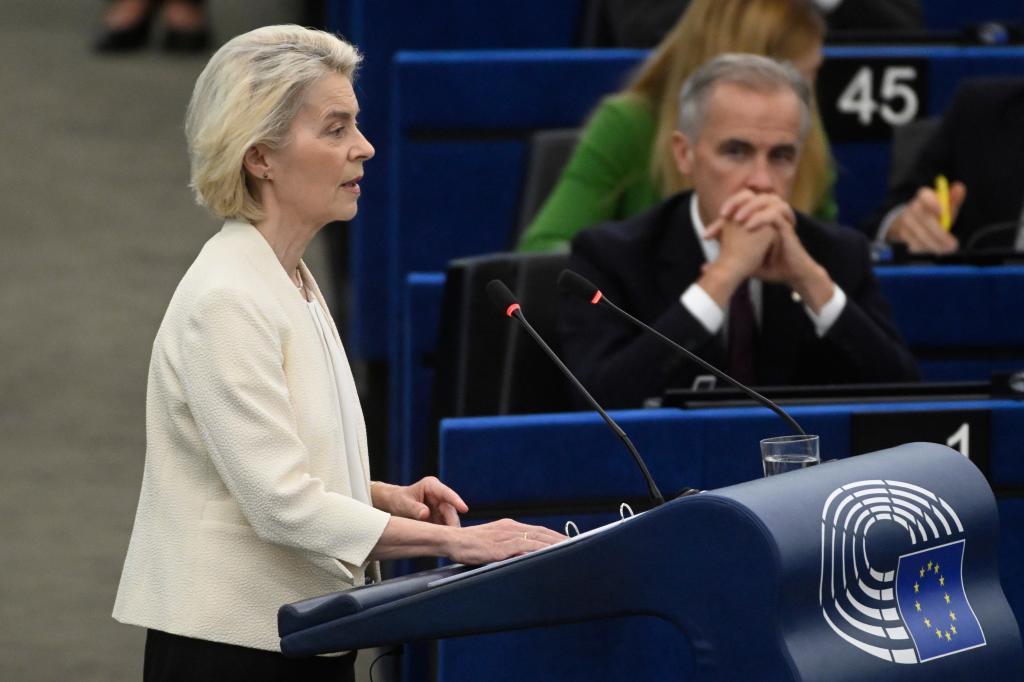
The European Union wants Canada to be its first associated state. The President of the Commission, Ursula von der Leyen, has offered this to the Prime Minister of the country. In person and directly, as Mark Carney has traveled to Strasbourg to be present at the State of the EU address that took place today and to give his own tomorrow.
"Dear Mark, I have said that we urgently need to rethink our partnerships. That's why I would like to work with you to open the door for Canada to become the first associated member of the European Union. We share an ocean, the same values, and the same view of the world. And now we will also build our common future. Thank you for being here," Von der Leyen pointed out.
The offer from the German senior official is undoubtedly very important. Historic. But it also occurs at a crucial moment given that the relationship between Canada and the United States is not at its best, precisely. Carney is in total opposition to the U.S. President, Donald Trump, due to, among other things, tariff threats from their southern neighbor.
Carney does not like the bully tactics of the magnate. Moreover, in Ottawa, they still remember when Trump boasted about the possibility of Canada becoming the 51st state of the U.S. But right now, it seems more likely that, in reality, it will become a sort of 28th state of the European Union.
"We see the world in the same way: from artificial intelligence to climate change, from the Arctic to geopolitics. And we have remained united: in Ukraine, in defense, in raw materials, and in supply chains," Von der Leyen stated.
"But above all, dear Mark, Europe and Canada believe in democracy. We believe that power does not belong to the strongest, the richest, or those who shout the loudest, but to all of us. That democracies have the freedom to choose who they want to work with," she emphasized.
Von der Leyen also wanted to emphasize that the partnership between Canada and the European Union "is not against anyone, but seeks to strengthen our common strength." But it certainly is, or at least, it certainly aims to protect itself from Trump, the adversary who has changed all global balances.
The President of the Commission did not specify what benefits Canada would have if it becomes the first associated member. But it seems possible to have greater economic integration, more intense collaboration in Defense, as well as easier mobility for people. Another very relevant aspect is that if this path is opened, other countries may be interested in taking a similar step. Australia, for example.