Tatiana stopped talking upon hearing the first bursts of machine gun fire. The last air raid alert had sounded just minutes before. One of the feared jet-powered "Geraniums" (the most modern version of the Shahed drone) was approaching the capital district of Holoiivskyi.
The Ukrainian woman quickly hid. Almost at the same moment, two rockets from the local defense system streaked through the air trying to intercept the Russian drone. They did not succeed. It outpaced them. One of the missiles exploded in the air while the drone continued its course. A distant detonation was heard moments later. It had hit another neighborhood.
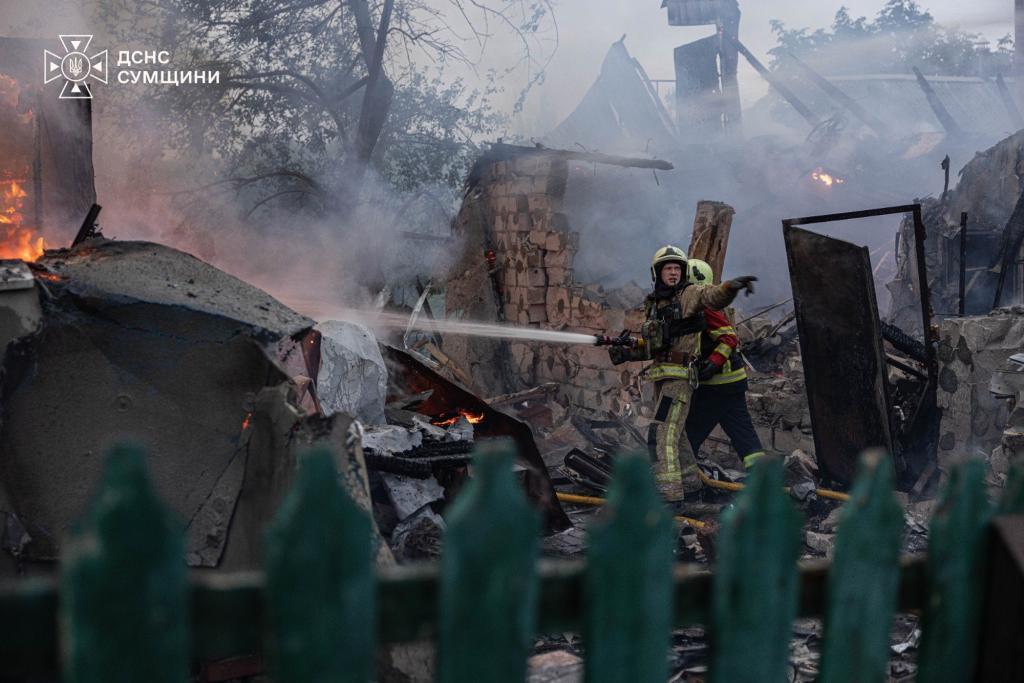
It wasn't even 10 in the morning, and the 60-year-old guard had already faced the same ordeal twice. The first time was at 8:00 when another unmanned aerial vehicle (UAV) of the same model crashed into the gas station across the street. The gas station's roof ended up in flames.
An hour later, the firefighters had already extinguished the small fire. "The explosion was heard from the metro. Just yesterday, we had a training session. The protocol is to leave our workstations immediately when the alarm sounds and take refuge in the metro," recounted Oleksandr Nochshevsky, an employee at a medical center adjacent to the gas station.
The conversation was interrupted again when the speakers blared once more. Another alarm. Her colleagues, who had just returned to the offices, rushed out. Some couldn't hide their fear.
Social media was flooded with warnings. "Evacuate gas stations and shopping centers! Drones are entering the city! Please be careful!" read the messages. Others warned about locations where Russian drones were detected.
"It's pure terror," stated Oleksandr Nochshevsky before heading back to the subway.
Thus, amidst pure shock, Kiev woke up this Tuesday to yet another day of the aerial offensive launched by Moscow against the Ukrainian capital in an attempt to "paralyze" it - as described by local media - with constant attacks, mainly carried out by their new jet-powered drones, the so-called "Geran" (Geraniums) of the latest generation.
Expansion of Attacks with "Geraniums"
The wave of unmanned aerial vehicles (UAVs) on this day left at least one dead and nearly a dozen injured. The bombings continued into the following day, giving no respite to the country's main city.
Russia's tactics have shifted since early summer when they used to resort to massive assaults on Kiev using hundreds of drones and missiles, spaced out over time. Now, the assaults are almost daily, with a reduced number of aircraft but an increase in ballistic missiles and especially jet-powered UAVs, whose speed surpasses the capabilities of the local anti-aircraft defense.
The escalation began in June. If Moscow used around 350"Geraniums" in the country back then, that number quintupled in July to reach 1,500 and rose to 2,800 in August, as stated by the Air Force spokesperson, Yuri Ihnat.
According to satellite images analyzed by experts, the central axis of Moscow's aerial operation against Kiev has been set in the village of Tsymbulova, in the southern region of Oryol, where the Russians have built a massive base for the mass launch of the new "Geraniums."
Ukrainian media warned back in December that these facilities could accommodate up to 500 UAVs, and now they alert about the recent expansion of their logistics.
The bombing of the gas station in the mentioned Holoiivskyi district added to a similar incident in another capital district. Since the beginning of this month, Moscow has extended the systematic campaign against Ukrainian gas stations that it started in the spring in many other destinations in the country like Kharkiv, Kherson, or Zaporizhia.
Yaroslav Starovoitenko, president of the Ukrainian Oil and Gas Association, estimates that so far Russian UAVs have attacked "about 300 gas stations across the country," which represents between 5% and 6% of all functioning facilities in their territory.
"80% of the damaged gas stations have been repaired and are operational again. Russia thought they could retaliate against our attacks on their oil and gas production facilities, which did cause fuel shortages there. That's not happening here. There are no lines at the gas stations," Starovoitenko affirms.
While burnt-out fuel stations were already a common sight on routes leading to the city of Kharkiv for months, this grim scene has started to multiply across Kiev.
Bogdan Kukura, CEO of Ukraine's largest oil production company and operator of a network of gas stations, Ukrnafta, explained to this newspaper that in other parts of the country, they had to allocate a special budget to equip many of their facilities with logistics that would seem almost dystopian in any Western European city: "we are reinforcing station protection with anti-drone nets, shelters, and gabions [metal domes] to protect our equipment from shrapnel." "We have also started to place gabions in Kiev," he added.
The Ukrnafta executive confirms that these premises, frequented by Ukrainians not only for refueling but also to enjoy the modern cafes and restaurants that had been added to the initial business, have become a top target for Russian drones this year. By mid-September, the company had recorded "over 130 attacks, a figure higher than [attacks from] the previous four years combined."
The assaults on gas stations are part of the chilling escalation of violence being carried out by Moscow's forces in Kiev, which has also suffered repeated attacks on logistical facilities, warehouses, and shopping centers in recent months. An extension of the massive destruction campaign that seems to have been undertaken in the rest of the country. "Russia has upped the ante with a scenario of total war," headlined The Kyiv Independent last month.
Russia's strategy
According to Ihor Romanenko, former lieutenant general and former deputy chief of staff of the Ukrainian army, Russia's main goal is to "generate a strong psychological impact among citizens, who cannot live normally."
The former military officer acknowledges that the massive influx of jet-powered "Geraniums" constitutes "a management failure." "Military and political leaders did not act in time, even though the Russians began testing this type of weaponry a year ago," he adds.
During the Yalta European Strategy conference held last week, Ukrainian Prime Minister Serhiy Koretskyi acknowledged the "significant destruction" caused by the intensification of Russian bombings. "The logistics industry, metallurgy, pharmaceutical companies, and the agricultural sector have been affected. It is a huge challenge, and currently, we do not have a tool to solve this problem [the new Geraniums]," admitted the head of the government.
"Russia wants to destroy the Ukrainian economy to break our resistance," echoed President Volodymyr Zelensky himself.
Their intervention came just days after Ukrainian Finance Minister Serhiy Marchenko announced an emergency austerity plan to deal with the damage caused by this spiral. "We are forced to implement measures to limit expenses," he said.
His colleague in charge of the Economics Department, Oleksandr Kravchenko, estimated that losses resulting from this offensive could exceed $10 billion this year—a figure representing around 4.5% of the country's GDP—and lowered the growth forecast from 1.3% to a mere 0.5%.
The devastating impact of the Russian onslaught is glaringly obvious to anyone traveling near Kyiv along the highway leading to the northern city of Chernihiv. Here, just a few kilometers from the capital, vast warehouses belonging to well-known companies like Rozetka and Raben lie in ruins, reduced to heaps of twisted metal and scorched aluminum.
The same fate befell the facilities of what was once one of the Epicentr company's main distribution centers in the capital.
From one of the few staircases that survived the blaze, the 20,000-square-meter facility—which once rivaled modern Amazon logistics hubs and could handle up to 250,000 packages of various sizes—now appears as an endless expanse of charred alloys and melted plastic. The massive fire raged for more than a day, causing the structure's four levels to collapse and fuse into a solid mass of scorched scrap metal.
"It was two missiles. Ten fire crews responded, but even they couldn't stop the blaze. Billions of hryvnias have been lost," explains Oleksandr Khimich, a manager at the center who witnessed the event. That same day, Russian drones and rockets also struck another complex owned by the same company on the outskirts of Kyiv.
Since early July, Russian drones have destroyed or severely damaged dozens of warehouse facilities. *Forbes Ukraine* estimated that these attacks resulted in the destruction of more than 400,000 square meters of such complexes. In late August, authorities stated that 90% of the country's modern storage facilities had been completely destroyed or damaged.
While the situation has not become widespread, some supermarkets in the capital have been forced to display empty shelves in recent weeks, accompanied by signs referencing the crisis. "Dear customers: due to an enemy attack, some items are taking longer to arrive. This is not the first time. We will get through this," read one. "Russia destroyed this product," stated another.
Kyiv's Response
ATB, one of Ukraine's leading retail chains, announced in late August that it was imposing purchase limits on certain goods to prevent price gouging.
Air raids on Kyiv intensified starting August 27. Between that day and September 1, the capital faced over 60 air raid alerts spanning a total of 52 hours. That month, shopping malls, for instance, had to suspend operations due to threats for one out of every five hours.
"Every time the alarms sound, we have to evacuate employees and customers. Our customers' lives are what matter most, but obviously, this pattern entails significant financial losses," says Victoria Savitska, a spokesperson for Epicentr.
During the first few days of this month, several Russian strikes destroyed hundreds of tons of medicine stored in the country's main metropolis and the nearby city of Boryspil.
Russian rockets and drones have also stepped up attacks on the country's most iconic metallurgical centers, located in Zaporizhzhia and Kryvyi Rih.
Following the third missile attack on its facilities in the former city within the last 30 days, Metinvest—owned by tycoon Rinat Akhmetov—acknowledged that these strikes aim for "the systematic destruction of Ukraine's industry and economic base. The damage is critical."
However, the "total war" is not one-sided. Unlike in previous years, Russia is facing a Ukrainian counter-response, now applying an "eye for an eye" approach. This summer, Ukrainian drones have repeatedly struck warehouses belonging to the country's two major distribution companies: Wildberries and Ozon. According to the Ukrainian magazine *NV*, Wildberries alone has been hit 22 times since July 18. Bombardments targeting oil industry facilities are also causing significant damage; indeed, the International Energy Agency recently revised its forecast for Russian production downward to around 4 million barrels per day—a 30% drop compared to pre-2022 levels.
The Institute for the Study of War has estimated that Ukrainian UAVs have struck 26 Russian refineries since the beginning of the year.
The most immediate consequence has been the restrictions facing Russian gas stations. According to Russian sources cited by Reuters, current production was meeting only 70% of domestic demand.
Robert Madyar Brovdi, the head of Ukraine's unmanned forces, stated on the 12th that his drones had attacked 285 tankers belonging to Russia's so-called "shadow fleet" in the Black Sea during July and August, forcing these vessels to halt operations in several parts of the region.
Amidst this dynamic, the mutual offensive targeting cargo ships and the logistics infrastructure used to export the adversary's agricultural products is driving a sharp global spike in grain prices—given that Russia and Ukraine are major global exporters of these commodities—raising the prospect of a crisis for many nations that rely on this supply route.
"It will be very difficult for us. But there will be many other countries in a worse situation. They simply won't have food. They won't have anything to eat, even if they have the money," President Zelenskyy stated on the 11th.
For Ukrainian analyst Mykola Beleskov, this devastating aerial conflict has only one possible outcome: "Russia and Ukraine are pushing each other back to the Stone Age. A war of attrition is a war that sacrifices the future."