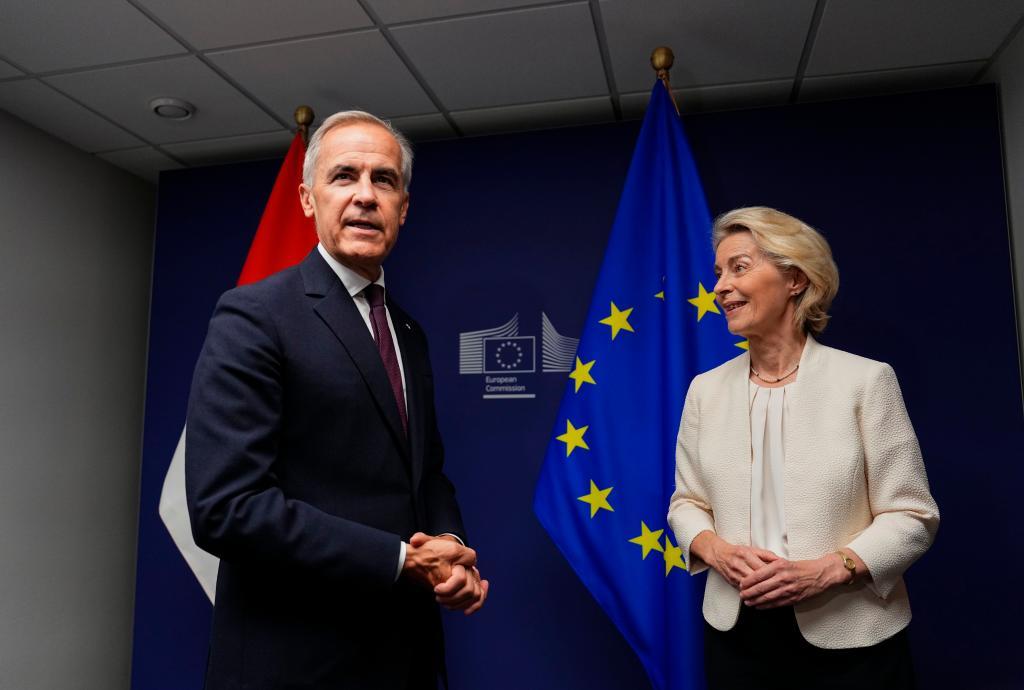
No one knows exactly how this will be carried out, and there is some surprise and even rejection among several countries. However, the offer made by the President of the European Commission, Ursula von der Leyen, to the Prime Minister of Canada, Mark Carney, for this country to become the "first associated state of the EU" represents a clear step towards a new form of geostrategic alliances. It is also a way to counteract the actions of the U.S. President, Donald Trump, and the disruption he decreed in the world order.
Von der Leyen's offer is directly linked to the speech that Carney himself delivered last January in Davos. "Middle powers like Canada must act together because, if you're not at the table, you're on the menu," he declared at the Swiss forum. And what the German senior official wants is precisely that, to act together with middle powers. With Canada, of course, but also with Australia, which has shown interest in greater integration with the EU at some point, or with Japan, which although not exactly a middle power fits perfectly into this new type of alliances.
"Dear Mark, I have said that we urgently need to rethink our partnerships. That's why I would like to work with you to open the door for Canada to become the first associated member of the European Union. We share an ocean, the same values, and the same view of the world. And now we will also build our common future," Von der Leyen conveyed to Carney, who attended the State of the Union address in Strasbourg in person and will deliver his own speech in the hemicycle today.
"Mark, Europe and Canada believe in democracy. We believe that power does not belong to the strongest, the richest, or those who shout the loudest, but to all of us," she continued, which seemed like a direct reference to Trump. Even the fact that she said "this partnership is not against anyone, but seeks to strengthen our common strength," was actually a way of saying that it is indeed against someone. Or, rather, to defend against someone: the U.S. President.
This is surely something that Ottawa appreciates. Carney and Trump are completely at odds following Washington's repeated tariff threats, and it would undoubtedly be a blow to go from being the 51st state of the United States, as Trump claimed, to a sort of 28th member of the EU. However, as mentioned, it is not at all clear what the process would be to achieve this.
To begin with, any enlargement process would require the unanimous support of the 27, which seems challenging. Some countries like Italy or Greece, for example, have already shown reluctance because they fear Trump's reaction. Therefore, that path seems unlikely, and it is much more likely that some imaginative solutions will be sought, as Brussels always finds when needed.
Commission sources insist that the aim is to shape a new form of partnership that has not existed before, establishing the closest imaginable partnership with a partner outside of Europe. They add that the next EU-Canada summit, scheduled for late October, will offer an important opportunity to continue discussing these issues, with the common goal of developing this ambitious agenda with imagination and energy.
Regarding the areas it will cover, Brussels explains that it will range from the economy to technology, the Arctic, artificial intelligence, and security and defense. The latter is very relevant because, along with the proposal for an associated state with the EU, Von der Leyen also proposed the formation of a European Security Council to Carney. Alongside Canada and the EU, this small NATO would be formed by the United Kingdom, Norway, and, significantly, Ukraine.
"For a long time, we have discussed the creation of a leaders' format focused on the security of our continent. This is now even more urgent, given the nature and magnitude of the risks we face. That's why we will present our proposals to make a European Security Council a reality," stated the German senior official during her speech.
The Commissioner for Defense and Space, Andrius Kubilius, later emphasized that this Council would not be against the North Atlantic Treaty Organization, but would be complementary, and would seek to increase Europe's role and responsibility in its own defense. This is what Trump demanded and is a key element in this new world order.
"Each of the member countries can contribute very specific military expertise, especially Ukraine, and that will make us much stronger. How that expertise will be incorporated and what we will do with it is still a bit premature," explained the Lithuanian commissioner. And one more thing on defense but without Canada. Von der Leyen also proposed the creation of a Article 4 at the European level that would allow countries to coordinate in the face of attacks coming from Russia. These and some more are the projects and tasks that Von der Leyen set out at the beginning of the European political term. Now we will have to see which ones become reality and if they truly serve to counter Trump.