At the feet of his bronze statue, Mao Zedong still receives alcohol and cigarettes. It is 10 meters of the communist leader dominating the main square of Shaoshan, a small city in the Chinese province of Hunan. In addition to the usual chrysanthemum wreaths, there are also bottles of liquor and cigarette packs left by pilgrims. Some raise their fists in front of the statue. Others solemnly bow their heads. During this month, buses loaded mainly with retirees and school groups are disembarking at the place where the founder of the People's Republic of China was born.
Shaoshan is one of the great sanctuaries of the so-called "red tourism", the patriotic industry driven around the foundational sites of the Communist Party. But this year the pilgrimage has a special meaning. On September 9, it marked 50 years since the death of the man who ruled China for almost three decades and whose gigantic shadow continues to loom over the country.
Zhang, a 58-year-old taxi driver from Shanghai, grew up hearing his parents talk about the turbulent years of Maoism. But he retains a more positive image of the former leader. "He made very serious mistakes, that no one can deny, but before Mao, our country was weak and divided. He made the Chinese people feel that we had a strong nation again," he argues.
A very different view is held by Fan, a 75-year-old retired teacher whose family suffered the persecutions of the feared Red Guards. "My parents, both academics, were arrested for their more open ideas," she recalls. "The older generation does not forget those dark years, but I am especially bothered by the forgetfulness of the younger generations, who idealize Mao without really knowing what happened."
As Fan points out, for those born decades after the death of the Great Helmsman, the figure seems more distant and blends with contemporary nationalism. Li, a 27-year-old programmer, says that his generation is aware of the tragedies of Maoism, but believes that the leader cannot be judged solely for them. "Mao made mistakes, but without the revolutionary movement he led, the strong China we have now would not exist," he states.
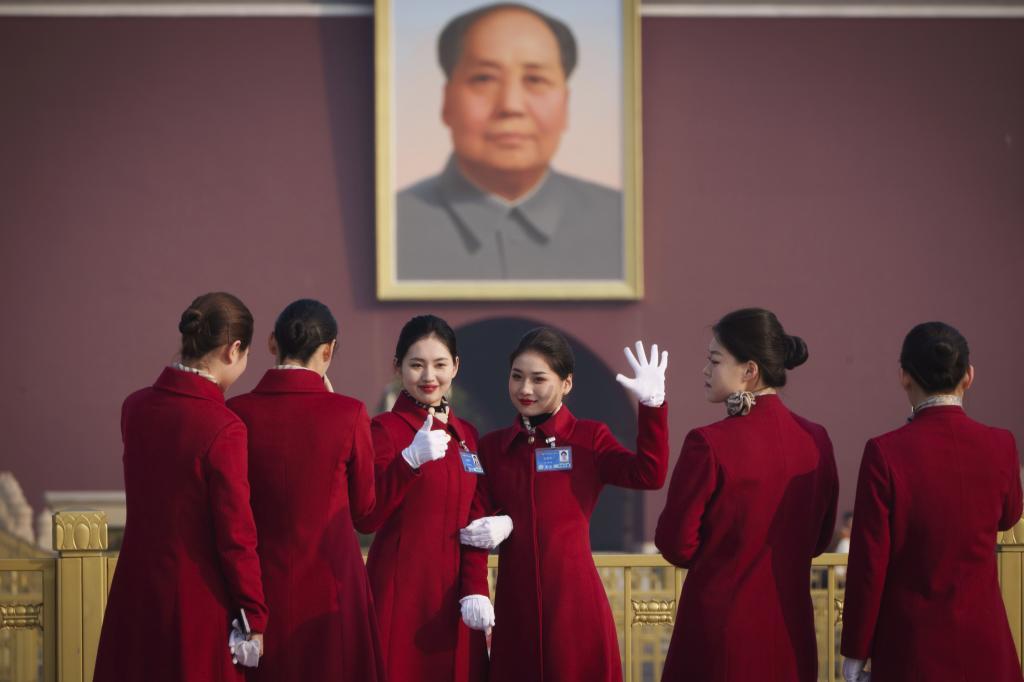
Half a century after his death, Mao's face remains printed on yuan bills. His six-meter portrait continues to watch over the entrance to the Forbidden City. Many taxi drivers have small amulets of him hanging from their rearview mirrors. His statues preside over universities and squares, while many rural homes still keep his photograph. In Beijing, long lines pass through security checks daily to view his embalmed body at the Tiananmen Mausoleum.
The China that contemplates all this today has little to do with the one Mao left in 1976. The country that once wore gray uniforms has become the world's second-largest economy, erecting skyscrapers, the fastest high-speed trains, and aiming to send astronauts to the moon. Part of this transformation occurred precisely when reformist Deng Xiaoping began dismantling much of Mao's economic model after Mao's death.
Here lies the great contradiction that the Party has never fully resolved. Mao is both its founding father and its most uncomfortable legacy. He was the revolutionary who led the communists to victory in 1949 after decades of foreign invasions. But he was also responsible for political persecutions and disastrous social experiments that caused one of the greatest human catastrophes of the 20th century.
The most devastating began with an impossible promise. Mao announced that China would surpass British industrial production in a few years. The Great Leap Forward, launched in 1958, mobilized millions of peasants to produce steel and build dams while abandoning crops. Officials, terrified of being accused of lacking revolutionary fervor, reported nonexistent harvests. Beijing requisitioned grain based on those fictitious figures while food began to run out in the countryside.
Collective dining halls, a symbol of the new communist society, ended up empty. Starving peasants died inside their homes or by the roadsides. Episodes of cannibalism were documented. Estimates of the victims vary greatly: from over 16 million to around 45 million deaths. It was one of the greatest famines known.
The next major upheaval came in 1966. Mao launched the Cultural Revolution and mobilized the Red Guards against officials, teachers, intellectuals, and anyone accused of representing old customs or "following the capitalist path." Universities were paralyzed. Temples and historical heritage were destroyed. Millions of young people ended up sent to the countryside to be "reeducated" by peasants.
Not even elite families escaped. Xi Zhongxun, father of current president Xi Jinping, was purged and persecuted. Xi himself, still a teenager, was labeled a "reactionary student" before being sent in 1969 to a poor village where he spent seven years.
The Cultural Revolution left particularly deep scars in Shanghai: schools and universities were caught up in political campaigns, teachers and intellectuals were persecuted, and numerous young people ended up sent to the countryside for reeducation. "When I read about what happened during those years, what impresses me the most is how normal people ended up denouncing and persecuting their neighbors, friends, and even their own family members. Suddenly, anyone could become an enemy," says Wang, a twenty-something studying in the financial capital.
When Mao died at 82, the country mourned for a week. But for those who had suffered his campaigns, his death also meant that a period of terror had ended. The subsequent leaders understood that condemning him completely equated to questioning the very origin of the regime. In 1981, the Party spent a year and a half drafting a historic resolution acknowledging his "serious errors," especially during the Cultural Revolution. "When we were young, in school, we were taught about both Mao's successes and the devastating famine and the Cultural Revolution," says Yuan, a Shanghai resident in her early thirties.
This balance has allowed for the abandonment of Maoist policies without tearing down the leader's statues. Deng Xiaoping opened China to foreign capital. His successors continued to move away from Maoist arbitrariness while preserving the founder's historical legitimacy intact.
With Xi Jinping, many analysts believe that the pendulum has partially swung back. The current leader has reinforced the cult of his personality and concentrated in his hands a power unseen since Mao's time. In 2018, China removed the two-term presidential limit, one of the safeguards built precisely after the Maoist experience to prevent a new extreme personalization of power.