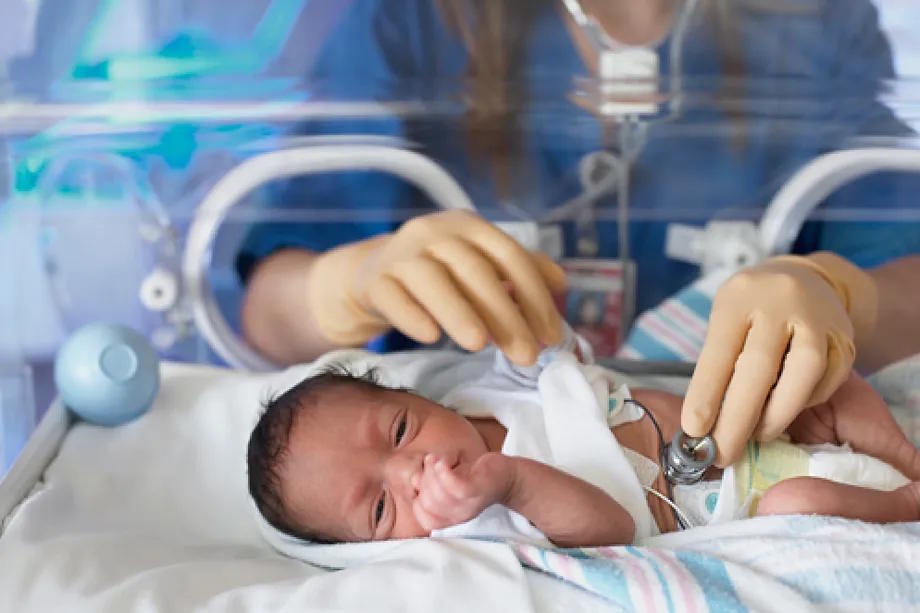
Nash Keen was born in Iowa (United States) on July 5, 2024 at 21 weeks gestation and weighed 285 grams. At just two years old - with neurodevelopmental problems and organic immaturity - he holds the Guinness World Record for prematurity. There are other documented cases of neonates who have survived with that gestational age, although they remain very exceptional. The limit of viability has changed significantly in recent years and is now at 22 weeks. But with an important caveat: gestational age alone is not enough as a criterion for action; it must be assessed along with other fetal, obstetric, and care factors.
In countries with highly specialized perinatal systems, "22 weeks currently represent the lower limit at which, in selected cases, survival-oriented care can be considered," confirms Gemma Arca, a neonatologist at the Hospital Clínic in Barcelona, to this newspaper. And she cites the recommendations of the British Association of Perinatal Medicine, which establish that decisions between 22 and 26 weeks and six days (22+0 and 26+6) should not be based solely on gestational age, although "before 22+0 weeks, it is not recommended to offer survival-oriented care."
Among the many factors that influence survival are weight, fetal growth, single or multiple gestation, the presence of congenital anomalies, infection or chorioamnionitis, prolonged membrane rupture, and the conditions under which delivery occurs. Sex is also very relevant, as in population terms girls have "slightly better prognosis", according to the neonatologist.
The decisive role of perinatal interventions should not be forgotten. The administration of antenatal corticosteroids, magnesium sulfate for neuroprotection when indicated, the transfer of the mother to a high-complexity hospital before delivery, the presence of an expert team in the delivery room, and a protocolized neonatal strategy significantly modify the prognosis. "Therefore, the prognosis does not depend solely on the biology of the newborn; it also depends on where they are born, the center's experience, the perinatal policy adopted, and the resources available," summarizes the expert.
Arca is the first author of an article recently published in the journal Anales de Pediatría, of the Spanish Association of Pediatrics, titled Attention to newborns at 22 weeks in Spain: the limit of viability and the need for a common audit framework, which laments the lack of a national information system that systematically describes the care of newborns at 22 weeks. "This lack of data limits the evaluation of clinical practice, hinders comparison between centers and the development of protocols, and reduces the information available for decision-making and informed consent, favoring the emergence of variability and inequities in care," highlight the authors.
Information for decision-making
Decisions as important as the viability threshold of a neonate and when to resuscitate extremely premature babies can only be made with exhaustive clinical knowledge and up-to-date information. In Arca's words, "we cannot make decisions in 2026 based solely on data that largely reflect an assistive practice from a decade or more ago, especially when clinical practice is changing so rapidly." Additionally, "in these children, the denominator greatly modifies the outcome," she adds. "We can calculate survival among all live fetuses at the start of labor, among live births, among those who received resuscitation, or among those admitted to neonatal intensive care units (NICUs), and we will obtain completely different figures." Thus, if only those who arrive alive at the NICU are recorded, "we select children with a better prognosis and can greatly overestimate survival."
According to the neonatologist, the registry should be prospective, multicenter, and perinatal, that is, not exclusively neonatal. "It should include gestational age in weeks and days and how it was dated, maternal and fetal characteristics, whether corticosteroids and magnesium sulfate were administered, the place of birth and transfers, prenatal treatment intentions, actions taken in the delivery room, how many children were born alive, how many received active or comfort care, complications during admission, and survival at discharge." And, especially, "it should continue with neurodevelopmental follow-up until school age." Finally, in addition to generating knowledge, "a registry would allow auditing results, comparing centers adjusting for risk, identifying beneficial practices, and reducing inequities."
All the aforementioned criteria serve to measure the success of care for extremely premature neonates and make decisions aimed at improving it. At this point, Arca emphasizes that success "cannot be measured solely in terms of survival at discharge. We must also know how these children evolve in the medium and long term: their neurodevelopment, respiratory health, feeding, quality of life, educational needs, and the impact on their families."
The most recent Swedish data illustrate this viewpoint very well: although the survival of extremely premature babies has improved, this improvement has not been accompanied by a parallel reduction in neurodevelopmental abnormalities. "In the most recent cohort, around half of the survivors born at 22 and 23 weeks had a moderate to severe neurodevelopmental impairment at 2-2.5 years," notes the neonatologist.
"When we talk about the viability threshold, we should not only ask how many children survive, but also how they survive," she explains. Ultimately, the debate should not focus solely on "how many weeks we can reach, but on how we can offer each child a reasonable chance of survival with the least possible burden of disease and disability, and support their parents in an informed decision in a context of enormous uncertainty."
When to resuscitate a premature baby?
Premature babies at the viability threshold pose an unavoidable scientific and ethical dilemma: when to initiate resuscitation? Given that there have been cases of neonates at just 21 weeks of gestation, can resuscitation be considered at such an early gestational age? Arca specifies that, in general terms and with the current evidence at hand, "systematic resuscitation cannot be recommended." She acknowledges that there are exceptional survivors, but "they come from very specific centers, with extremely rigorous selection and still very small numbers." These are data that need to be studied before turning 21 weeks "into a new standard of treatment".
At 22 weeks, the perspective is quite different: "In some highly experienced centers, a survival-focused approach is taken after individually evaluating the case and extensively discussing with the parents."
The United Kingdom took a significant step in 2019, which was consolidated with the previously mentioned 2026 guidance, by allowing active treatment to be considered from 22+0 weeks. In the guidelines, children are divided based on risk: extremely high, high, and moderate.
For those at extremely high risk, a comfort-centered care model is recommended; for those at high risk, it is considered legitimate to focus on both comfort and survival - incorporating parental preferences.
Lastly, for neonates at moderate risk, active treatment is initially advised. The situation in Spain is described as "more conservative and heterogeneous" by Arca, who believes that it is not possible to simply transfer the results from highly specialized centers or systems to any Spanish maternity ward.
The latest national data published by the SEN1500 network, covering births between 2004 and 2019, show that "an active approach was attempted in approximately 41% of births at 22 weeks," with a survival rate of around 8.7% among those who received active treatment.
These are "very valuable data, but largely reflect a time before the recent international change in attitude and need to be updated," emphasizes the expert. **Research Lines** Arca emphasizes the ethical perspective as essential for further progress: "The goal should not be 'to save at any cost' nor automatically establish that a certain gestational age makes treatment futile." It is necessary to seek "the best interest of the child, weighing real possibilities of survival, risk of suffering and severe disability, specific birth conditions, and family values." It is also important to "honestly acknowledge uncertainty." Uncertainty is not synonymous with insecurity or lack of knowledge.
Advances in recent years allow for hopes of future improvements in terms of disability-free survival. Among the most significant advances that have led to the current situation are the centralization of high-risk deliveries in tertiary hospitals, antenatal corticosteroids, neuroprotection with magnesium sulfate, delayed cord clamping, early and less invasive surfactant administration, less invasive and more protective ventilation strategies, better thermal, nutritional, infectious, and hemodynamic control...
Arca particularly emphasizes the positive influence of "increasingly specialized and individualized nursing care: promoting skin-to-skin contact and bonding with parents, encouraging breastfeeding, minimizing pain and stress, adapting manipulations and treatments to each patient, reducing excessive exposure to light and noise, and fostering neonatal units open to families."
"We now know that it is not only about ensuring the survival of these children but also about promoting their neurological development and long-term quality of life," she points out. "We have also learned that the care for extremely premature infants begins before birth. When deciding to provide survival-focused care, there must be a coherent obstetric and neonatal strategy: optimizing their chances through antenatal corticosteroids, intrauterine transfer when possible, and delivery in an experienced center."
Several particularly interesting lines of research are on the horizon. "One is to refine the transition to birth: delayed cord clamping, stabilization with the cord intact, optimal oxygen concentration, and extremely protective ventilation," describes the neonatologist.
There are also projects aimed at improving the specific needs of these babies in areas such as nutrition, microbiome, inflammation, and prevention of bronchopulmonary dysplasia, enterocolitis, and infection.
And in the longer term, there are very promising experimental initiatives underway, such as artificial placenta or liquid incubator.