SpaceX took the lead in the United States with the Falcon 9, Blue Origin followed suit with the New Glenn, China successfully tested the Changzheng 10B this summer... and Europe joins the space race with the manufacturing of a reusable rocket, capable of cutting mission costs in half and accelerating the pace of launches to put satellite constellations into orbit.
Spain can score with the Miura 9, a 42-meter rocket designed to place up to 1,500 kilos into orbit and be recovered through propulsive landing. Manufactured in Elche by PLD Space, the reusable version could be completed by 2028, as confirmed by Raúl Verdú, co-founder of the company. Its launch would be from the Kourou Space Center in French Guiana, where the Miura 5 (a non-reusable recoverable model) will take off first.
"We can proudly say that we are the pioneers: we founded the company in 2011 and in 2018 the European Space Agency (ESA) awarded us a contract for the development of commercial and reusable launchers," assures Verdú. "Spain has always been well positioned in the aerospace sector, now we are even leading the race for the recoverable and reusable rocket."
"It is no coincidence that while Macron was celebrating his space summit, Pedro Sánchez came to see us in Elche," adds Verdú, co-founder with Raúl Torres of a company with 550 employees and the largest test bench in Europe. "We have a friendly rivalry with European companies: we can be the first, but the satellite launch market is so large that there will be enough for everyone."
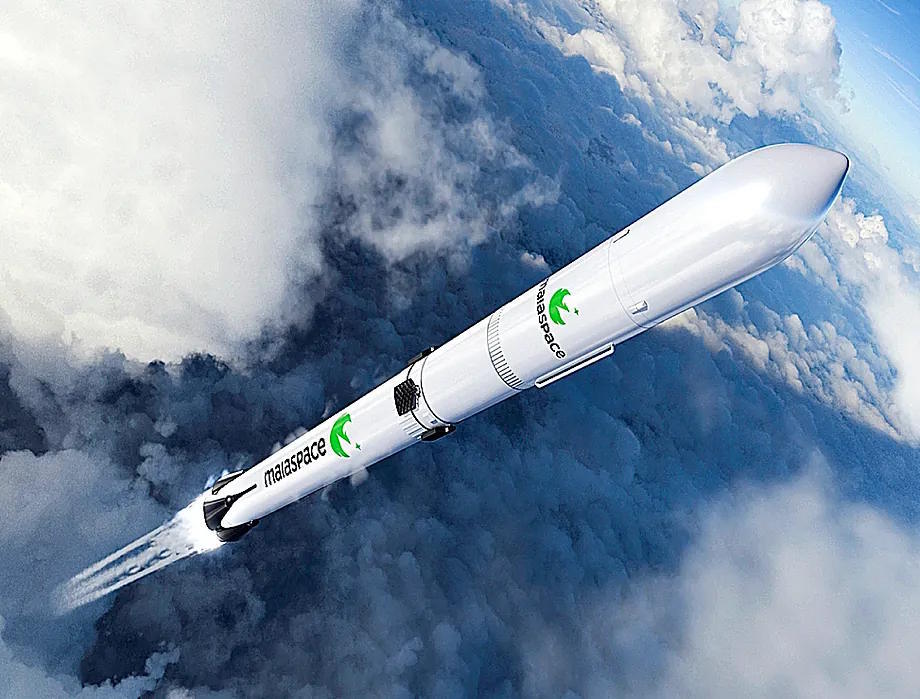
Meanwhile, in Vernon (France), the giant Ariane has given a boost to Maiaspace, which expects to debut its first 50-meter mini-launcher with a 1.5-ton payload next year. The first version will be classic or consumable (falling into the sea and lost in the depths), but in five years, it hopes to have the reusable rocket operational, with its Prometheus engine and deployable legs for precise vertical landing.
"The reusable rocket will allow us to do everything cheaper and faster, besides the environmental factor and the fact that we can reuse a machine at least six times that we would otherwise lose after just eight minutes of useful life," warns Yohann Leroy, CEO of Maiaspace, during a tour of the startup's prototype factory and test benches in Normandy shared with Ariane, the parent company.
"Although the recoverable shuttle may not always be the best solution because it limits the payload and range of missions," emphasizes Leroy. "In any case, I don't believe there is a division between old and new space. We boost innovation, but it would not be possible or scalable without the accumulated experience of Ariane and the resources of the ESA."
Leroy acknowledges that the space "gap" with the USA will continue to exist, but the fact that companies like Amazon Leo [the giant's subsidiary for satellite internet] are already contracting launches with European companies is an indication of "the competitiveness and potential projection that the old continent can have." The key, in his view, is for Europe not only to join the reusable rocket race but to contribute "something innovative," as in the case of Colibrí from Maiaspace, an additional mini-stage incorporated into the rocket that could be crucial for space debris collection in the future.
On the other hand, the Chinese Changzhen 10B (Long March 10B), a 63-meter rocket powered by seven kerosene engines, descended 10 minutes after its launch in July and successfully landed on a ship at sea.
In the USA, the new generation of medium payload reusable rockets is led by Rocket Lab's Neutron, designed with carbon fiber to withstand up to 20 flights and land on a marine platform named Return on Investment (ROI). The startup Stoke Space plans to commercialize Nova by 2029, powered by liquid hydrogen and oxygen, 100% reusable in its two stages and capable of flying again hours after returning to Earth.