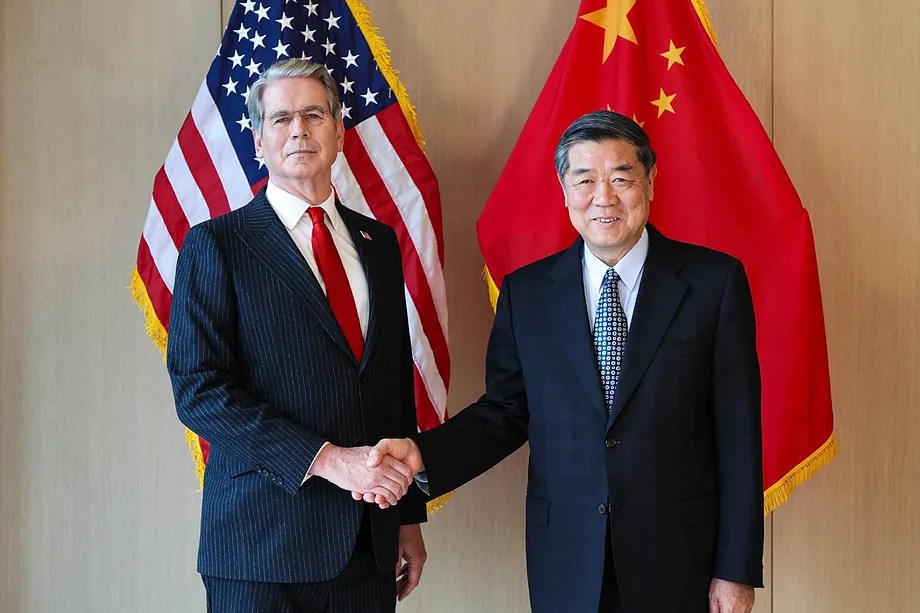
For eight hours, in a room at the JPMorgan headquarters in New York, the two largest technological powers on the planet tried to establish rules for a race that barely has any.
US Treasury Secretary, Scott Bessent, and Chinese Vice Premier, He Lifeng, did not resolve the dispute over advanced chips, algorithms, or rare earths. But they agreed to open a dialogue on artificial intelligence and activate a bilateral Trade Board, two political firewalls erected just days before Donald Trump receives his Chinese counterpart Xi Jinping in Washington this week.
"We had a very successful meeting with the Chinese on trade and artificial intelligence," celebrated Bessent after the Sunday meeting. Beside him, US Trade Representative, Jamieson Greer, explained that the ideas outlined during Trump's visit to Beijing in May were beginning to materialize into concrete mechanisms. The immediate goal, he acknowledged, was to lay the groundwork for the summit on Thursday between the two presidents not to derail before it even starts.
The most innovative advancement is also the most delicate. Washington has proposed creating a "notification mechanism" to communicate incidents related to AI that may affect national security.
Beijing has not yet publicly accepted the formula, but both delegations have agreed to start discussions to identify "common objectives and common threats". It is a modest agreement, still without protocols, deadlines, or a shared definition of what constitutes an incident. Its relevance lies precisely in the fact that until now, such channels barely existed.
USA and China are competing to develop the most powerful models, control the semiconductors that power them, and extend their own technological standards. At the same time, they are incorporating AI into military systems, intelligence networks, critical infrastructures, and cybersecurity operations. A failure, a false alarm, or a misinterpreted automated action could quickly escalate in a relationship already burdened by Taiwan, the disputed South China Sea, and strategic distrust.
The comparison with the Cold War is inevitable, although still imperfect. Washington and Moscow already created direct lines and notification agreements to reduce the risk of an error leading to a nuclear confrontation. With AI, the danger is more opaque: systems evolve quickly, much of the technology is in the hands of private companies, and often not even their creators can fully explain how a model reaches a conclusion. A bilateral channel can prevent a technological accident from being mistaken for a deliberate attack.
But the dialogue between the two giants is surrounded by deep disagreements. Washington wants to focus on security, risk control, and potential military uses. Beijing aims to take it to the broader field of global governance, where it claims a voice in setting international standards and denounces US controls on chips as an attempt to contain its development.
The Trump Administration also accuses Chinese companies of leveraging American models through distillation techniques to accelerate their own systems. China argues that this is a common practice throughout the industry.
Both governments fear that uncontrolled AI could threaten security, but neither wants to slow down first and give an advantage to the rival. Trump has argued that slowing down innovation would allow China to catch up. Xi, on the other hand, has made technological self-sufficiency a national priority in the face of Washington's restrictions.
Therefore, a major AI treaty is not expected from the summit, but something more rudimentary and perhaps more realistic: keeping the channel open, specifying which incidents should be reported, and separating, as much as possible, risk management from technological battle.
The other avenue of relaxation will be commercial. The confirmed Trade Board, announced in May after Trump's visit to Beijing, aims to draw up a list of non-sensitive products that can be exchanged with reduced tariffs and outside of future retaliations.
China could sell consumer goods and low-tech items; the USA, energy, agricultural products, and medical devices. The volume would be limited to $30 billion for each party, a small figure for economies of this scale, but enough to create a protected space within a relationship dominated by sanctions and controls.
The main obstacle remains the trade truce agreed upon by Trump and Xi during their first face-to-face meeting in South Korea in October last year. That agreement, expiring on November 10, temporarily halted new US restrictions and postponed Chinese controls on exports of the much sought-after rare earths. Beijing wants to extend the pause until the end of the Republican's second term. Washington, on the other hand, prefers a six-month extension.