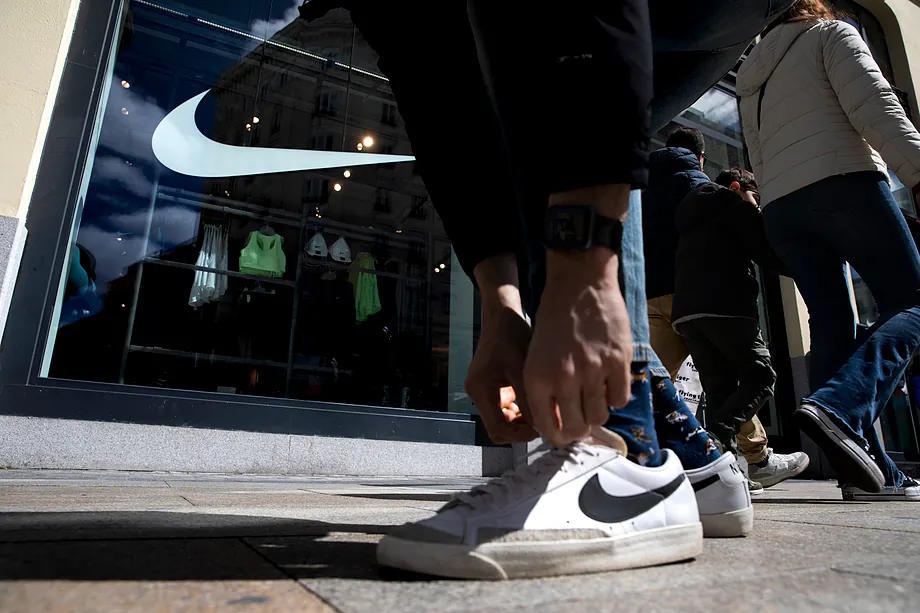
Nike will be removed from the S&P 100 before the market opens on September 21, after almost 18 years in the index. The change is part of the quarterly review announced on September 4 by S&P Dow Jones Indices. The company stated that these changes "ensure that each index is more representative of its market capitalization range." The statement does not attribute Nike's exclusion to a specific cause.
Nike will exit the index along with Honeywell Aerospace, Simon Property Group, and Colgate-Palmolive. Their spots will be taken by Dell Technologies, Palo Alto Networks, Arista Networks, and Sandisk. In the S&P statement, the four additions are classified within the information technology sector.
The change within the S&P 100 also reflects, according to Elena Fernández-Trapiella, an analyst at Bankinter, that "the U.S. index is becoming increasingly technological, due to the higher valuation of technology companies, leading to index recompositions increasingly leaning towards this technology sector."
The company will continue trading on the New York Stock Exchange under the symbol NKE and will remain in the S&P 500. The company defines the S&P 100 as a subset of the S&P 500 that measures the performance of a hundred blue chips, large and established companies with recognized liquidity from different sectors.
According to Fernández-Trapiella, Nike's exclusion will impact its image. "Furthermore, this exit implies that all funds and ETFs indexed to the S&P 100 will not have Nike shares in their investment portfolios, resulting in reduced demand for its shares," she points out.
The change coincides with a business transformation. According to Nike's published results, the company closed its fiscal year 2026 with revenues of $46.4 billion, unchanged in reported terms and 2% lower when adjusted for exchange rates. Net income was $3.1 billion, 3% lower.
Differences between channels show one of its main challenges. Nike Direct, which includes its own stores and digital platforms, generated $17.7 billion, 6% less than the previous year and 8% less at constant exchange rates. In its annual report filed with the U.S. Securities and Exchange Commission (SEC), the company attributed the decline to reduced traffic. The brand's digital sales decreased by 12% and its physical store sales by 4%.
The wholesale channel evolved in the opposite direction. Its revenues reached $27.5 billion, 6% higher in reported terms. Nike informed the SEC that it is reinvesting in wholesale distribution while repositioning its digital platform as a full-price sales channel.
The evolution was not uniform across regions. According to the annual report, revenues increased by 5% at constant exchange rates in North America, but decreased by 3% in Europe, the Middle East, and Africa, by 13% in Greater China, and by 1% in Asia-Pacific and Latin America.
The setback is also reflected in some of Nike's key assets in sports. Kylian Mbappé, one of the company's prominent faces for almost two decades, has ended his partnership with the brand to join the Swiss company On, which is preparing to enter football. The Frenchman joins the departure of Lamine Yamal, who in 2024 became part of the ambassador portfolio of Adidas.
Fernández-Trapiella believes that the exclusion is a response to both the company's performance and market changes. "Nike has lost 77% of its value in the stock market. This has been due to its own activities but also to a very adverse sector context (tariffs, commercial disruptions for a company that mainly manufactures in Asia, loss of consumer purchasing power, rising raw material costs, new competitors in the U.S. and globally, Adidas' positioning, etc.)," explains the analyst.
Nike has not released a specific response to its exit from the S&P 100. Their most recent corporate position is in the June 30 results statement, where their CEO, Elliott Hill, states that they have made significant structural improvements to strengthen the brand's solidity while adjusting operating costs for greater long-term efficiency.
Nike detailed to the SEC that its strategy focuses on sports and innovation and includes reducing the offering of certain footwear products and reinvesting in wholesale distribution.
"After an aggressive inventory reduction policy through discounts, Nike has to demonstrate that renewed innovation and focus on the 'running' segment bear fruit," says Fernández-Trapiella. "It is difficult to anticipate a recovery in value until Nike clarifies the timing and magnitude of the revenue and margin recovery," she concludes.