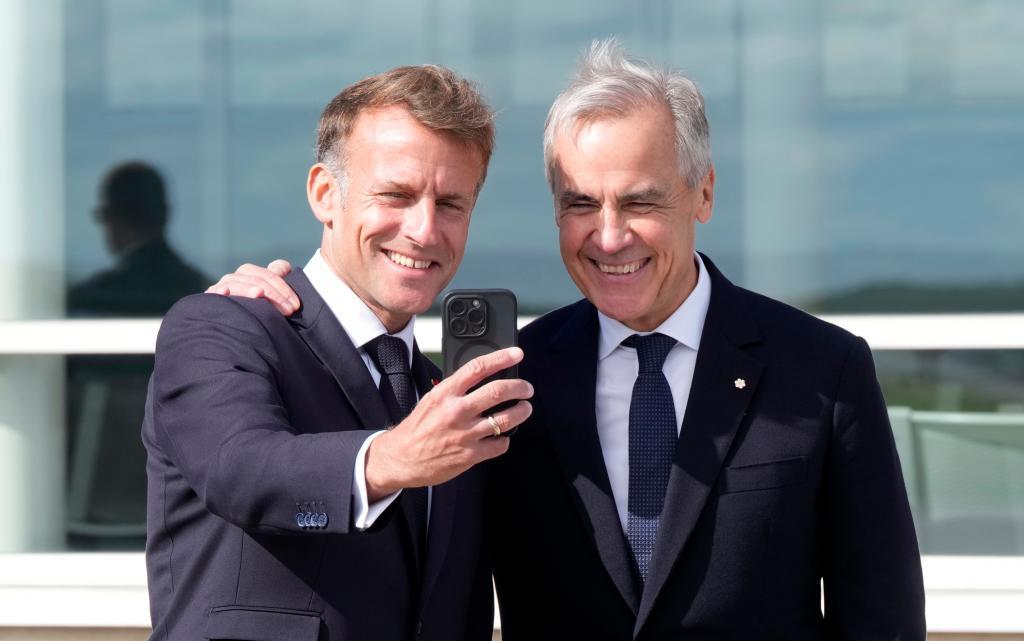
The French President, Emmanuel Macron, and the Canadian Prime Minister, Mark Carney, reaffirmed this Sunday "the sovereignty of nations" in a meeting full of symbolism against Donald Trump's territorial ambitions in the archipelago of Saint Pierre and Miquelon, the last vestige of the Viceroyalty of New France 25 kilometers off the coast of Newfoundland. They also supported the rapprochement between Canada and the EU.
"We support the approach agenda in this alliance of the future" between Canada and the EU and the project of the President of the European Commission, Ursula von der Leyen, for it to be part of "a European political community," Macron stated. "Canada and France have a similar view of the period we are going through. We are two great independent countries that want to remain so, we believe in democracy, the rule of law, respect for international law, and free and fair trade," said the French leader.
Carney called for "building a new alliance" that materializes in different sectors, such as Artificial Intelligence or trade, and that "will strengthen collective resilience so that they can live as chosen, based on shared values."
"It is obvious that Saint Pierre and Miquelon is French territory and is proud to be so; there is no debate about that," Macron declared upon his arrival at the French overseas territory of 5,800 inhabitants. "We are not going to say it every morning because people have strange ideas or say strange things."
Macron was indirectly referring to the map of North America shared by Trump on social media, where Canada and the French archipelago were seen with the stars and stripes of the American flag. Macron, however, celebrated the recent security agreement reached between the United States and Denmark: "Danish sovereignty is respected, and international law is respected: anything that goes in the direction of appeasement is good."
Macron's stop in Saint Pierre and Miquelon is seen as a strong message of unity against Donald Trump, on the eve of the UN General Assembly. The meeting between the two leaders comes days after Carney's speech to the European Parliament, supporting the idea of Canada's approach to the EU as an "associated state".
"In a world in crisis, our friendship is a force," Macron wrote on his X account just before the meeting. "Together, we affirm our sovereignty, our freedom to decide, and our willingness to build a future of peace and prosperity."
It is, in any case, the first visit by a French president in 12 years to the 242-square-kilometer archipelago, doubly affected by the economic crisis due to the decline of the once flourishing cod industry and the climate crisis, with the rising sea levels that have forced the evacuation of 400 homes near the coast (the first French "climate refugees").
François Hollande visited Saint Pierre and Miquelon in 2014, on an official trip clearly marked by the economic crisis. Among other proposals to boost the archipelago's economy has been the idea of setting up a center for repatriating illegal immigrants. Macron's interest is now primarily strategic, due to the value that the French archipelago holds in the EU's approach to Canada.
Macron will spend two days on the French archipelago, on his way to New York to participate in the UN General Assembly. In addition to the official dinner, the two leaders participated yesterday in a tribute ceremony to those who fell for the "Free France", for the role the archipelago played during World War II in support of General De Gaulle during the Nazi occupation.
"We must focus on new perspectives of cooperation," Macron declared upon his arrival on the islands, emphasizing above all the need to increase imports of Canadian liquefied gas.
Mark Carney is indeed the first Canadian Prime Minister to set foot on French overseas territory, a gesture interpreted by an Elysée spokesperson as "a symbol of the strength of the relationship between the two countries."