The warning seemed serious enough to mobilize planes and prepare a group of US military personnel to board a Chinese cargo ship in the Middle East. According to a US intelligence report distributed in the spring, in the midst of the war with Iran, the ship was carrying components intended for a nuclear weapons program. Commanders began to organize the interception. Only when the operation was about to be executed, someone took a closer look at the document that had triggered all the alarms.
The decisive source was not an infiltrated spy, a satellite image, or intercepted communication. It was a chatbot.
According to a report published by CNN, an analyst from a US special operations command had turned to AI to examine the ship's cargo. The machine misidentified the material and its conclusion ended up being turned into a report that circulated as if it were reliable intelligence.
The document was "completely false" and "was on the brink of triggering a war," recounted one of the four sources familiar with the episode cited by CNN. Attacking or forcibly boarding a Chinese ship would have pitted the two largest military powers on the planet against each other.
It didn't take a killer robot rebelling against its programmer. A wrong response that escalated through a human chain too willing to believe it was enough. The immediate danger is not that the machine starts a war, but that it delivers a convincing falsehood to those who can start one when there is little time left to verify it.
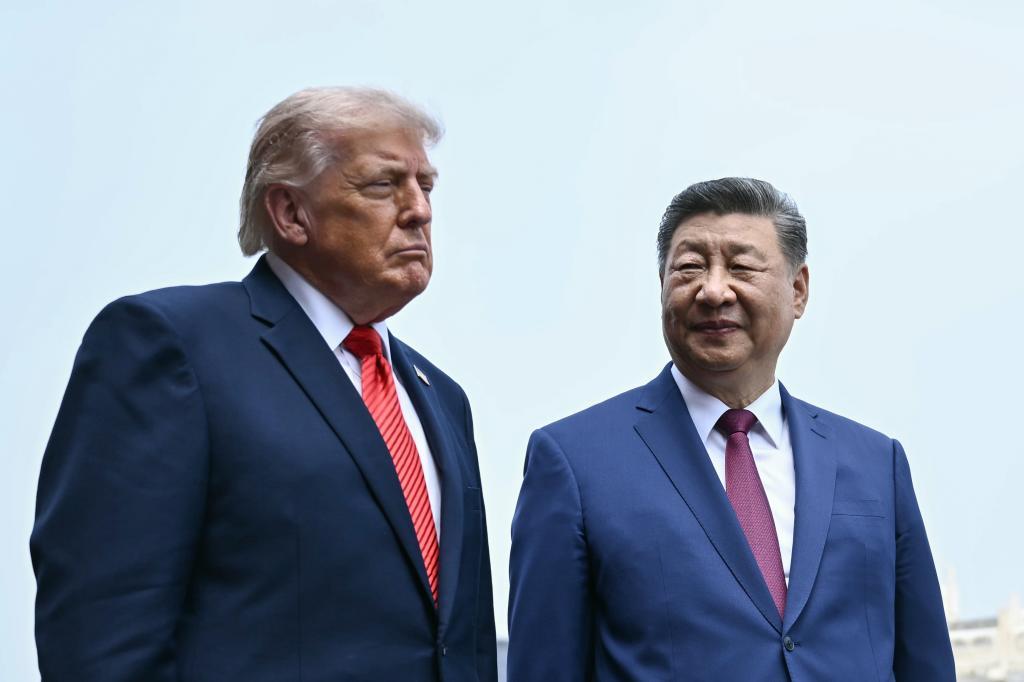
All this debate will accompany Donald Trump and Xi Jinping when the two most powerful men in the world meet next Thursday in Washington. AI is part of the preparations for a summit also dominated by tariffs, semiconductors, rare earths, and Taiwan. Negotiators are studying possible safeguards against the misuse of models. But no one expects a major treaty: both countries fear the same accident and neither wants to accept limits that would allow the rival to move faster.
Trump summarized his doctrine this week with an unequivocal statement: "Whoever wins in artificial intelligence, wins." Washington is integrating algorithms into almost every layer of its military apparatus: they process data, locate threats, help select targets, and recommend which resources to deploy.
In January, Defense Secretary Pete Hegseth presented a strategy to accelerate this adoption and eliminate bureaucratic obstacles. The US argues that it cannot hold back while the Chinese People's Liberation Army applies AI to surveillance, planning, drone swarms, and electronic warfare.
This week, concern reached the Xiangshan Forum, the main showcase of Chinese military diplomacy. Some 2,000 officers, diplomats, and academics from around a hundred countries gathered for three days in Beijing. They talked about cheap drones, algorithms capable of recommending an attack in seconds, and fake news that can inflame a crisis before a government can refute it. AI, presented for years as the great multiplier of military power, appeared in a less triumphant light: the technology accelerates war much faster than the rules designed to contain it.
"AI speeds up decision-making, while misinformation can erode public trust even before governments are able to respond," warned Pakistani Defense Secretary Muhammad Ali. An algorithm detects a signal, classifies it as a threat, and proposes a response in moments. The faster it is, the less margin the operator has to distinguish between a real attack, a decoy, or a hallucination like that of the Middle Eastern cargo ship.
Jürg Lauber, vice president of the International Committee of the Red Cross, called in Beijing for preserving human control over the use of force. Ukraine has already shown the trend: cheap drones surveil, adjust fire, and attack; automatic target recognition promises to further reduce fighter intervention.
The risk multiplies when these systems come close to nuclear arsenals or command centers. Beijing and Washington share a fundamental red line: the decision to use nuclear weapons must remain in human hands. Experts from both countries propose a direct line for AI-related incidents and notification protocols. The problem begins when turning these principles into verifiable rules.
China used its main defense forum to present itself as a defender of multilateral governance. Defense Minister Dong Jun described international security as "fragile" and called for cooperation on AI. Xi called during the recent BRICS summit to develop the technology "for the common good." Almost at the same time, State Security Minister Chen Yixin defined it as "the main battlefield of global technological competition." Beijing calls for universal rules while securing its algorithms and pursuing self-sufficiency in chips.
The contradiction is repeated in Washington. Trump is wary of regulation that could hinder American companies just as China offers cheap models to the Global South. He may accept guardrails against a catastrophe, but not an agreement that reduces his advantage. Xi will not freeze an essential tool to modernize his army.
Therefore, analysts point out that the most plausible outcome of the summit is not a treaty, but a handful of narrow commitments: opening emergency channels and exploring shared security tests. When Trump and Xi sit down face to face in Washington in a few days, they will negotiate over a technology that they both want to control without giving up dominating it.