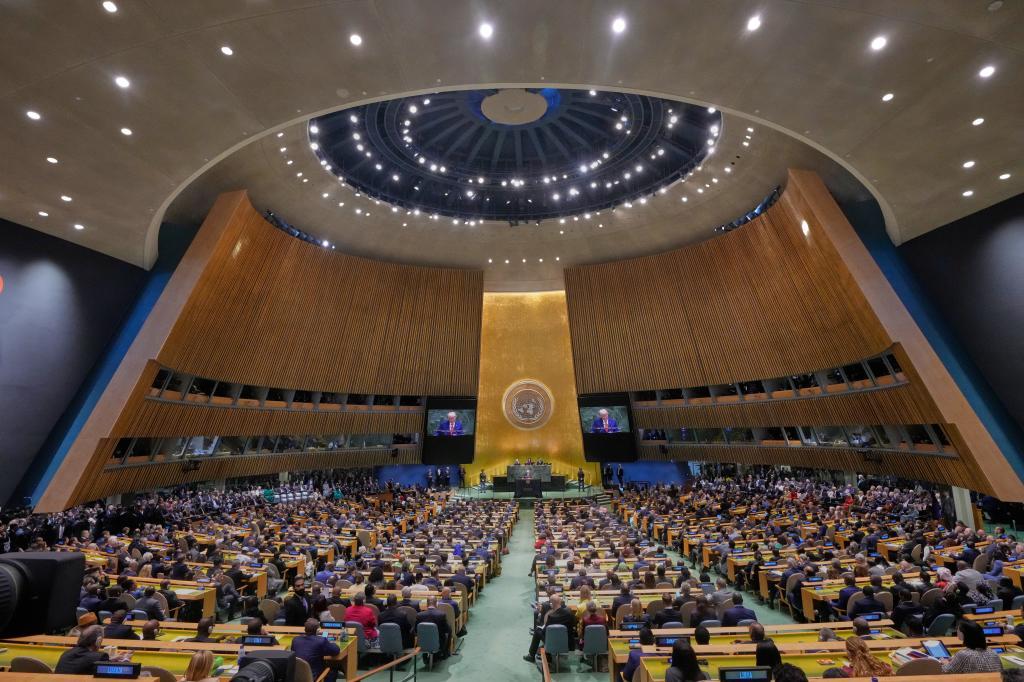
The UN's grand week, every September in New York, is always a monumental and unpredictable phenomenon. The major current issues (such as the election of the next Secretary-General, the wars in Iran, Ukraine, Israel and Gaza, the environment, and above all, Artificial Intelligence) are usually very clear in advance, but when you bring together over 140 heads of state and government and many hundreds of ministers and diplomats in the city that never sleeps, things always happen, and there are surprises. So many that they never fit into a single chronicle.
Under the theme Restoring Trust, Managing Transformation: A United Nations that Delivers for All, in the coming days, there will be thousands of bilateral meetings at all levels, conferences, debates, presentations, and awards. There will be secret negotiations to reduce the number of candidates to succeed the Portuguese António Guterres. And demonstrations and biblical traffic jams on the streets of Manhattan. But much of the media attention will be on the meeting between Donald Trump and Venezuelan Delcy Rodríguez, who will meet for the first time.
The American, who will receive Xi Jinping at the White House on Thursday, has been praising his chosen successor to Nicolás Maduro for months, hindering any possibility of a transition to democracy or the calling of free elections while reaching agreements to retain a significant portion of Venezuelan oil. And now he will provide Rodríguez with valuable diplomatic support after years of international boycotts and sanctions. "He may do it, we already have the oil that implies thousands of barrels per month," the Republican leader tersely responded to a question in recent days about a painful face-to-face for the opposition. Shortly after, his team confirmed that there will be a brief informal meeting on the sidelines of the Assembly.
Last year, the recognition of Palestine and the organization's funding cuts were the two overarching themes. In 2026, the week's agenda encompasses concern over the (in)ability of the multilateral system to respond to an increasingly fragmented, distrustful, and disbelieving world, a world where centrifugal forces win elections, where AI (OpenAI's CEO, Sam Altman, will privately address the UN Security Council these days) begins to play a critical role and instills fear, with destabilizing wars and increasingly disruptive figures like Trump himself, who last year took the stage, with reports of sabotaged escalators and a clash turned into an opportunity with Lula da Silva.
On Thursday, outgoing Guterres warned leaders that the world faces at least three existential problems: uncontrolled Artificial Intelligence, runaway climate change, and growing inequality fueling instability. Additional elements to the "fierce storm" described the same day by Canadian Mark Carney from the European Parliament.
Guterres also stated that geopolitical division and the paralysis of the Security Council have created an environment of "impunity". He cited examples such as the Russian invasion of Ukraine but also US attacks on Iran. He did not need to mention the threat from Washington to Greenland because one of the best news for the international community this year is the agreement between the Danish government, local authorities, and the Trump administration that should, in theory, definitively halt speculations about a possible forced annexation. The signing of that Agreement on Security in the Arctic and North Atlantic is expected precisely for today or tomorrow here in New York.
Despite all the mockery, criticism, the entrenched structure, the slow decision-making process, and the dirty and ideological maneuvers in the hallways, the UN remains the only universal forum for global cooperation on matters of war and peace in this international order that is crumbling under unbearable pressure. Even Trump himself, surprisingly, and despite drastically cutting contributions and withdrawing his country from the United Nations Educational, Scientific and Cultural Organization, the UN Human Rights Council, and the World Health Organization, seems reasonably comfortable with the idea of the UN, at least to some extent.
However, instead of focusing on what should be its raison d'être, such as peacekeeping missions or the status of the Sustainable Development Goals (SDGs), which include areas like health, women's rights, and poverty reduction, or the urgent reform it needs, the organization expends its energies on surviving, avoiding as many cuts as possible, and thinking about a new leader. Before the 2030 deadline, only 20% of those Goals are being achieved.
"Under the Trump Administration, the United States went from being an imperfect advocate of the international legal order to a blatant violator. While the US has not repudiated the UN-led multilateral system, it has caused great harm to the organization, insisting on reducing multilateral peace operations, slowing down funding, and trying to impose its ideological agenda (...) Regarding the most pressing challenges to peace and security today - the war between the US and Israel and Iran, as well as Ukraine and Sudan - the UN stands out mainly for its stagnation," summarizes the International Crisis Group's analysis.
Now, "uncertainty and unease" increase due to the anticipation generated by a change in leadership. Secretary-General António Guterres will end his term at the end of December, and at least seven candidates [Chilean Michelle Bachelet resigned on Saturday after realizing she lacked sufficient support and faced Trump's veto] are campaigning more or less openly to succeed him. "Some hope that the next Secretary-General can revitalize the organization and, if Washington is receptive, regain some political relevance and financial stability. Others fear that the US, China, and Russia will conspire to elect a weak candidate firmly under their control, and that the Trump Administration will force the next UN chief to make even more drastic cuts throughout the institution," the think tank points out.
The organization is facing serious financial difficulties that have led to thousands of layoffs and the suspension of programs and initiatives. The United States, the main historical contributor, maintains a very tense relationship with the headquarters. Washington has just made a payment of $827 million outstanding from its contributions to regular and peacekeeping budgets, temporarily avoiding the loss of its voting rights, but the amount paid is just a fraction of what the US owed, nearly $5 billion.
In one of his recent appearances, Guterres urged countries to "fulfill their promises in an era of profound uncertainty." Carney, in Strasbourg, put it differently: "A single tree succumbs to a storm, forests resist."