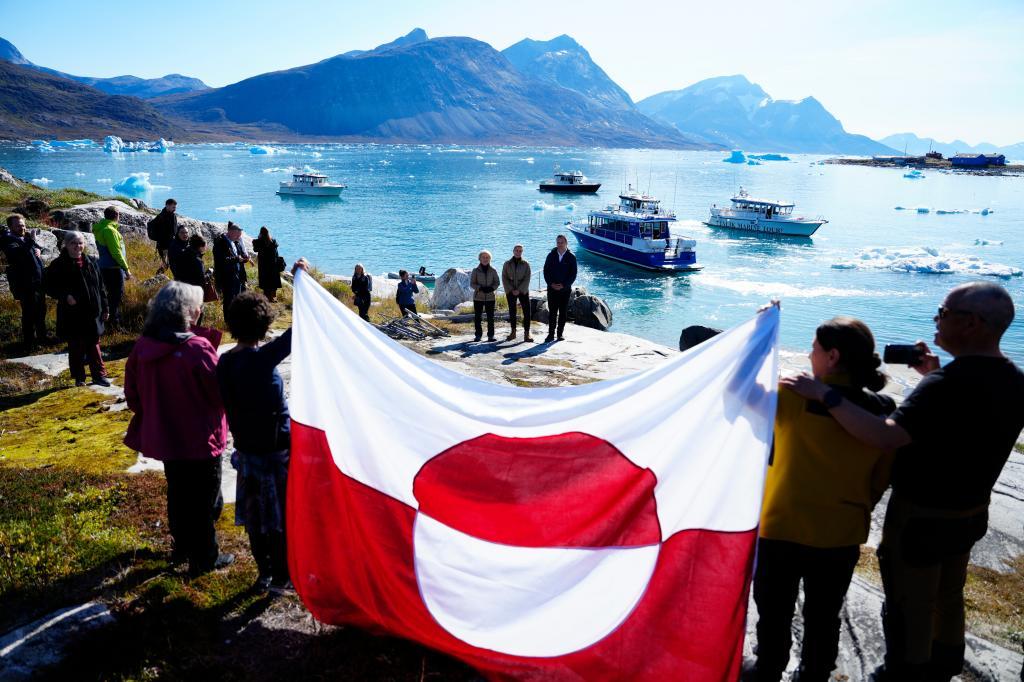
Despite efforts by Ronald Lauder - heir to the Estée Lauder cosmetics empire - to convince his friend Donald Trump in 2017 that Greenland should be American, the Danish island is completely different from the United States from a cultural and social perspective. Therefore, the total opposition of its inhabitants to becoming American is more than predictable, as is the potential agreement announced by Trump on Friday.
Just compare Nuuk, the capital of Greenland, with Fairbanks, the second-largest city in Alaska. Both are at a similar latitude, only 119 and 263 kilometers apart from the Arctic Circle, respectively. Fairbanks has 32,515 inhabitants. Nuuk has 20,113. And there the similarities end.
As soon as you step out of the car (in Fairbanks) or the plane (in Nuuk), it is clear that the former could be a copy of Casper, Wyoming, or Minot, North Dakota, while the latter resembles Hammerfest or Tromsø in Norway, or Akureyri in Iceland. Fairbanks lacks a proper urban center. Its official and corporate buildings are huge squares. The residents live in the famous American suburbs, meaning scattered single-family homes with almost identical and interchangeable designs whether in Alaska or Florida for tens of kilometers around. This is how the metropolitan area of the American city reaches around 100,000 inhabitants.
Nuuk is much more compact. There, three types of constructions coexist: traditional Nordic houses with pointed roofs, apartment blocks with a certain brutalist touch from the sixties and seventies, and other more modern and smaller residential buildings. From its suburbs, like Nuusuaq or Qinngorput, you can see the urban center. A real urban center that Nuuk has, unlike the U.S. Because Nuuk has an area of restaurants and cafes where you can enjoy a coffee or a pizza while outside it is thirty degrees below zero.
And there lies the greatest symbol of Greenlandic Europeanism: the Katuaq, or Cultural Center of Nuuk, with its wavy facade, restaurant, concert halls, and exhibition rooms, all funded by the Danish taxpayer (because Greenland wants independence but cannot afford it). A Katuaq would be inconceivable in the United States.
The urban and architectural differences reflect the political and economic policies. It is not just that Nuuk lacks suburbs. It is that the nearest population is called Kapisillit, has 49 inhabitants, and is 80 kilometers away, only accessible by boat (if the waters of the Nuuk fjord are calm).
All of this is due to History. Nuuk has been built through a progressive process of colonization and settlement that began with the foundation of a mission to convert the Inuit to Christianity by the Norwegian missionary Hans Egede in 1728.
However, Copenhagen's interest in Greenland has always been less intense than the US interest in Alaska. This is partly because sovereignty over the island was never entirely clear—though the dispute was with Norway, not the US—and also due to the physical challenges of colonizing the territory.
In terms of climate, Greenland is far harsher than other regions at the same latitude, such as Alaska itself, Iceland, or northern Norway, Finland, and Sweden. The reason lies in the cold ocean currents washing against its shores, which alter the climate. Consequently, most of the island lies buried beneath a three-kilometer-thick sheet of ice. If Greenland's ice were ever to melt, we would discover that it conceals not just one, but three islands. A fourth would also emerge, as the immense weight of the glaciers currently keeps it submerged.
Precisely for this reason, Denmark has never had the slightest objection to the United States handling Greenland's defense. In fact, the 1951 bilateral defense agreement between the two nations—which remains in effect—stipulates that while Copenhagen must authorize the establishment of any US military facility on the island, once that approval is granted, the US has the authority to deploy any type of weapon at those bases. The agreement was amended in 1968 following the famous Palomares incident, in which a B-52 bomber dropped four atomic bombs near Almería. Since then, the United States has been required to seek Danish authorization to fly over Greenland with nuclear bombs, send ships carrying them to its ports (though none of the ports can accommodate large vessels), or station them on its territory. In 2004, with George W. Bush in the White House, Washington and Copenhagen added Nuuk to the list of capitals that must greenlight U.S. bases in Greenland—a territory that once hosted 17 bases during the Cold War, though only the Pituffik base remains today.
No military obstacles
The new restrictions imposed by Denmark and Greenland do not appear to pose a serious problem for a potential U.S. military expansion. During the Cold War, the Pentagon attempted to build a nuclear reactor within the Greenland ice sheet—an operation worthy of a James Bond villain—but had to abandon the project because the movement of the glacier's ice would have ruptured the walls of any nuclear reactor.
Furthermore, the alleged need for the U.S. to maintain bases in Greenland is difficult to justify. It is true that the Arctic is melting due to the greenhouse effect, prompting China to launch the "Arctic Silk Road" this year—the name given to a maritime trade route stretching from Shanghai to England. However, the ice is opening up north of Siberia, not in the expanse between Iceland and Alaska—that is, at the opposite end of the Arctic from Greenland. The reason, once again, lies in ocean currents. When Trump claims there are "lots of Russian and Chinese ships" around Greenland, he is not telling the truth. There are none, because there is nothing there to explore. The business opportunities lie to the east.
Finally, there is one last issue. The U.S. lacks the equipment to monitor navigation in the Arctic. It possesses only a single icebreaker, compared to Canada's twenty. Building bases in Greenland would be costly, and at a time when the Pentagon is overextended—from Iran to China—it seems unlikely that it could allocate significant resources to such an undertaking.
The differing approaches to the colonization of Greenland have shaped the island's character. Much like those in Alaska or other Canadian territories. Returning to the case of Fairbanks, the town—like almost all U.S. cities—is the product of "boom and bust" dynamics. In its case, these were driven by gold, by wars (World War II and the Cold War, which led to the opening of a massive airbase), and later, by oil pipelines. The city is named after Charles Fairbanks, the then-Republican senator from Indiana.
Indigenous names
Nuuk, by contrast, is an Inuit—or Eskimo—word. Local names have prevailed over Danish ones in Greenland, reflecting another difference between the island and the US. For instance, the US military base at Thule (named after the mythical realm of "Ultima Thule," which the Romans placed north of the British Isles) is now called Pituffik, which means "anchorage" in Inuit. In Alaska, conversely, English names are gaining ground. On the first day of his second term, Donald Trump changed the name of the highest mountain in the state—and the entire US—from "Denali" ("The High One" in the language of the indigenous Koyukon people, a name given by Barack Obama). Since 2021, the mountain has once again been called McKinley, in honor of the US president who went to war against Spain in 1898 over Cuba, Puerto Rico, and the Philippines.
Greenland could only become part of the United States if it ceased to be what it is. And while it is not Denmark either, it is much closer to its "metropolis"—a term that is not controversial there, as neither Danes nor Greenlanders have any qualms about referring to the island as a "colony" and acknowledging that it will one day achieve independence. This opposition to annexation appears to have played a role in softening Trump's stance. If the island were to be occupied, it is highly likely that a large portion of its inhabitants would leave for Denmark or other Nordic countries (though not Canada, with whom Greenlandic Inuit maintain very few ties, despite the geographical proximity).
This is because locals view a change in sovereignty as a form of much harsher colonization, as evidenced by the experiences of Canadian and US Inuit (Eskimo) populations. An example often cited by residents of the Danish colony is how Copenhagen took children away to "civilize" them against their parents' wishes. In Canada, more than 5,000 children were taken. In Alaska, no one bothered to distinguish the Inuit among the more than 10,000 children torn from their families. That is evident today. 90% of Nuuk's population identifies as "Greenlandic," even though the vast majority are of mixed continental European and Inuit descent. In Fairbanks, barely 9% of the population identifies as "Indigenous."
Todas esas diferencias históricas explican el sinsentido de las reclamaciones de Trump auspiciadas por su amigo Lauder, que, como presidente del Consejo Mundial Judío y aliado del primer ministro israelí, Benjamin Netanyahu, también tiene una considerable influencia sobre la Casa Blanca en materia de Oriente Medio. Groenlandia no es ni cultural ni histórica ni políticamente parte de EEUU. El único interés de Trump es el económico.
El hijo del presidente, Don junior, comparte ese interés. El fondo de capital-riesgo 1789, cofundado por Rebekah Mercer, la dueña de la web Bretibart y una de las mayores impulsoras de Donald Trump, tiene entre el 8% y el 12% de la empresa estadounidense Critical Metals, que quiere abrir una mina de litio en Tambreez, a 450 kilómetros al sur de Nuuk. Sin duda por casualidad, cinco días después de que Trump padre ganaras las elecciones de 2024, Don junior fue invitado a entrar como socio de 1789. El problema es que la mina de litio no ha extraído hasta la fecha ni un gramo de ese mineral. No está claro cuándo lo hará. Las riquezas groenlandesas están bajo tres kilómetros de hielo. Y eso es algo que ni Donald Trump puede liquidar.