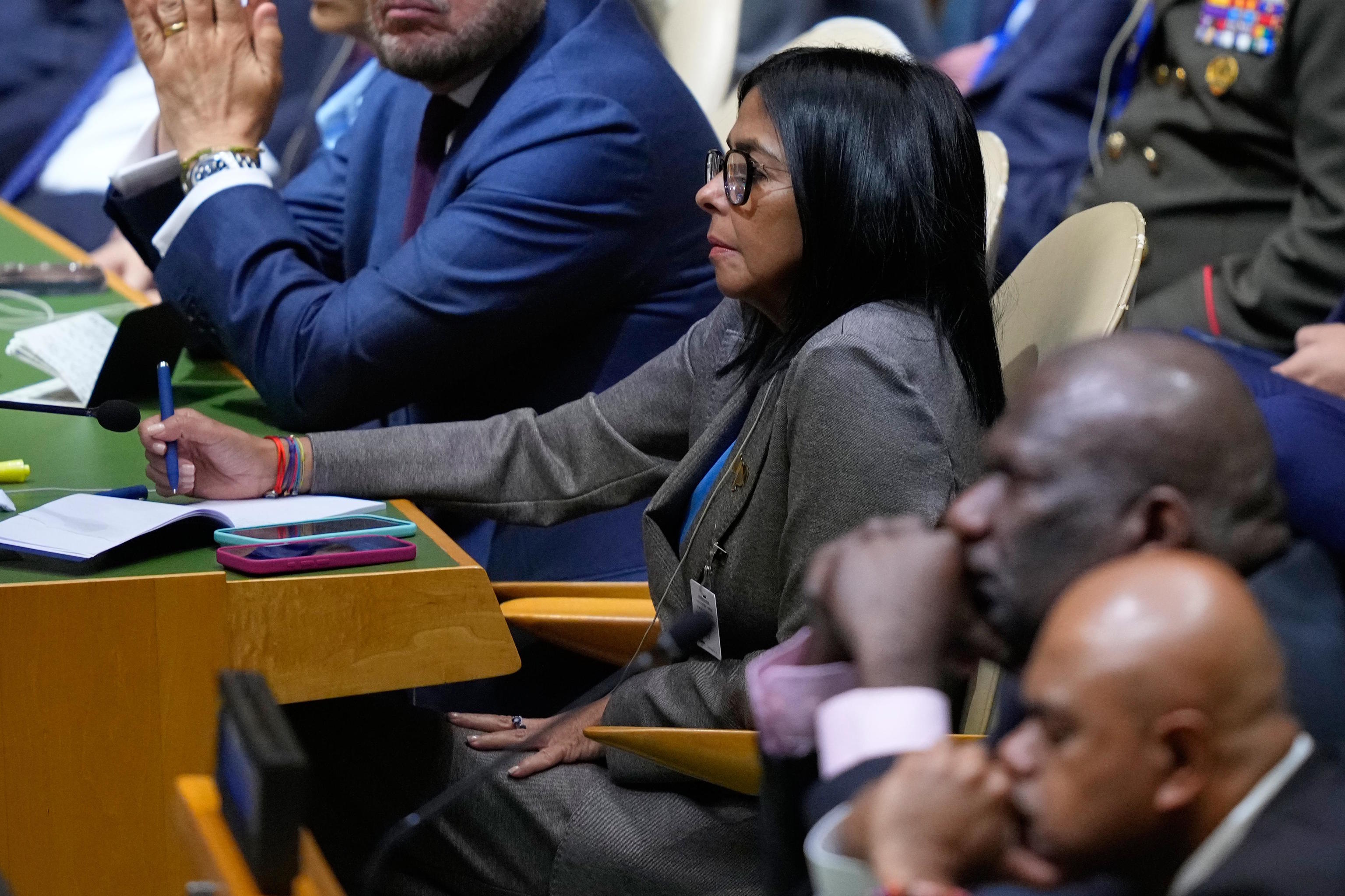
Venezuelan Delcy Rodríguez has undergone one of the most incredible and rapid metamorphoses in recent history of international relations. She may not have the talent and charisma of Charles-Maurice de Talleyrand, the chameleon-like French diplomat capable of serving kings, revolutionaries, and during the Restoration, but she does have his ability for survival and submission, going from being a central figure of chavismo (sanctioned by Washington) to becoming a privileged interlocutor of the Government of Donald Trump and a legitimized, if not legitimate, president of her country in a matter of months.
Her evolution has led her from denouncing U.S. sanctions as "state terrorism" and condemning "imperialism" at the United Nations to remaining impassive as the American president, in that same room, called her former boss a "dictator and criminal" and stated that "the spoils belong to the victors," referring to her country's oil. She posed smiling and flashing the victory sign in a photo with her former mortal enemy, while almost simultaneously the opposition leader, María Corina Machado, tried repeatedly, but in vain, to return to Venezuela, trapped in Panama due to administrative issues, expired documentation, and Washington's maneuvers.
For her, what happened this Tuesday in New York is the best news possible. At the same time, the administration has extended a hand to her regime and shut the door on her main rival. Rodríguez speaks of "support for the reintegration process of our country into multilateral spaces," and she is absolutely right. Today has been the most significant step on that path, but it surely won't be the last.
"We had a historic meeting with the President of the United States, Donald Trump, with whom we discussed strengthening bilateral relations," wrote Rodríguez on her official X account.
A key figure alongside her brother during the years of Nicolás Maduro, the United States included Delcy Rodríguez in September 2018, during Trump's first term, on its list of sanctioned individuals for human rights violations. However, after Maduro's capture in January 2026 and the establishment of an 'interim' government, Washington gradually shifted from a policy of maximum pressure to a cooperative relationship with Caracas. There is no longer talk of transition, elections, or democracy, and there is no path for Machado.
On April 1, the Department of the Treasury formally removed Rodríguez from the sanctions list. In July, the Administration asked the Department of Justice to recognize her immunity from a civil lawsuit in Florida, arguing that she was now the head of state of Venezuela. And by the end of summer, the rapprochement had reached an additional dimension, after Washington and Caracas reached an incredible agreement on oil, debt, and the reconstruction of the Venezuelan industry.
Meanwhile, the Spanish government, which until recently referred to the leader as "temporary president" and welcomed Edumundo González and other top-level political exiles, has invited her to the Ibero-American Summit held in Madrid in early November, despite the EU sanctions that theoretically prevent her from setting foot on European soil. These sanctions were key in the controversial and never fully clarified stopover at Barajas airport in 2020, with meetings with Minister José Luis Ábalos and his collaborators.
The final step of her transformation, and her diplomatic whitewashing, came this Tuesday in New York, during the grand week of the UN General Assembly. In the morning, Rodríguez managed to grab headlines with a striking and at times uncomfortable image, after getting up from her seat during the plenary session, approaching Spanish President Pedro Sánchez, and exchanging a kiss and a greeting.
But her greatest success came in the afternoon when Trump agreed to a face-to-face meeting. A pull-aside, in local jargon. A quick aside during a reception at a hotel in the city before Trump returned to Washington. The meeting included the two politicians, accompanied by Marco Rubio, Treasury Secretary Scott Bessent, Trump's chief of staff Susie Wiles, and the White House's top advisor on domestic issues, Stephen Miller. The U.S. administration did not provide any details to the pool of journalists, and the president did not answer questions later on the plane back to Washington.
However, Rodríguez took to social media a few hours later to celebrate the unofficial and public recognition. "We had a historic meeting with the President of the United States, Donald Trump, with whom we discussed strengthening bilateral relations between our countries and advancing a cooperation agenda in strategic areas such as energy, mining, security, and other matters of common interest. We express our gratitude to President Trump and his government for the determined support provided during the emergency caused by the earthquakes on June 24, as well as for their support for the reintegration process of our country into multilateral spaces. Venezuela and the United States share a historical relationship that, in this new stage, we are called to channel through dialogue. We will continue to promote diplomacy in the service of national interest, aimed at achieving concrete results and collective benefits for the Venezuelan people," she posted on her X account.
Last night's meeting, with strong symbolism and a devastating blow to the opposition led by María Corina Machado, the leader who handed her Nobel Prize medal to Trump, had been in the works for months. Already in January, days after the military operation that led to Maduro's capture, White House officials claimed that a visit was possible. Weeks later, she herself said she would "at some point" visit the United States. And when her presence at the UN General Assembly was confirmed, only the timing, format, and type of coverage remained pending.
It took place at the Lotte New York Palace hotel. The decision sends many messages. While it was somewhat minor from a protocol standpoint, with a small room with two chairs and the flags of both countries, it was huge from a diplomatic perspective. During his first year, Trump received every relevant international leader at the White House, but in recent months, the system has changed, and for delicate meetings, such as with the Syrian or Brazilian presidents, he has opted for private encounters, without cameras or press conferences. This time was similar, but with Trump posing more than satisfied alongside the woman who has staunchly defended him since January.
In 2026, Delcy has shifted from denouncing Trump as a demon to speaking of "cooperation and reconciliation," "peace and dialogue," and her "friend and partner." Her government has turned a relationship that began with a military operation and was based on constant threats into something commercial and agile, culminating in negotiations on oil and U.S. investment. Rodríguez continues to insist that she is not relinquishing Venezuelan sovereignty, but in practice, as discovered by the American press, she is in constant contact with Marco Rubio, the Secretary of State, and does not make any significant decisions without his permission or approval.