Last Friday, the President of the United States, Donald Trump, announced that he was revoking press credentials at the White House for journalists from CNN, MS NOW, and Politico, alleging that they were publishing fake news and false content about his administration. The following day, the network correspondents were unable to enter the presidential complex, and their permanent cards were confiscated.
"I am proud to announce that, effective immediately, I will ban CNN from the White House for the fake news, MSNOW (which recently changed its name from MSNBC due to lack of audience and credibility!) and Politico (which benefits from an illegal and ridiculous eight million dollar grant from the United States government, under the mandate of corrupt Joe Biden, to keep them afloat! To me, that seems like corruption)," wrote the Republican leader on his social media.
Since 2016, Trump has been in a constant battle with the media. No president, nor politician in general, has had a closer and more constant relationship with the media. He speaks practically every day, gives constant interviews, accepts daily calls from many of them. The access is infinitely superior to any predecessor. But at the same time, no one has insulted, belittled, attacked, and threatened the press like him. All kinds of daily contempt, especially towards women. Reproaches, lack of respect, pressures, warnings through regulators, lawsuits demanding tens of billions for their information.
In his first term, he tried to expel a CNN journalist, and the courts did not stop him. Last year, he even expelled journalists from the AP agency from the pool that follows the president around the world 365 days a year because the organization refused to change the name of the Gulf of Mexico to the Gulf of America in its reports, a ban that reached the courts. But this time, he has gone further and for the first time has also encountered some resistance. "This morning we notified the government that we will file a lawsuit today to protect our rights under the First Amendment and defend the principle that the government does not decide what the press reports or publishes," declared the three excluded media outlets in a joint statement. Without prior notice or legal procedure, the White House revoked our journalists' credentials for opposing our information. If not challenged, this action threatens press freedom and the public's right to independent journalism, free from government interference," their statement says.
At the same time, the rest of the major U.S. networks joined an extraordinary protest against the ban, a boycott that practically suspended a large part of Trump's visual coverage. For decades, White House correspondents have rotated to follow the president. There are always journalists from agencies, newspapers, radios, or television. Yesterday it was CNN's turn, and after the ban, the others decided not to replace it and suspended joint coverage. Additionally, AP, AFP, Washington Post, and The New York Times decided not to publish photos of the presidential events that day, and as a result, the inauguration of the new heliport at the White House and Trump's trip to the UN General Assembly took place without live TV coverage. Even though there were cameras, the sound did not reach.
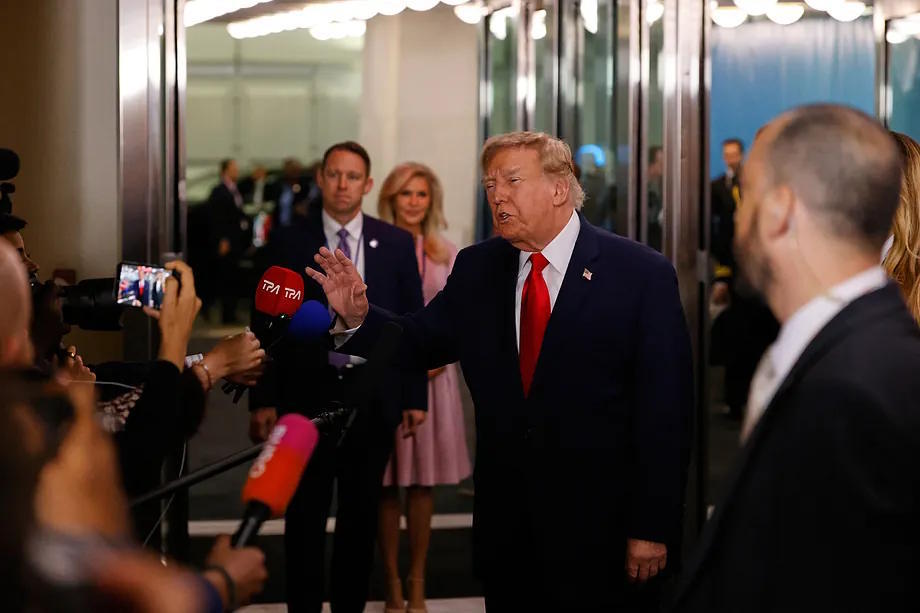
The same scenario repeated on Tuesday morning. No cameras or photos, but with press and agency reporters still following the president. Something he took advantage of, both days, to mock the press and the pool itself, claiming that they are incapable of not following him no matter what happens. "You shouldn't be here covering me. You said you weren't going to cover me. You shouldn't be covering me," he snapped at one of CNN's star reporters and presenters, who was in the halls of the UN with the institution's accreditation.
"If it's fake news, I believe I have an obligation not to allow them access to a very special House. Fake news is very harmful to the country, very harmful to national security. So I have that obligation. We'll see how the situation develops (...) It's funny because they said they were going to boycott me, but they never do, so I wasn't too worried. Look at all that press (...) the press also has an obligation, and they know I won by a landslide. I won the elections by a landslide. I have done great things. I have done many important things. I have resolved eight wars (...) If you watch CNN, it's fake news. If you watch MS Now, I don't even know what MS Now is. I suppose it's MSNBC, what it used to be, or MSDNC, as some call it, which is the Democratic National Committee, but it's just biased news. And I believe these media have an obligation to be impartial," Trump said on Monday night.
Historically, it was the White House Correspondents' Association that organized the pool rotations. The White House has intervened in this legislature to incorporate additional sympathetic media just as it has included influencer supporters of the president in White House briefings, but the rest of the traditional media still had the same role. Until now.
Trump's clash with the television networks goes far beyond a few questions or the White House pool. On one side, there is a high-level political operation for a major corporate restructuring, something that also affects CNN. Trump's allies, especially the Ellison family, are behind the largest media power concentration maneuver in decades. First, they acquired Paramount, which broadcasts the CBS network. And then the new company, Paramount Skydance, acquired Warner Bros. Discovery, which places major brands like CBS, CNN, HBO, and numerous television channels under the same group.
This is compounded by pressures and threats from regulators, in the hands of Trump supporters, to the networks. This led, for example, to the cancellation of comedian Stephen Colbert's show or the suspension of Jimmy Kimmel's show for a few days. Kimmel himself explained two weeks ago that he could not air an interview with a Democratic politician from Texas due to FCC threats that could cost the ABC network its license, or rather, do a lot of damage to its affiliated channels in Texas.