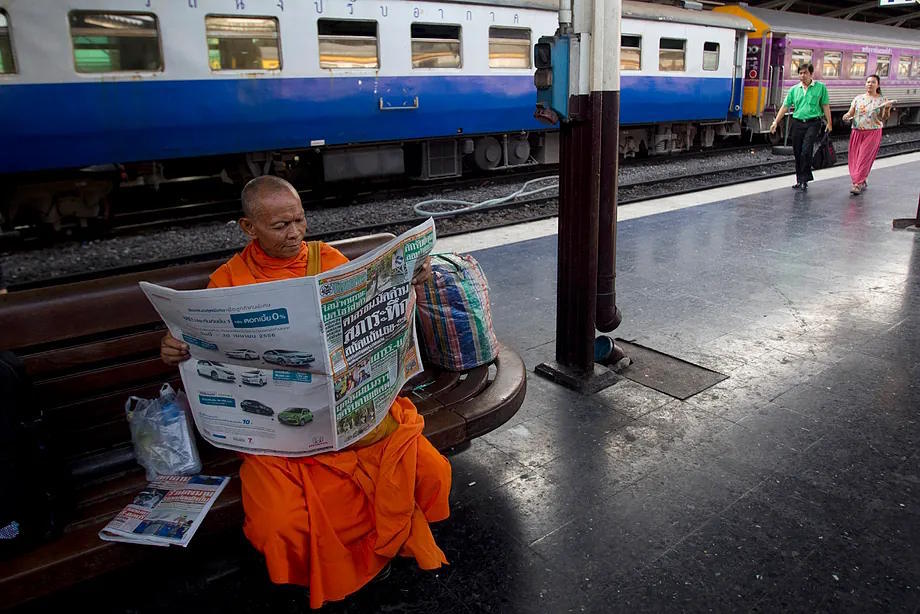
When customs agents at Colombo Airport (Sri Lanka) asked monks to open their suitcases, they suddenly found 110 kilos of kush, a potent variety of marijuana, hidden in double bottoms. The 22 monks had just returned from a four-day vacation in Thailand paid for by a mysterious benefactor. This incident in April summed up better than any police report how drug trafficking networks had found in Thailand an immense breeding ground for new messenger profiles.
Criminal organizations now recruit monks, flight attendants, backpackers, and students. Individuals who, precisely because they seem less suspicious, can cross borders with fewer controls and move small quantities that, when multiplied by hundreds of travelers, fuel a multimillion-dollar business.
Bangkok has become one of the main stages of this transformation. In the city where golden temples, night markets, and thousands of cannabis dispensaries coexist, criminal organizations have adapted their methods as quickly as legislation on marijuana is changing.
The latest alarm was raised after the arrest in Melbourne of a Thai Airways flight attendant accused of smuggling over a kilogram of heroin hidden in the lining of 12 fabric bags. The drug, valued at around 500,000 Australian dollars on the black market, triggered a joint investigation between Australia and Thailand and raised an uncomfortable question: are criminal organizations using airline crews as international couriers?
Days before that arrest, a flight attendant from a regional airline received a private message on TikTok. "Are you flying to Australia? Are you transporting luggage? What is your rate?" She ignored it. But that conversation revealed a perfectly organized system.
"Criminal organizations create fake profiles on TikTok, Facebook, or messaging apps to locate airline employees who post their destinations or travelers willing to transport packages of marijuana, cocaine, heroin, or methamphetamine," recounts another flight attendant from an Asian company. "We all know workers who have received these messages," she says.
One of the most recent high-profile cases was that of Charlotte May Lee, a 21-year-old British flight attendant arrested last May at Colombo Airport immediately after landing on a flight from Bangkok. Authorities claimed to have found 46 kilos of kush in two suitcases.
Lee, who had traveled to Sri Lanka to renew her Thai visa after spending time in Bangkok, claimed she was unknowingly used as a "mule" and that someone had introduced the drugs into her luggage while she was in Thailand. If convicted, she could face up to 25 years in prison.
Regarding heroin, according to the Thailand Narcotics Control Board, traffickers mainly acquire it in Burma, where poppy cultivation has reached its highest level in the last decade due to civil war and economic collapse, and they use Thailand as a logistical platform to send it to much more profitable markets like Australia or Taiwan. Many intercepted shipments were hidden among silk garments, coffee packages, and decorative vases.
But while heroin follows the old Burmese route, cannabis has opened a completely different path to Europe. In northern England, the BBC discovered that criminal organizations are flooding cities like Manchester, Liverpool, or Sheffield with marijuana grown in Thailand and sold as if it came from dispensaries in California. A trafficker even explained how he continuously sent "mules" from Bangkok knowing that many would end up being arrested.
An Opportunity for Criminal Organizations
The legalization of cannabis in 2022 turned Thailand into the new "Amsterdam of Asia" for several years. In tourist neighborhoods of Bangkok, Phuket, or Chiang Mai, thousands of stores where buying marijuana was almost as easy as ordering a coffee proliferated. This attracted millions of visitors, but also criminal organizations that quickly understood the opportunity: recruiting foreign tourists to transport drugs by taking advantage of the fact that they could legally acquire them within the country.
Investigators describe two recruitment models. The first consists of locating young people - especially women - through social networks, paying for their trip, and offering them several thousand euros to carry a suitcase. The second occurs directly on-site.
In hostels, bars, or areas frequented by backpackers, intermediaries appear offering between 2,000 and 6,000 euros to transport seemingly innocent luggage to Europe. Many accept without really knowing what they are carrying inside; others believe that the profit outweighs the risk.
The story of Bella Culley illustrates this phenomenon. This young British woman had shared on social media images of her vacation in Thailand before being arrested in Georgia with large amounts of cannabis hidden in her luggage.
The UK National Crime Agency warned of an unprecedented increase in intercepted cannabis at airports, while Thai authorities acknowledge hundreds of detentions related to travelers leaving the country loaded with hidden bags of marijuana. Although soon all of this will be more challenging because the Thai government is tightening regulations, cracking down on unlicensed dispensaries and aiming to restrict cannabis to strictly medical use.
Meanwhile, controls at Thai airports are increasing. They no longer only check passengers. They also inspect pilots, flight attendants, and airport staff more intensively, aware that criminal organizations have learned that the best way to move drugs is to hide them among those who raise the least suspicion.
In the new geography of Asian drug trafficking, "mules" no longer have a defined profile: they can wear airline uniforms, tourist backpacks... or the saffron robe of a Buddhist monk.