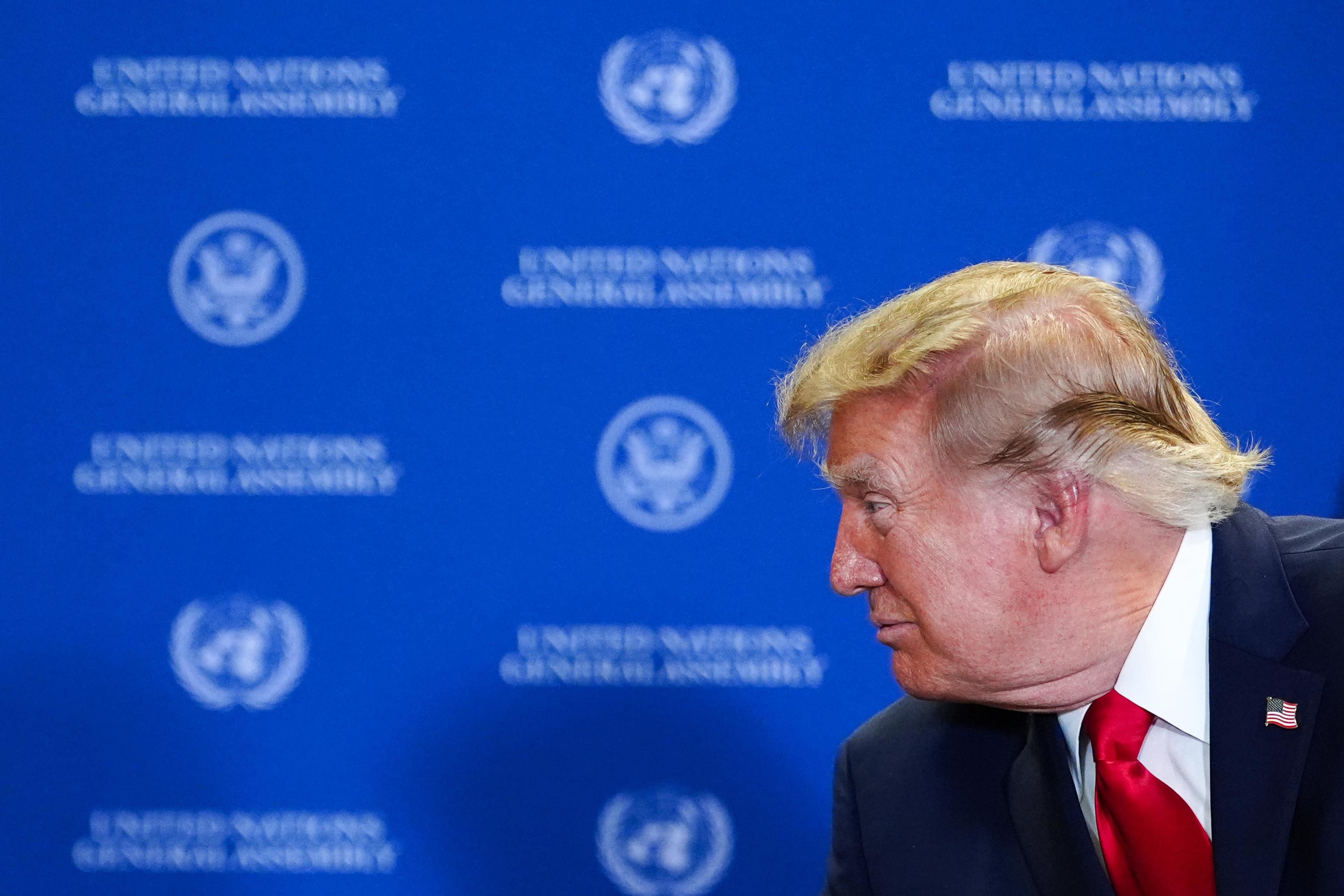
The philosopher Michel Foucault famously argued that "power is not possessed, it is exercised." It is not physical or static, but dynamic, changing, constantly subjected to tests of effort and resistance. Something that manifests in and through relationships between people, laws, institutions, and of course discourses. That is why there are few better places to study the ambiguous meaning of power than the corridors of the United Nations headquarters in New York. An institution known and ridiculed for its moral aspirations, legal authority, and international legitimacy, with little material capacity to enforce its decisions. With ambiguous power and Nations Unidas, in New York. An institution known and ridiculed for its moral aspirations, legal authority, and international legitimacy, with little material capacity to enforce its decisions. With auctoritas, without potestas, but through these corridors this week circulate the majority of the most powerful men and women on the planet, discussing war and peace, crisis and change, life and death.
It is usually difficult to choose a single theme, a clear thread, to synthesize the infinite debates and encounters of the days of the UN General Assembly. Not this year. Power, power, power. With the American Donald Trump on one side and the rest seeking their place. A struggle to redesign the international order in the era of uncertainty and Artificial Intelligence.
"The crises facing the world are essentially a matter of power: Who has it? Who is denied it? How is it used? How is it changing? Today I ask world leaders how they will act to ensure that power is governed by law or by force, by cooperation or coercion, by responsibility towards young people and future generations or indifference to their destiny. Because the defining challenges of our era are expressions of power. And they will determine whether the world sinks deeper into division and instability or moves towards cooperation, justice, and collective security (...) Military power alone does not guarantee peace. Economic power alone does not bring stability. An interconnected multipolar world can create the conditions for a more balanced and representative resolution of global problems," said the outgoing Secretary-General, Antonio Guterres, in his address to the plenary, one of his last in office.
The American's response, minutes later, has been very clear. In his speech, Trump has clearly outlined how he is using American power to address the main long-term challenges and reshape the world... for the benefit of the United States. "While others talked, I acted. While others talked about peace, I forged it. While others ignored threats, I faced them. While others talked about courage, the United States demonstrated it. While others promised strength, I used it to make the United States the most powerful country in the world," said the American. "To the victor belong the spoils," he added about the oil of Venezuela telling friends and enemies: "if necessary, we will use our incomparable military power to safeguard vital national interests of the United States."
Last year, in a one-hour speech, Trump lashed out against the institution and especially European countries, saying they were "going to hell" and asserting that the real threats did not come from Russia or China, but "from within." "The UN has enormous potential, I have always said that. It has enormous potential, but it doesn't even come close to reaching it. They just write very strong letters and then don't follow up. They are empty words, and empty words do not solve war. The only thing that solves war and wars is action," he said then, railing against policies on climate change, immigration, green agendas, and multiculturalism.
This year, the focus of his intervention has again been the vindication of his power, his style, his legacy. "I can proudly state that the United States has risen and is stronger than ever today. Our economy is the envy of the world. Our armed forces are the most powerful on the planet. Our technology is unsurpassed and we lead in virtually everything. Our energy drives the planet. The United States is thriving. Our nation is growing. Our power is expanding. Our country is better than ever, and our future is very promising," he boasted.
Trump maintains a certain respect for the idea of the United Nations, at least in terms of peacekeeping operations. But in his first 18 months in this second term in the White House, he has launched a kind of 'plan' to sideline the institution, even to replace it, imposing a completely opposite philosophy and redesigning the international architecture. It is not just that he has brutally cut his country's financial contribution, forcing thousands of layoffs and the extinction of programs (he currently owes more than 4,000 million of his commitments. Or that he has withdrawn the US from agencies. It is the eagerness to replace the diplomacy of the last 80 years with something different, starting with his Peace Board, with him at the helm as an absolute monarch.
His agenda this week is the best way to understand it. After his speech, Trump has attended the signing of the trilateral agreement with the leaders of Denmark and Greenland, a pact after more than a year of annexation threats. He will meet with historical partners such as the United Kingdom or Japan. He will meet with the Ukrainian Zelenski while dreaming of a summit between them and Putin in Miami at the end of the year. Today he will also host an event of the Americas Shield, with his ideological allies on his continent. He will meet with the Cooperation Council of the Gulf, his Arab world allies. And he will meet face to face with the Venezuelan Delcy Rodríguez. His administration does not rule out even having a bilateral meeting with the Iranian delegation present in New York, 48 hours before receiving Xi Jingpin at the White House.
Hard power, classic power, clear power. "I have a big decision to make. An agreement with Iran that allows them to rebuild and create a much larger country than ever before, or do I annihilate the Islamic Republic and do it quickly, without giving them the opportunity to kill and destroy people and countries again? Do I lead them to hell without the possibility of survival and without hope of future greatness or generations? I think we will make a deal right after the elections," he frivolously stated during his long speech as the Tehran delegates left the room. When he talked about ending a civilization six months ago, it was a major scandal. Now he repeats the idea, from the UN podium, and it is something anecdotal that does not prevent the final round of applause from many delegations.
He has also directly targeted Cuba: "Cuba will fall", without specifying how. After those words, the Cuban delegation stood up. "The communist regime is under strong pressure, the greatest it has ever known. It will fall," he declared, adding that Washington was conducting negotiations with Havana and predicting: "Freedom will come to Cuba". Earlier, he had threatened to use military force in Latin America if his country's interests are threatened. "The United States will no longer allow threats against the country to take hold anywhere in the American continent. And, if necessary, we will use our unparalleled military power to protect the national interests of the United States," he warned.
In his previous intervention, Guterres had warned that "the fault lines in our world are widening. The cracks have become canyons. Geopolitical divisions have opened up, and inequalities have intensified." Trump responded by attacking "the out-of-control institution known as the International Criminal Court," warning that he will never allow members of the US armed forces "or anyone else to be investigated or subjected to mock trials by an anti-American court without jurisdiction over us. They are a group of evil people. I call on all ICC member nations to officially resign from this dishonest institution immediately. It is equally unacceptable that, with all the real atrocities in the world, the high human rights officials of the UN spend their time criticizing the United States for protecting our children from exploitation and transgender madness, and for enforcing our immigration laws. The cowardly hypocrites of the Human Rights Council have little to say about the persecution of Christians," he railed.