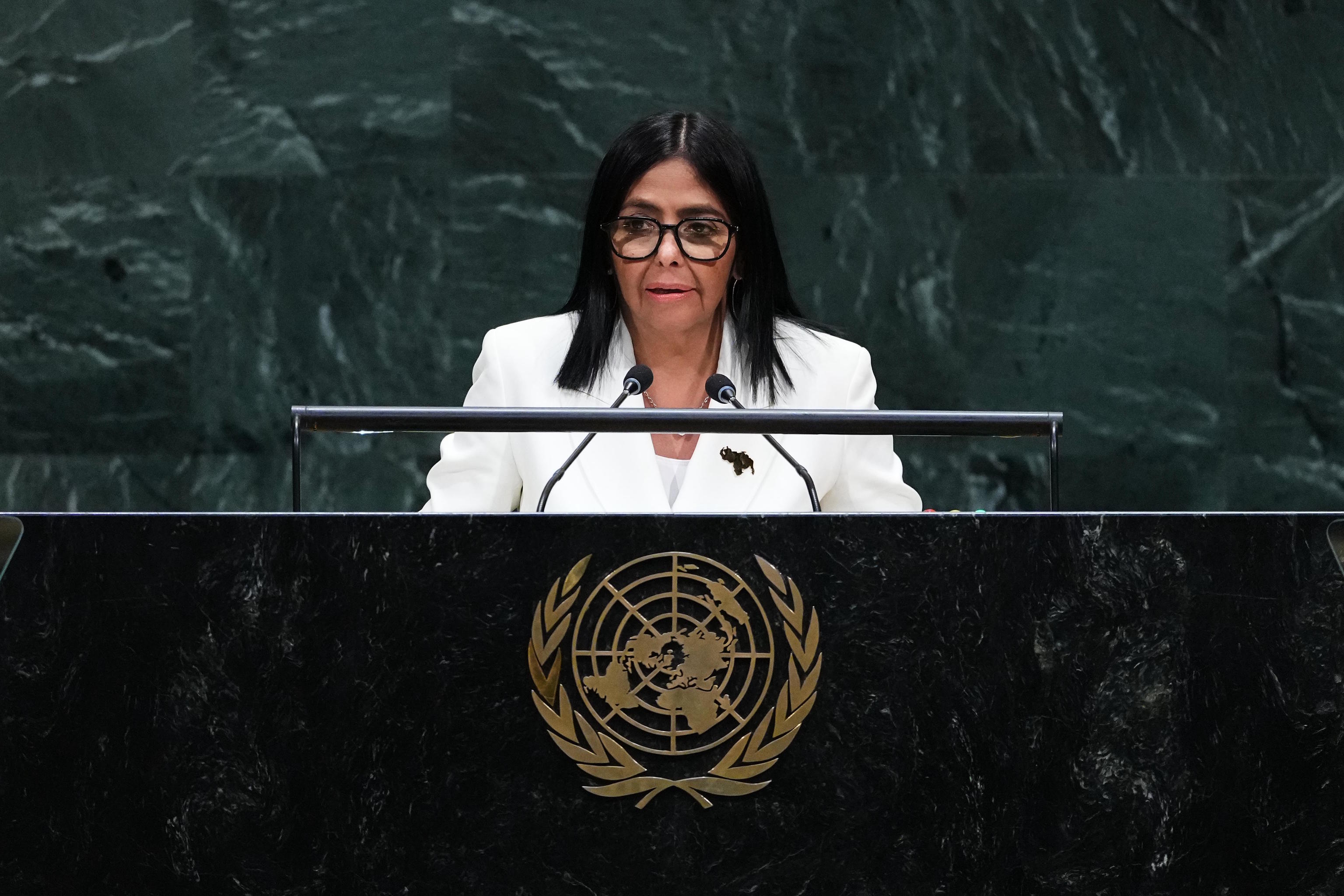
The last time Delcy Rodríguez attended the United Nations General Assembly in 2019, she began her speech by saying she came "on behalf of the only Venezuela, the dignified, brave Venezuela that does not kneel before any imperial power. With greetings from President Nicolás Maduro Moros and the Venezuelan people. A Bolivarian greeting, also in the name of the spirit of our commander Hugo Chávez Frías." In her speech, she attacked Donald Trump, defined U.S. actions as "state terrorism imposed on peoples that no longer uses bombs, but banks and insurance companies," and referred to the Treasury Department as "the Economic Pentagon, which militarizes international relations and punishes millions of innocent people to apply regime change doctrines and shamelessly steal nations' resources."
Seven years later, Delcy and post-Chavismo still control Venezuela, there is no democracy, and millions of people have left the country. But something has changed, indeed it has changed. In her speech before a half-empty Assembly this Wednesday, with no prominent figures in the room, the interim president personally thanked Donald Trump, spoke of the excellent relations with the U.S., ignored her former boss and friend, now imprisoned just minutes away in a federal prison, and aligned herself with the same "empire" she denounced for years. Rodríguez also promised that there will be elections, but in her own way, without specifying when or explaining how: "The Venezuelan people, with their ancestral wisdom, will determine the right moment".
It was undoubtedly one of the most anticipated interventions of the week. And it did not disappoint, but it did provoke indignation. "Today Venezuela is reborn, it is reborn (...) today Venezuela aspires with the United States, with its neighbors, with all the countries of our continent and the international community, to rebuild and sustain cooperative, respectful, and equal relationships. I want to thank President Donald Trump and his Government for their willingness to resume the path of diplomatic and cooperative relations with Venezuela. Today we work seriously to resolve existing differences through dialogue, but mainly to pave the way for energy relations, the promotion of security, the common fight against transnational crime, and cooperation for the economic benefit of both peoples and our continent," she stated.
However, the most important message was different. "I want to make it very clear in this General Assembly that there will be elections in Venezuela, and in that direction, we have initiated a political dialogue with opposition sectors that will lead to a process with equal conditions for all," she promised. "Venezuela will guarantee real participation conditions for all political forces in the country, but democracy is not measured by the existence of elections; democracy is measured by the quality of the competition preceding those elections. An election must be a solution, not a generator of irreconcilable conflicts," she emphasized with extraordinary cynicism after being one of those responsible for the fraud in the last elections.
The change in tone, submission, and surrender were spectacular in the speech, as well as her ability to fill her message with euphemisms, in which she did not directly mention Nicolás Maduro.
Rodríguez deliberately did not set a date for those elections. "The Venezuelan people, with their ancestral wisdom, will determine the right moment, and its institutions will be prepared to guarantee that inclusive and transparent process, a country not subject to any economic restrictions, to ensure its right to development, the rest and the spasmodic reactions from within and outside are part of the show that they no longer want to see," she added, speaking of an upcoming national convention. "The Venezuelans will be consulted to say when, where, and on what terms they want to hold the great national convention. There, the people will freely exercise their omnipotence. There, they will decree their fundamental laws, only they know their good and are masters of their fate."
Without shame, she presented herself as a figure of consensus and transition, capable of healing the broken soul of a nation, subtly and non-frontally asking the U.S. not to interfere.
"Venezuela must definitively abandon the path that allowed extremism and intolerance to prevail over democratic and peaceful coexistence" (...) "To my beloved people, I say this is not the end of a speech, it is the beginning of a commitment to the international community. I tell Venezuela is ready to walk hand in hand with those who believe in a respectful international relationship, without intrusions or prejudices. To the young people who have grown up seeing a fractured country and who have often decided to leave in search of what they did not find in our country, I tell them it is worth believing again. This is the moment to build the country that many want to return to, not just the one that many wanted to flee from," she insisted as if the departure of seven million people had been an external process, as if it were the consequence of a natural phenomenon and not of repression, insecurity, or economic devastation after almost decades of Chavismo.