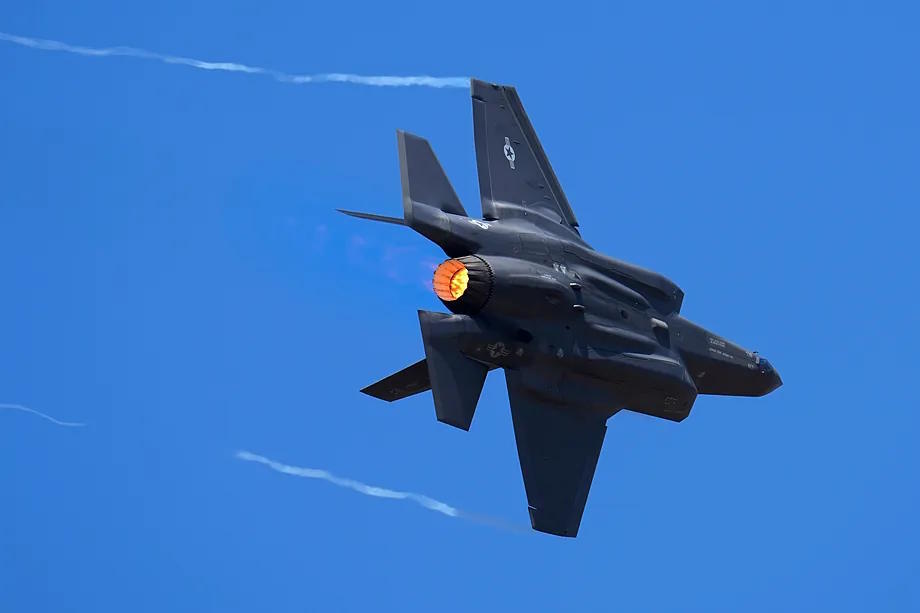
The package was supposed to cross the Pacific to return home. Inside were two parts of one of the most protected aircraft in the US arsenal: the canopy covering the cockpit of an F-35 and a door from its weapons bay. They had left Australia bound for the United States to be examined and then repaired or discarded.
But the shipment ended up in Hong Kong. Months later, Washington is still trying to recover it. According to sources familiar with the incident cited by Bloomberg, the Chinese government acquired the parts and still retains them.
The story contains an irony that is hard to hide in Washington. Donald Trump welcomed Xi Jinping at the foot of his plane at Andrews Air Force Base on Wednesday. Both are meeting at the White House while the Pentagon investigates whether technology from its aviation has fallen into the hands of its main competitor. Democratic Senator Elissa Slotkin pointed out the contradiction to Bloomberg, although she clarified that she had not received classified information about the case.
The journey begins in late May. UPS, an American courier company, was transporting components of an F-35 that had been operational in Australia. The shipment passed through South Korea and from there was directed to Hong Kong. No one has explained the stopover or the change of destination.
Politico first revealed the incident and Congress's investigations; Bloomberg later identified the transport company and stated, based on its sources, that the Chinese authorities have the parts.
The Pentagon acknowledges a problem with a shipment of "unserviceable" components and says it is working to recover them and investigate what happened. But a part taken out of service still reveals how an aircraft is manufactured. Two sources said that the canopy and the door contained radar-absorbing material.
The US Air Force has explained that the canopy incorporates a thin transparent layer of this material: the pilot can look out without offering such a visible surface to radar. The door belongs to the compartment that conceals the weapons inside the fuselage. Its shape and finish also help maintain the aircraft's discretion.
Having the parts would allow studying their composition and contrasting hypotheses about stealth design; it could also help improve sensors or future fighters. JJ Gertler, a former analyst at the Congressional Research Service, explained that a real part allows verifying what has been found out by other means.
Richard Marles, Australian Minister of Defense, stated on Tuesday that, according to his information, they were not sensitive components. Australia is reviewing what happened on its territory. In the US Congress, committees from both chambers are demanding explanations. The immediate question is where the parts have been these months; the most uncomfortable one is who could have accessed them.
The case exposes another weakness: the control of spare parts for a program spread across the world. Australia serves as a maintenance and distribution center in the Indo-Pacific; parts circulate among governments, contractors, and carriers. In 2023, the US Government Accountability Office (GAO) reported that a contractor had accounted for over a million lost, damaged, or destroyed parts since 2018, worth over $85 million.
Meanwhile, Beijing is accelerating its aeronautical development. It has already deployed the J-20, its stealth fighter. In 2025, the Chinese Navy announced that the J-35, designed for aircraft carriers, had taken off using electromagnetic catapults and landed on the Fujian aircraft carrier. These are different programs from the F-35, but they demonstrate the extent of rivalry: every detail protected by Washington is of interest to a competitor aspiring to build the world's most powerful combat aircraft.