France has already taken the first steps to protect its critical infrastructures against Russia's "hybrid warfare". Last Thursday, a day before the emergency meeting convened by Emmanuel Macron with opposition leaders, Interior Minister Laurent Núñez gathered all prefects and announced the preparation of a plan to protect the most sensitive sites of industrial and technological defense, as well as vital facilities for energy, telecommunications, transportation, and water supply.
"We are talking about a threat that is real and well-documented, a hybrid warfare led by Russia," Núñez declared this week to BFMTV, which, along with other French media, dedicated extensive coverage this Thursday to the EL MUNDO exclusive titled: "Russia's Attack on France? CIA Alert".
"Most Intelligence services of European countries, and of course French Intelligence services, have identified the characteristics of this hybrid warfare," added Núñez, citing the failed attack with drones loaded with explosives at the Leipzig airport in Germany as the most recent example. "Operators (in energy, transportation, and telecommunications) are already taking protective measures, have reinforced their patrols, and are in contact with our Intelligence services."
Núñez stated that France has not yet been overflown by Russian drones, but attributed to Moscow cyberattacks such as the disruption of postal service deliveries last Christmas or the fraudulent extraction of personal information from state databases. When asked about the possible Russian intervention in the accident of a regional train in Normandy on September 11, the Interior Minister acknowledged that "no possibility is ruled out."
The urgency with which Emmanuel Macron has wanted to address the issue of "hybrid warfare" is directly related to an Intelligence services report in August, warning about how Russia has accelerated its plans to launch attacks on European countries by 2027, with energy plants, railways, telecommunications, and water supply as "potential targets" (French authorities are indeed planning a total blackout drill in 2027 as part of the preparation for hybrid attacks).
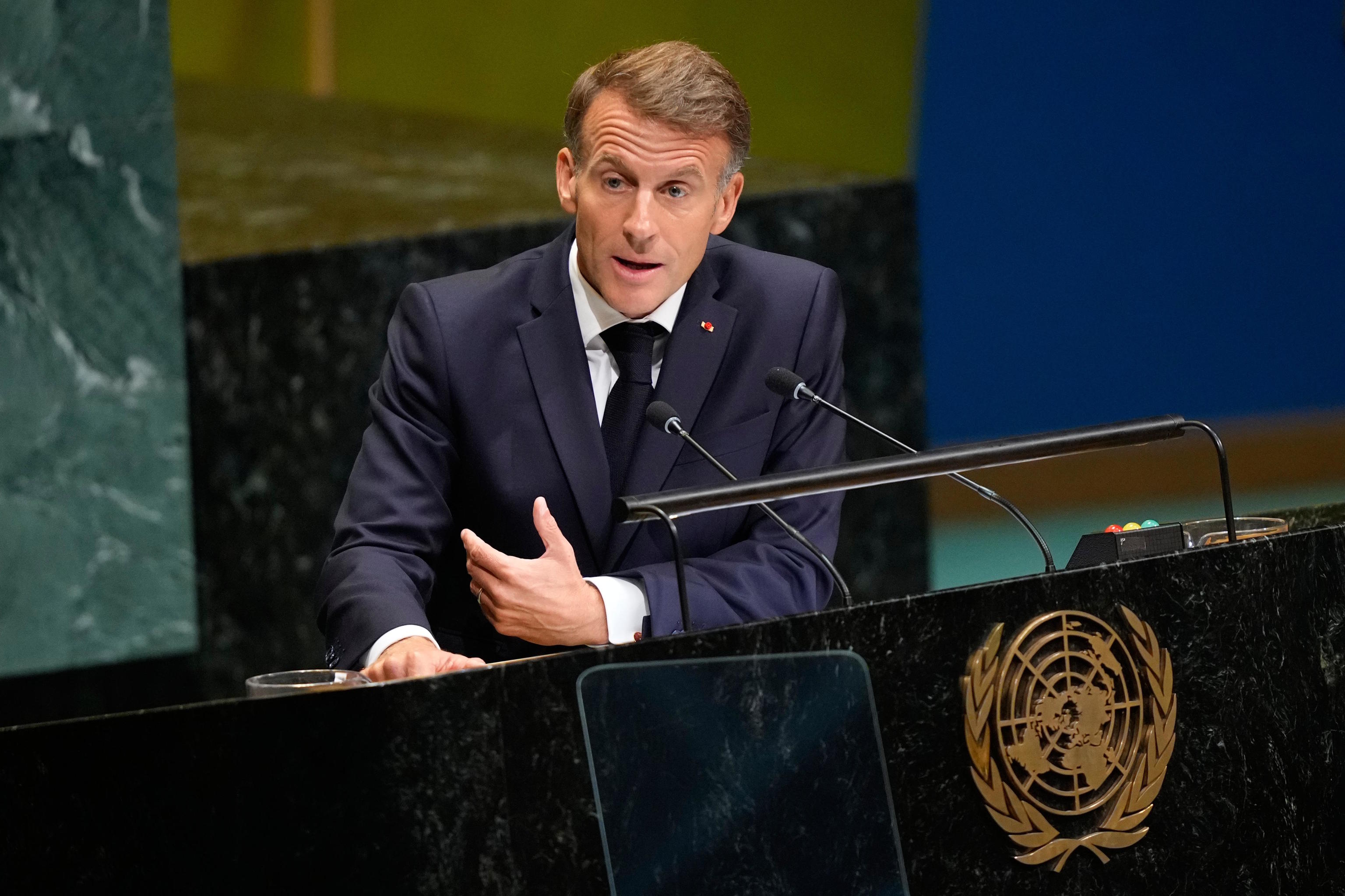
Macron, who is nearing the end of his term as the second most unpopular president of the Fifth Republic (surpassed only by François Hollande), is determined to convey that "urgency" to European leaders. In this context, his official visit to Spain next week will address the extent of the "Russian threat" to both countries. The French president is convinced that Putin's goal is to intimidate European countries and weaken their Volunteer Coalition. "But our position is clear," he emphasized in the press conference after the meeting with leaders. "Support for Ukraine is more essential than ever because it is the condition for our own security."
The leader of La France Insumisa, Jean Luc-Mélenchon, accused of being complacent with Putin in the recent past, has surprisingly reversed Macron's reasoning in the midst of the 2027 Presidential campaign: "No one seems to be concerned about why the Russian threat seems greater today than it was some time ago. Why? Perhaps we have to wonder if it has to do with the depth shots in Ukraine."
Mélenchon was criticized by most presidential candidates for establishing this unusual link between the attacks in Ukraine on Russian soil and the growing threat of Russia to other European countries: "Who can imagine that a country would let its capital be attacked and not provide any response to that situation?". Hours later, the insumiso leader was forced to remind on social media that his party condemned the invasion of Ukraine and called for Russia's withdrawal and a diplomatic solution after four years of war.
Putin's recent decision to confiscate the businesses and assets of Nestlé and three other French groups has also brought Marine Le Pen, the leader of National Rally and favorite in the polls, into the debate. Also pursued by the shadow of collusion with Moscow, Le Pen and her protégé, Jordan Bardella, distanced themselves last Saturday with a joint statement ensuring that Russia "cannot directly dictate France's policies through intimidation, threats, destabilization, or psychological pressure."
"No provocation, clandestine operation, or destabilization action will be able to push France to facilitate Russia's objectives in the war in Ukraine," Le Pen concluded in the statement with which she has distanced herself from Moscow as never before, amid growing concerns about "Russian interference" in the presidential elections (allegedly favoring far-right National Rally candidates).
In July, the French government approved a new bill to toughen penalties against the crime of "foreign interference" in the 2027 presidential and legislative elections, following constant reports of cyberattacks and disinformation campaigns in the local elections held this year. The National Assembly had already taken action with a first law in 2024 and the creation of the cyber surveillance body Viginum.
The Viginum system precisely warned in the middle of summer that former Prime Minister and centrist candidate Gabriel Attal had been a victim of a "disinformation operation" orchestrated by the pro-Russian network Matriochka (as were also candidates Edouard Philippe and Raphaël Glucksman). "For me, it is not a surprise, as we expected these destabilization maneuvers," stated Attal. "If we do nothing to protect ourselves from them, these elections can be distorted and stolen from the French," he added.
"Russia's hostile acts are multiplying, and that is why we must be realistic about the evolution of the threat," acknowledged Emmanuel Macron this Thursday in an interview on TF1 news. When asked if an attempted drone attack like the one at Leipzig airport would be possible in France, Macron did not hesitate to say, "the answer is yes."
"Russia considers Europe as the strategic depth of Ukraine," added the French president. "We have been attacked on all fronts for years. Tensions have increased in recent weeks (...) In the last few days, we have convened all prefects, and region by region, we are reinforcing the protection of civilian and military facilities."
However, Macron stated that the CIA has not relayed to French intelligence services an alert about a possible drone attack from ships stationed in the Mediterranean.
Elysée sources confirmed that European security and Russia's hybrid attacks will be on the agenda of Macron's meeting with Pedro Sánchez, although they did not provide further details.
"Russian threats are of all kinds," declared Foreign Ministry spokesperson Pascal Confavreux when asked if the possibility of an attack like the one revealed by EL MUNDO was discussed by President Macron with opposition leaders on September 18.