One side seems to rely on personal relationships, charisma, chemistry, and the president's ability to close deals. The other, true to its more distant style and confident due to its size and potential, insists that it is not so important to be great friends, but rather to be good trade partners and respectful neighbors on the global stage. The dominant superpower wants to preserve its status. The emerging superpower insists that "strategic stability," with Washington assuming that it will have to gradually retreat from China's vital areas of interest, is the only acceptable framework for the future. Both sides publicly say that "Thucydides' Trap" - Xi's words - the idea that conflict is inevitable between a declining power and one aspiring to take its place, "can be overcome." But neither seems to fully believe it.
It is well known that for Donald Trump, international relations are a zero-sum game where not everyone can benefit. If your rival, your enemy, or even your friends thrive and grow, then you are doing something wrong or they are taking advantage of your generosity. At the same time, his worldview, anchored in the Cold War era and an economic system that no longer exists, is based on the idea of spheres of influence and great personalities. He shows clear sympathy or admiration for strongmen like Vladimir Putin, Recep Tayyip Erdogan, and certainly Xi Jinping. Authoritarian, assertive, nationalist figures. Lastly, as an expert in television and public relations, he loves a spectacle capable of attracting global attention. Parties, receptions, ballrooms, grand ceilings, and golden things. A good military parade, an arch of triumph. And he has blind faith in himself to resolve any situation.
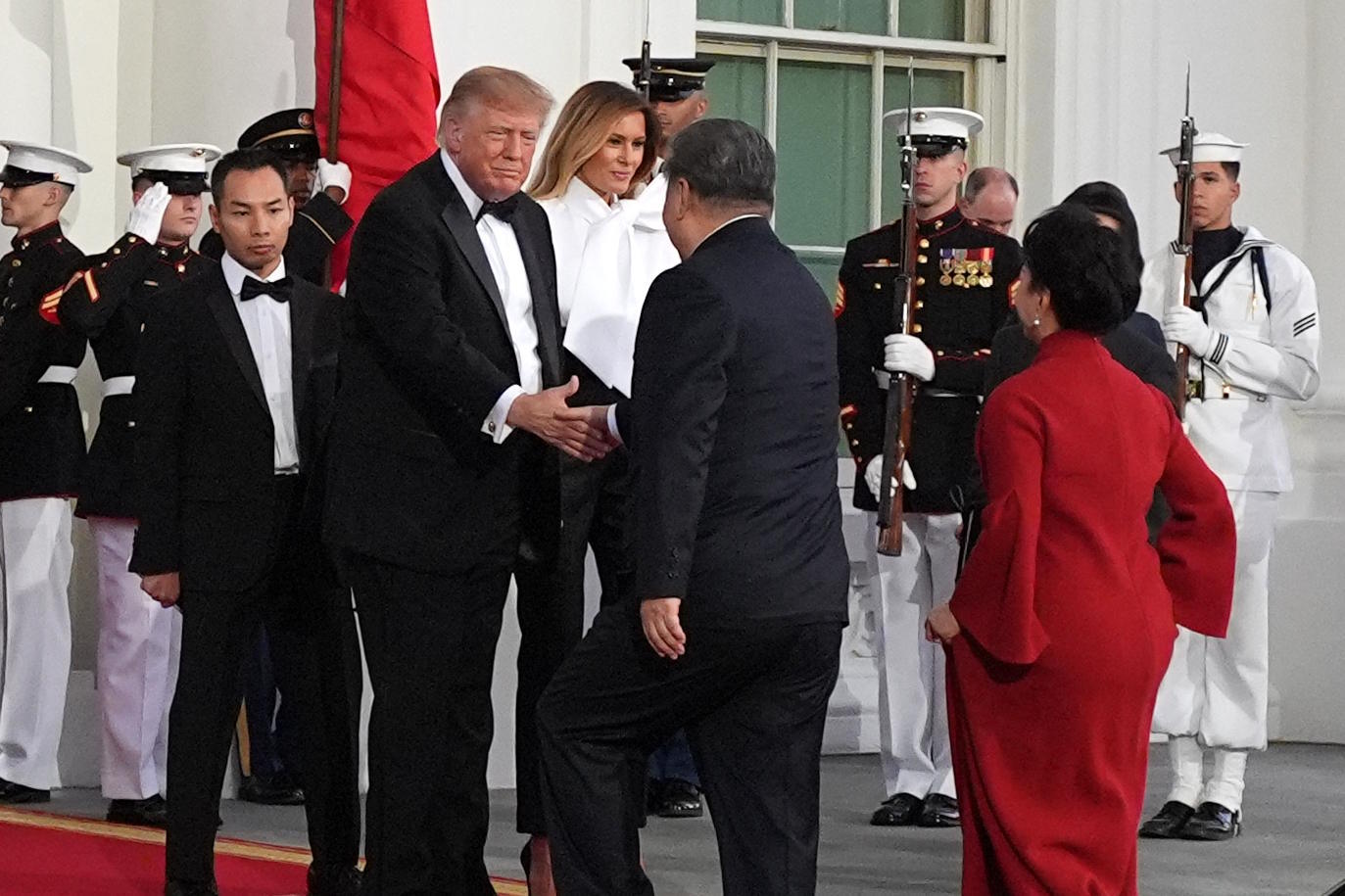
This set of factors serves to contextualize and place the official visit that the Chinese president is making this week in the United States, which began on Tuesday with a welcome at the foot of the plane and will continue in the coming hours with numerous meetings and a State dinner. A display of pomp and circumstance, with the best attire, to try to honor and dazzle Xi, returning the honors of Trump's visit to Beijing in May of this year. However, the festivities cannot hide the reality behind it. In the Chinese capital, it was clear that Xi did not share Trump's enthusiasm and that he had no intention of pretending that there is such a good relationship and personal friendship, as the White House claims. And that the many serious tensions between them, regarding Taiwan, tariffs, artificial intelligence, cyberattacks, and support for Iran and Russia, are not going to disappear. On the contrary.
Xi, the most assertive and aggressive leader of China in decades, did not yield to the Trump storm in 2025. He did not accept his rules of the game, the onslaught of threats and tariffs, the suspension of licenses or chip exports. He stood his ground, responded in kind, did not accept fighting by his rival's rules. And Trump, instead of doubling down, backed off. Beijing took note, and in Xi's speeches, including today's, there are subtle jabs. Phrases reminding that "China has four times the population of the United States." Or about "the great changes that are accelerating," a reference to what they see as the decline of the American empire.
Today marks Xi's second official visit to Washington (not the U.S.) as a leader, following the one in 2015 with Barack Obama as president. He is the first president of his country to do so. It is also the seventh time he sits alongside Trump since 2016, as they met at Mar-a-Lago and in Germany, Argentina, Japan, South Korea, and Beijing. However, a notable difference from previous meetings is that Xi arrived without business leaders in his entourage. According to Xinhua agency, heavyweights like the Foreign Minister, Wang Yi, or Cai Qi, a member of the Standing Committee and Chief of Staff of the Central Committee of the Communist Party of China, are present, but no more. "Both countries should be partners, not adversaries (...) Both parties should come closer and work together to build a stable relationship, where cooperation is the fundamental pillar, competition is kept within appropriate limits, differences are managed, and peace can be aspired to," the Chinese leader said in a statement just before leaving his country, without mentioning deep friendships.
Enthusiastic, Trump went to the airport on Tuesday to welcome Xi, something completely unusual (except in the case of a Pope, a U.S. president had not done so with a foreign leader since the 1960s), and this morning he said he saw his counterpart "strong, vibrant, and in shape, better than ever." "We have forged a truly great friendship," he said at the doors of the White House this Thursday. "President Trump and I respect each other. We have forged a good personal relationship and have stayed in touch," his counterpart toned down.
"During this visit, we will also discuss urgent issues related to security, technology, and superintelligence. The decisions we make today in these areas can promote peace and prosperity for the next decades," Trump stated. "Mr. President, during your visit to China this year, we agreed to build a constructive relationship between China and the United States based on strategic stability, which has been widely welcomed by the peoples of our two countries and the international community. I am willing to work with you to guide the bilateral relationship towards a prosperous future," replied the Asian leader. "We must cooperate sincerely; the interests of China and the United States are deeply intertwined, and there is ample room for us to work together. Cooperation between China and the United States may not solve all the world's problems, but without our cooperation, it would be difficult to solve many of them."
Despite the trade war, the rhetoric in this second term of Trump's presidency is nothing like the first. It is much more conciliatory, less aggressive. There are no longer accusations like the origin of Covid and constant insults. He no longer talks all the time about electoral interference, monetary abuse. Trump is determined to try to create a personal bond with his counterpart, someone not exactly known for his kindness. And this shift has been conveyed to the general population.
A survey by the Chicago Council, conducted between July 10 and 21 of this year, indicates that "the American perception of China has improved since the lows of 2024." Despite the trade war, Beijing's increased assertiveness, and pressure on Taiwan and its neighbors, "Americans today have a more favorable view of China, are less likely to see it as a threat, and more likely to favor cooperation over containment," although at lower levels than in the 2010s. This shift "towards cooperation and dialogue aligns with the general direction Trump has taken since his meeting with Xi Jinping in Beijing in May 2026," the report says.
However, most Republicans in the MAGA movement "continue to favor limiting China's power growth instead of cooperation." Laura Loomer, a friend and ally of the president, conservative influencer, and online queen of conspiracies, wrote last night, in one of the dozens of tweets she posted, that it was "truly shameful that American men and women in uniform were asked to formally receive Xi Jinping, the communist dictator of China while the Republican Party pushes messages about the need to fight communists and says we must never forget what communism has done. I guess everyone forgot about the China Virus and China's interference in the 2020 elections. Truly incredible," she denounced.
The survey shows surprising and disturbing data for international relations, at least as they have functioned for decades. Four out of ten Americans consider China's territorial ambitions to be a critical threat to the United States, a significant drop from the 52% who thought so in 2022. Furthermore, in the event of a Chinese invasion of Taiwan, only 38% of Americans support the use of U.S. troops, when five years ago it was also more than half.
For different reasons, the majority of Americans (57%) believe that the United States "should engage in friendly cooperation with China", compared to 40% who are in favor of "actively limiting Chinese power growth." MAGA supporters (63%) are in favor of limiting Chinese power growth, while non-MAGA Republicans (57%) prefer a cooperative and dialogue approach. On the other side of the aisle, Democrats across the ideological spectrum "support cooperation and dialogue with China." More so liberals (72%) than moderates or conservatives (64%).