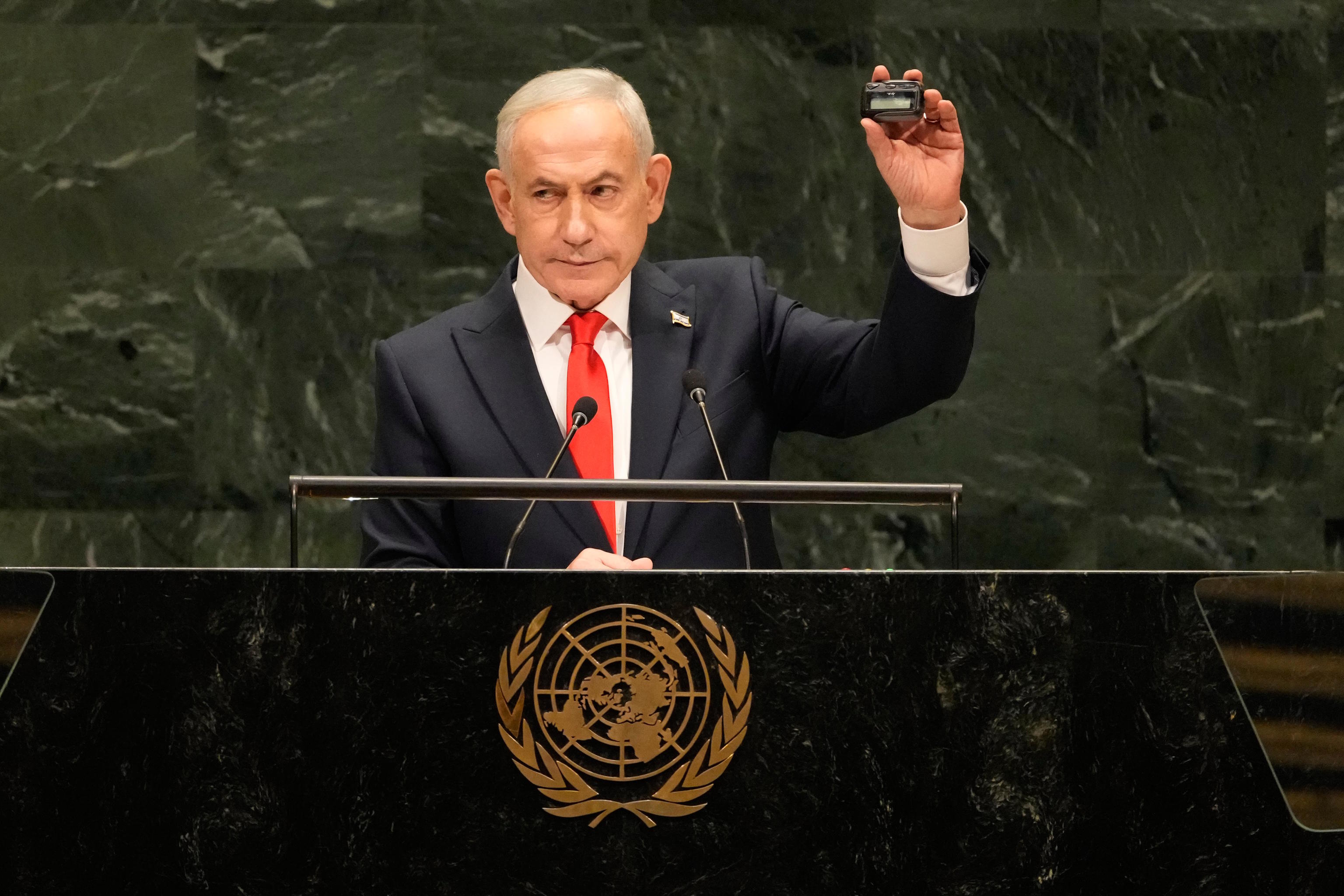
For some time now, the UN's big week, with its General Assembly and over 140 heads of state and government, has its traditions. The President of the United States is among the first to speak, but always after Brazil, due to an organization's early heritage when no one wanted to break the ice. For similar reasons, the Russian delegate speaks on Saturday, small countries use and abuse their time to try to attract attention. And no matter what, the Israeli Prime Minister ends up being the most controversial and protested. This 2026 has been no different.
Dozens and dozens of delegates from around the world stood up and left the room this noon when Benjamin Netanyahu took the stage. Amid chants and applause from the Israeli delegation, and boos from his critics, the Prime Minister, in his element, said: "If there are still moral cowards who have not left this room, please do so now". He then went on to antagonize with France, United Kingdom, Qatar, or Turkey, in a speech more focused on national issues than international, seeking to project himself as a protector of the country, defending the strength and resilience of his nation. "The anti-Semites want to terrorize us, but I have news for them: the days when Jews were defenseless victims led to the slaughter are over. Now we have a state, an army, people ready and willing to defend themselves. Today I have a message for Jews around the world: hold your head up high, be proud, have confidence, do not be intimidated, stand up (...) Israel has never been stronger. We are no longer afraid, but I will tell you who is: the tyrants of Tehran," he said.
The Prime Minister spoke hours after the Palestinian Abu Mazen, once again remotely due to the U.S. visa veto, repeatedly advocated for a "two-state solution" and international mobilization to make it a reality. Mazen has denounced that violence in the West Bank is progressing towards "racial discrimination, ethnic cleansing, and state terrorism". "Israeli policy even threatens the life and existence" of Palestinians, he insisted. "It is a malignant colonial plan whose objective is to make life impossible for Palestinians, to force them to leave their land".
Netanyahu returned to the podium at one of the most delicate moments not only of his political career but also of his country's relationship with the organization. Amid accusations of genocide and war crimes for the Gaza offensive and violence in the West Bank, as well as a pending arrest warrant against him from the International Criminal Court. But added to this is the electoral context, just a month before the elections in Israel, and with a murky judicial landscape.
If the main topic in 2025 was peace in Gaza and the two-state solution, the 2026 General Assembly has arrived with the United Kingdom, France, and Canada announcing sanctions on Israeli settlements in the West Bank. Israeli diplomats left the room when Recep Tayyip Erdogan took the floor on Tuesday. King Abdullah of Jordan called for sanctions, asset freezes, embargoes, and diplomatic isolation for Israel. Ministers like the British Ed Miliband already speak of ethnic cleansing against Palestinian communities. And French President Emmanuel Macron, frustrated, was equally forceful. "Look at what is happening in Cisjordania, where violations occur daily. In the name of what? Hamas has never attacked in Cisjordania." This makes it increasingly impossible to achieve respect for the legitimate right of the Palestinian people to exist." An intervention that Bibi described as "absurd and grotesque".
In his speech, Netanyahu denied that there is an ongoing genocide and assured that the daily images of violence and abuse in the West Bank, with the army's complicity, are just minor actions, "by 150 juvenile delinquents". He also referred to the Israeli army as "the most moral army on the planet" and labeled Erdogan as a "tyrant" who "wants to rule over Jerusalem", accusing Qatar of "indoctrinating and brainwashing thousands of young people to hate Israel and the United States". He mocked the "hypocrisy" of the "inventors of colonialism" and called Donald Trump the best ally of the Jewish people.
To the day's cocktail of controversy, protests must also be added. As in previous years, thousands of people have taken to the streets to denounce his presence. A mix of critical Israelis residing in the United States, anti-Zionist Jewish groups, young Arabs and Muslims, pro-Palestinians of all tendencies. "Less than a month from the third anniversary of October 7 and the Israeli elections, the Hamas financier, the instigator of October 7, the accused in multiple criminal trials and war criminal sought by the ICC, Benjamin Netanyahu, comes to New York," wrote the group Israelis for Peace on their Instagram account. "He is not welcome here and should only be in jail. Join us to let him know."
Although the main protest was scheduled for mid-afternoon in the middle of Manhattan, before he took the floor, dozens of people had already been arrested for blocking streets and bridges near the United Nations headquarters. The mentioned groups but also left-wing parties and associations and New Yorkers in general, reacting, among other things, to Israeli government attacks on the city's mayor. Netanyahu announced earlier this week that he would come to "tell the truths about Zohran Mamdani", whom he accuses of supporting Hamas and "inciting violence against New York Jews". The Muslim mayor called the Prime Minister a "war criminal" and "architect of genocide" and repeated one of his campaign mantras: that the International Criminal Court's arrest warrant against Netanyahu must be enforced. The Israeli diplomacy's response is that the socialist mayor should be the one in prison. "Mr. Mamdani, since you were elected mayor of this city, many Jews no longer feel safe in New York. You tried to prevent me from coming here, you tried to silence me, you cannot silence me, you cannot silence the truth."
A Pew Research summer survey indicates that 62% of American citizens have a negative opinion of the Netanyahu government. According to another poll by the Mellman Group, conducted for the Jewish Electorate Institute, 56% of Jewish voters in the United States have an unfavorable opinion of Netanyahu and 60% would like Netanyahu to be replaced in the elections, while only 16% would support his reelection.
Netanyahu's trip is especially short and with a much lower-profile agenda than usual. The Prime Minister, the international leader who has visited the White House the most since Trump returned, will not be received by the U.S. government. It will be a quick stop in New York, with very few things, and he will have bilateral meetings with the presidents of Argentina, Bolivia, Paraguay, Panama, and Ethiopia, as well as the vice president of Colombia and the prime ministers of Greece, Slovenia, and Papua New Guinea.