The toast was with a Schramsberg Blanc de Noirs, a Californian sparkling wine loaded with diplomatic memory. It was not an innocent choice. It was the same wine uncorked in Beijing in 1972 during the so-called "Toast for Peace", when Richard Nixon and Zhou Enlai sealed one of the boldest geopolitical maneuvers of the 20th century: the thaw between the United States and Communist China. That glass opened a crack in the Cold War, allowed Washington to balance Moscow, and offered Beijing a gateway to the world that would eventually transform a impoverished country into the second most powerful on the planet.
Half a century later, Donald Trump and Xi Jinping raised their glasses again in Washington, but this time the symbol spoke less of openness than of an uncomfortable coexistence: two giants who can no longer separate, even though they tolerate each other less and less.
In his State dinner speech, Trump wanted to present the summit as the meeting between two opposing models destined to understand each other. He admitted that he and Xi represent different political systems but emphasized that "the ties between our peoples endure" and assured that "both countries have never gotten along better". He added that "together we can continue building a relationship that promotes prosperity and security for future generations," in an attempt to wrap the strategic rivalry between Washington and Beijing in the friendly language of cooperation.
As a symbolic gesture, Trump presented Xi Jinping with a sculpture of a bald eagle, the national emblem of the US. He explained that the piece had been created by an American artist and designed by Melania Trump and himself. The bird, he said, represents "the free and bold spirit of the US". He then expressed his wish for the sculpture to find a place in Beijing, a patriotic offering wrapped in diplomatic courtesy.
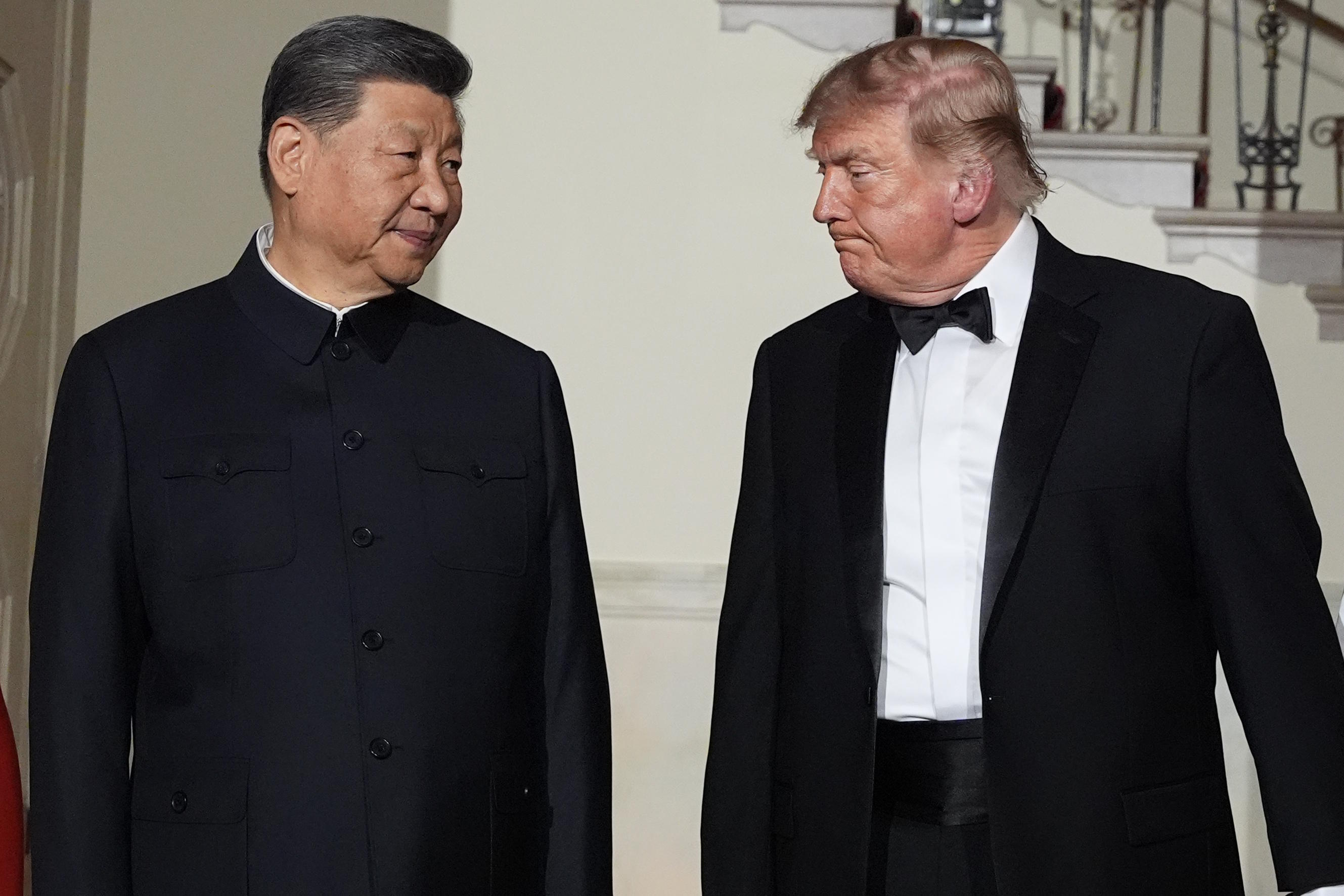
The White House dressed the night with a carefully calculated setting to please the Chinese guest. The room was bathed in red, the color of fortune and power in China: red tablecloths, abundant flowers, dahlias, and ranunculus arranged as if diplomacy could also be ordered by layers of petals. Xi arrived in a Zhongshan black suit, the closed-collar jacket known in the West as a "Mao suit," a garment that evokes revolutionary austerity and a stern idea of national authority. By his side, First Lady Peng Liyuan wore a long red tunic.
Arrival at the State dinner.EFE
In his speech during the dinner, Xi responded by enveloping the summit in the long memory of the bilateral relationship. He recalled the "ping-pong diplomacy," the sports exchange that over half a century ago broke the ice between Washington and Beijing and set in motion the historic process of normalizing relations. He also emphasized that in less than half a year, he and Trump had met twice and exchanged State visits, something he presented as a milestone in the relationship between the two powers.
The Chinese leader stated that both had maintained "sincere and deep exchanges" and reached "a common understanding on many issues." According to Xi, this consensus added a "new component" to the constructive relationship of "strategic stability" between China and the US and offered a new orientation for the bilateral bond.
Xi once again referred to another shared memory: the cooperation between Chinese and Americans against Japan during World War II. "A friendship like that, forged in blood and fire, will undoubtedly endure through the generations," he stated.
The dinner menu ended with creamy vanilla ice cream, sour cherry jam on walnut frangipane, and ice cream made with honey harvested at the White House. But the guest list spoke as much as the menu. At the tables were Elon Musk from SpaceX; Jensen Huang from Nvidia; Sam Altman from OpenAI; Tim Cook from Apple; Sundar Pichai from Google; Satya Nadella from Microsoft; Jamie Dimon from JPMorgan Chase; Jane Fraser from Citigroup; James Taiclet from Lockheed Martin, and Albert Bourla from Pfizer. The American business elite dined with the leader of the country that Washington defines as a systemic rival, essential market, critical factory, and technological threat.
Trump lavished Xi with all available pomp throughout the day. There was a formal welcome ceremony, anthems, nearly half a thousand military personnel in the South Garden, and a flyover of a B-2 Spirit bomber escorted by four F-22 Raptors. The visual message was twofold: respect for the guest and a display of strength.
Trump spoke of peace, prosperity, and decisions capable of shaping "decades and decades". Xi responded with his preferred formula for major meetings: he called for steering "the great ship" of the bilateral relationship on a stable course, invoked friendship between peoples, and adapted his host's slogan to the Chinese narrative. The "great rejuvenation of the Chinese nation" and "making America great again," he said, could go hand in hand.
However, the visit left more ceremony than concrete progress. Washington secured an extension of the trade truce, but it was limited. Treasury Secretary Scott Bessent explained that both sides agreed to extend by two months the understanding that had halted the tariff war and was set to expire in November. The formula provides breathing room, not a solution.
Beijing spoke of a "new joint agreement" on trade and presented it as good news for companies, citizens, and the global economy, but without offering too many details. Trump hinted at progress on a mechanism to equivalently reduce tariffs on non-strategic products. In practice, the summit served to postpone another crisis and keep channels open in a year where both leaders could meet again at the APEC meetings in Shenzhen and the G-20 in Miami.
Taiwan once again occupied its usual place in these meetings: the invisible centerpiece of the table. According to Chinese state media, Xi asked Trump to "adhere to the correct position of opposing Taiwan's independence." The wording is significant. Washington has maintained for decades that it does not support Taiwan's independence, a carefully ambiguous formula that preserves the status quo without granting Beijing the desired phrase. "Opposing" independence would be a more assertive step, and for now, there are no signs that the Trump Administration will officially modify that language.
The Chinese president also brought up the "Thucydides Trap", the thesis that rivalry between an emerging power and an established one tends to lead to war. Xi stated that this fate can be avoided, but the mere mention reminded of the shadow hanging over the bilateral relationship: the risk that a crisis in Taiwan, the South China Sea, or the technological space could escalate into a military clash between the world's two largest powers. That's why he called for regular military dialogues and crisis prevention mechanisms.
AI "always under human control"
Artificial intelligence provided another contrast. Trump has argued that AI should be called "superintelligence" and has been in favor of not imposing new restrictions, trusting in the oversight of the Department of Justice. He even claimed that China shared that view.
Xi, on the other hand, used a more regulatory language. As leading powers in AI, he said, China and the US have "the capacity and responsibility" to develop and manage that technology for the common good, keeping it "always under human control." Beijing seeks to present itself as a guarantor of international AI governance while building one of the most sophisticated algorithmic control systems on the planet.
The editorial published this Friday by Global Times, a nationalist organ of the Chinese media ecosystem, encapsulated the narrative that Beijing wants to project. The visit, the newspaper argued, provides "confidence" to build a strategic and constructive relationship based on stability. The text insisted that China and the US should be "partners, not rivals"; that competition should be kept "within reasonable limits"; and that without cooperation between both powers, it will be difficult to solve issues such as economic recovery, regional conflicts, AI governance, cyberspace, or outer space.
The international press was much less solemn. The shared diagnosis of many analyses was that the summit lowered the temperature without altering the structure of the conflict. Trump achieved the image of a statesman capable of receiving the Chinese leader in Washington amidst military honors and tech entrepreneurs. Xi obtained something perhaps more valuable for Beijing: a scene of equality in the US capital, the image of a de facto G-2 in which China no longer appears as an aspirant but as an inevitable interlocutor.
However, the underlying issues remain intact: tariffs, controls on chip exports, military pressure on Taiwan, technological warfare, and strategic distrust.
The detail of the Schramsberg thus enclosed an irony. In 1972, Nixon and Zhou toasted to an opening that changed the world. In 2026, Trump and Xi toasted to prevent that world from ending up divided. Back then, the US needed China to balance the Soviet Union, and China needed the US to break out of isolation. Now, they both need each other to prevent the global economy from derailing, but they see each other as adversaries destined to compete in every chip and algorithm.