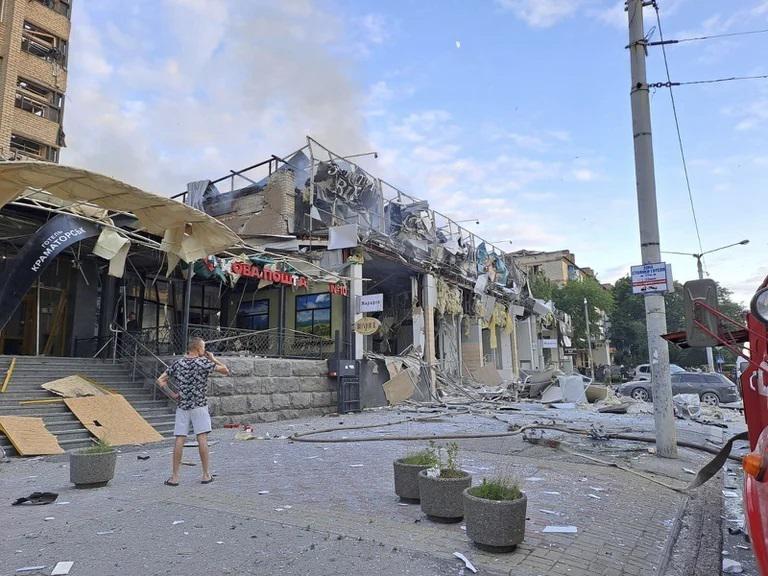
Yaroslav Leuchenko used to be a pheasant hunter. Now he hunts drones. The patrols under his command deployed in the corners of Kramatorsk or protecting municipal workers repairing the damage from Russian bombings do the same.
The number two of the local police special forces has just responded to a fire caused hours ago by another assault from their adversaries.
A nine-story building in the northern district of Damansky. Flames violently emerge from several apartments as two fire trucks try to combat their progression. Thick smoke rises to the sky.
The large residential blocks in Damansky have become one of the favorite targets of Russian unmanned aerial vehicles (UAVs). It is not uncommon to come across these structures blackened by past fires. Or with ruins of crushed dwellings like those next to the current fire.
The work of extinguishing the flames has taken on an almost dystopian dynamic. They are seen equipped with bulletproof vests and helmets. One of them remains with a drone detector scanning the sky. Leuchenko's police officers keep watch around.
It is not an imaginary danger. At 11:20, the group suddenly stops their work amid shouts of "FPV, FPV!" (a drone model). Everyone present disperses in a hurry. In different directions. They trust fate. The Russian pilot can only choose one victim.
In this case, Leuchenko's officers aim their weapons and fire bursts at the approaching drone. The flight ends with a spectacular explosion in the sky.
The routine is repeated several times.
"Cabs, Cabs, to the shelter, to the shelter!"
Sometimes they have to run for cover from the UAVs and sometimes from the arrival of those chilling bombs weighing over 250 kilos, whose thunder - even if they explode a few kilometers away - resonates throughout the area.
"The Russians have attacked firefighters more than a dozen times in the last few months. That's why we have to protect them," explains Yaroslav.
It is not uncommon for conversations to be cut short. "More drones are coming!" shouts another officer as his colleagues kneel down. More shots.
One of the UAVs got stuck on the roof of the building. Its explosive ended up embedded in the community kindergarten garden. Yaroslav picks up the remains of another flying device that has just fallen on the street. "They are everywhere," he comments.
This is the second similar incident that Yaroslav has responded to in just over an hour. The previous one, another tower block hit by a UAV, forced the evacuation of the last seven residents. They all sit on a park bench watching the scene.
The incident occurred the previous day, at night, but the firefighters no longer respond to these emergencies when daylight disappears. The residents say they slept on the street.
"The fire started at 5:00 in the afternoon. The firefighters started working but when they were warned of a new attack, they left and have not returned until morning. We don't know what to do or where to go," says Irina Ivanchenko, 56 years old.
Inside, public employees fight against the blaze that continues to devour several floors. "We can't go up any further, the heat is unbearable!" shouts one of the firefighters.
"The Russians are using terrorist tactics. They attack civilian residential buildings to generate panic," Leuchenko recounts.
The drone hunts by the Kramatorsk police are part of the surreal environment that has settled in what serves as the "capital" of Donbass controlled by Ukraine, which Moscow has been besieging since the summer with a massive assault of drones, rockets, and bombs.
The battle that Moscow intends to be the final one for Donbass officially began on August 21, when Kyiv declared the two main urban centers of the so-called "Donbass Fortress" as "active hostility zones."
According to a Kremlin source cited by Reuters, Russian President Vladimir Putin will not accept any kind of agreement or ceasefire until his army captures all of Donetsk. Currently, they occupy 80% of the province.
According to Ukrainian General Andriy Biletsky, one of the most well-known military figures in the local army, Putin has demanded that his troops take control of the entire province by early 2027.
"It's an unrealistic deadline," stated the head of the Ukrainian Third Army Corps.
The city, a battlefield
The omnipresent presence of drones has turned movements through this city into a kind of roulette, where vehicles and pedestrians must take cover every time they hear the dreaded buzz of these devices.
Andriyi Quola, a 46-year-old Marine, doesn't even put down his anti-drone rifle while enjoying a coffee in one of the increasingly scarce businesses still open in town.
"We just shot down a Shahid (another Russian UAV) on the hill. Be careful, the FPVs are very active today," he warned before continuing on his way.
On September 5, Russian aviation attempted to destroy the main bridge connecting the two halves of the town to accentuate its gradual isolation. The structure was damaged but remains open to traffic.
The presence of burned cars in the town center is a reminder of the Jersón model that was implemented here several months ago. Anything that moves is a target for Russian devices.
Another team of police officers watches over a water company's work in a grove. The drilling machine remains covered by anti-drone nets.
Feder, a 46-year-old agent, clarifies that in the three hours they have been there, they have had to open fire on another trio of UAVs. In reality, four, because his words are interrupted when one of his companions fires his machine gun at the approaching flying device.
"The Russians are acting crazy this morning," notes the security forces member.
Yaroslav Leuchenko estimates that his forces usually shoot down about 30 UAVs each day, but adds: "The army snipers stationed before Kramatorsk destroy about 500 before they reach here."
Kramatorsk and Sloviansk hold a special symbolism for Ukraine. They were captured by pro-Russian forces in the spring of 2014 - when Moscow initiated the conflict - and later liberated in July of the same year.
War and Robots
War has returned to these cities, but it is not the same war. It is something completely different. The landscape of these urban centers is more reminiscent of Mad Max: nets covering the avenues, vehicles protected by bars and spikes, UAVs soaring in the sky, and dozens of robots, roaming the routes heading towards the confrontation zone.
Now, most of the supplies received by the soldiers stationed in the so-called "Death Zone" - a variable-width space - are sent with these unmanned ground vehicles (UGVs). Resupplying with trucks or SUVs is history. "It would be suicidal," indicates Oleg - nicknamed Dream - the leader of a unit in the 93rd Mechanized Brigade.
His group is preparing to send three of these UGVs to the front. They are loaded with drone batteries, ammunition, food, and water.
This new form of warfare involves unconventional know-how, such as the proper way to load cargo onto the robots. Dream—a 26-year-old former rock band vocalist—explains to his subordinates that water bottles must be placed at the front. "FPVs usually attack from this angle, and the water helps put out the fire," he notes, pointing to the front of the small transport unit.
The uniformed men load the robots onto a van and a trailer. They are to escort them to a nearby route—still far from the combat zone, yet already within range of enemy drones. For this reason, a soldier armed with a shotgun takes up a position at the rear, while Dream sticks his machine gun out the window.
"If a drone shows up, we all jump out of the vehicle and run in opposite directions—okay?" he explains before setting off.
After a tense drive—passing the blackened wreckage of cars that failed to evade UAV surveillance—the team brakes in the middle of a nearly deserted road. The four men step out of the off-road vehicle with rifles at the ready, eyes constantly scanning the sky.
"Quick, quick!"
The goal is to spend as little time as possible at the site. Just a few months ago, a member of their unit was killed during a similar operation; his vehicle was struck by a UAV.
Unloading the UGVs takes only a few minutes. Dream and his men do not operate them; they simply position them at the starting point. The actual pilots are stationed several kilometers away at a different location.
It is an underground facility—nondescript from the outside, yet housing half a dozen pilots seated before modern plasma screens. Yevgeny is in charge of the operation. The group leader monitors the three robots' journey while watching a screen that alerts him to threats along the route. Small icons appear on the display, identifying the type of approaching enemy drone: FPV, Molniya, or "unknown."
"These missions usually last between three and eight hours. The robots have three gears. In third gear, they can reach a top speed of 18 km/h, but we usually drive in first," explains the commander of the UGV pilot group.
The robots' cameras show them traveling along roads littered with the wrecked hulls of vehicles—including many UGVs. "The robots rarely last more than half a dozen missions. They don't survive longer than a week," notes Yevgeny.
It is like watching a video game, but real. Cameras and microphones allow the team to see and hear the war from a distance; gunfire and explosions can be perceived. One of the UGVs passes a burning car. "It was just hit; it didn't look like that before," one of the soldiers remarks.
Another robot crosses paths with a pack of dogs that begin to bark, unsettled by the movement of the mechanical device.
One of the "drivers" is Marina, a 45-year-old Ukrainian woman who hasn't neglected her grooming; she wears her hair in a bun and operates the controls with red-painted fingernails.
Suddenly, Yevgeny urges her to stop. "Stop, stop!" Two FPV drones appear on the screen, very close to their path. "We're stopping the robot. It's like playing dead to throw the killer off the scent," the group leader explains. The triple mission of Yevgeny and his team is to supply other units, but in the Donbas, robots are already fighting with machine guns or acting as mobile bombs. The technicians under the command of Andriy—known as "The Magician" because he made his living as a sleight-of-hand artist before 2022—are capable of turning these structures into kamikaze machines.
"We strap two of these 'cabbages'—the local slang for artillery shells—onto them and make a Russian salad," remarks Denice, an engineer like Andriy, with a touch of macabre irony.
The massive use of UAVs and UGVs has upended military strategy, making lightning offensives by tanks and infantry impossible.
For this reason, experts doubt that Moscow's troops can meet the new deadline set by Putin.
Far from the end
The Institute for the Study of War has noted that the Russian leader has set no fewer than 15 deadlines for its capture since February 2022. "In practice, Russia is not achieving its battlefield objective of seizing the rest of Donetsk by the end of 2026," the think tank's analysis stated on the 6th.
"At their current rate of advance, Russian forces will not take the rest of the region until 2032—if they take it at all," the text added.
The commander of the 93rd Mechanized Brigade, Lieutenant Colonel Shamil Krutkov, agrees with this assessment. In his view, "we are still a long way from the final battle" for control of the Donbas. "The situation in Kramatorsk has worsened, but the first fiber-optic drone appeared here eight months ago."
"Back then, everyone said this town would be paralyzed within three months, yet it's still alive," he asserts.
"The same thing happened in Dobropillia and Kostiantynivka (two towns near Kramatorsk). The Russians entered them and were driven out. Now, about 150 Russians remain in Kostiantynivka, but Ukraine controls the city," he notes.
Krutkov believes the main purpose of the repeated Russian shelling of Kramatorsk and Sloviansk is "to instill fear in the population. They are certainly succeeding at that—many people are leaving—but it makes no military sense."
The young military commander—he is only 28—speaks from a room that houses a photographic exhibition on the unit's long history. The 93rd Mechanized Brigade was established shortly after the country gained independence. Soldiers from the unit served as peacekeepers in conflicts such as those in the former Yugoslavia, Iraq, Sierra Leone, Liberia, and Lebanon. Later, the war caught up with them in their own country.
Since 2014, troops from the 93rd have fought in battles as symbolic as the one for Donetsk Airport. Photos in the small museum commemorate their presence in the bloodiest clashes of the war's new phase—which began with Russia's full-scale invasion in 2022—including Bakhmut, Pokrovsk, and Soledar.
"The original museum was partially destroyed by shelling recently." "This is what we've salvaged," explains Dimitro—a graphic artist, former hippie, and now a soldier—who creates installations using war paraphernalia for this unusual space.
The museum's photographs focus on the years 2022, 2023, and 2024. They are snapshots of a war that is no longer seen: tanks firing, a soldier using a drum-fed machine gun, an anti-tank RPG. Dimitro's latest work, however, does not ignore the new reality. It is a creation made from an amalgamation of drone shells. "It's not finished," he says.
Shamil Krutkov explains that the difference between the 2014 war and the current one is like the gap between two different universes. Dimitro, who fought during those years, is more explicit: "Back then, you could be in a trench, firing at Russians hidden in another trench just 25 meters away. That is unimaginable now."
The Brigade's top military commander agrees that "drones and robots are replacing soldiers. Eighty percent of our logistical missions are already carried out by robots. Once a week, we also launch an assault using robots."
"Europe doesn't understand this change," he concludes.
Leuchenko's police officers are also guarding the large flag flying in Jubilee Park. They are almost the only ones present. It is drone territory.
The 80-meter flagpole supports a banner that is no less massive. Since spring, Russian drones have attacked it on several occasions. You can see the black holes in the metal pole.
The officer proudly points to the banner, which he says they've had to replace more than half a dozen times, torn by attacks from the UAVs.
"The Ukrainian flag is to the Russians what a cape is to a bull. But the flag of Kramatorsk is still flying," he adds.