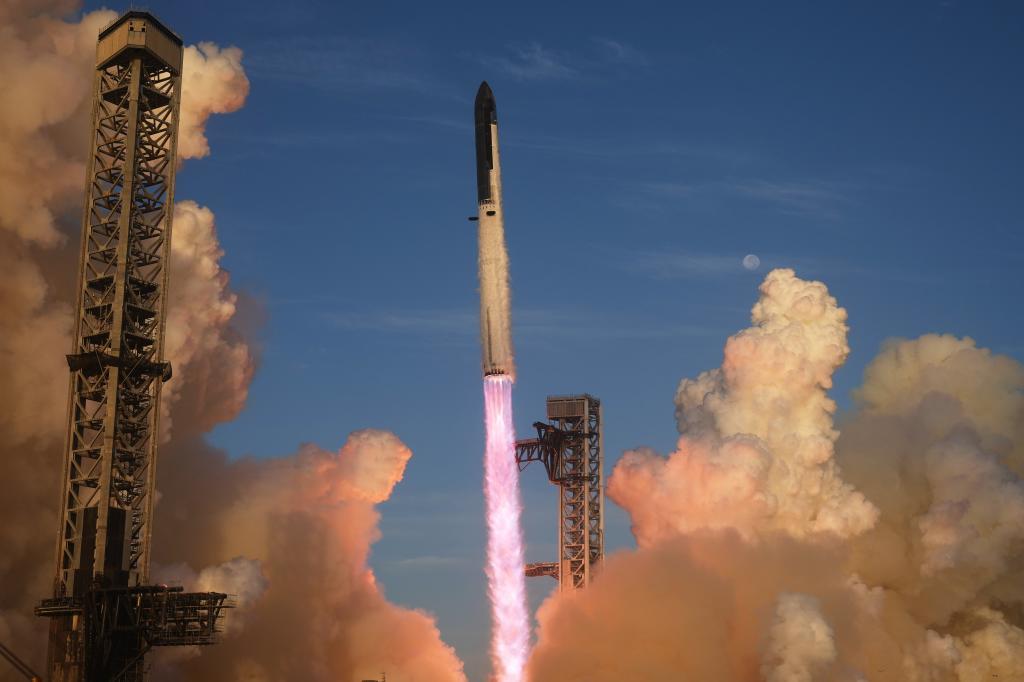
NASA's mission to return to the Moon is now a step closer: SpaceX's Starship megarocket, developed by Elon Musk's company, has finally reached Earth's orbit and positioned itself about 300 kilometers above, a crucial step for the most powerful spacecraft to become operational and capable of carrying payloads into space. However, the ambitious test - the fourteenth one - lasted just over three hours, instead of the initially planned 10 by SpaceX. Several engines failed, and after landing in the Pacific, it exploded, engulfed in flames.
It was, therefore, a complex flight where SpaceX demonstrated that an operational Starship is getting closer, but also that there are still aspects to improve and resolve to make it a reliable vehicle, up to the grand plans set for it. Nothing less than making it a key player in the major feats planned for humanity: returning to the Moon and traveling to Mars for the first time.
The Starship spacecraft is reusable, measures 124 meters in height, and consists of two parts or stages - the SuperHeavy booster and the Starship capsule or ship. Elon Musk has designed it for missions to Mars - his big dream - and to the Moon, both private and governmental. The current model is the third version of the vehicle (V3), which made its third launch on Monday.
The achievement of reaching Earth's orbit occurred during the fourteenth test, carried out on Monday with a launch from SpaceX's Starbase complex in Texas, near the Gulf of Mexico, starting at 2:48 p.m. (Spanish peninsular time).
If the end of the 14th test was marked by the spectacular rocket explosion, the beginning was full of uncertainty. One of the engines of the first stage shut down earlier than expected, and during the official broadcast, SpaceX spokesperson Dan Huot stated that Starship would not achieve Earth's orbit. However, minutes later, he corrected himself after receiving an update from the engineers, who confirmed that the spacecraft could still attempt a key ignition to reach the planned altitude.
The main goal of Monday's test was for the spacecraft to reach Earth's orbit - six Earth orbits were planned over 10 hours - and to deploy the first batch of actual satellites from the Starlink network - so far, only replicas had been used during the testing program. Therefore, it was the most ambitious mission of the Starship to date, and the longest. However, the company had already announced that its engineers would reassess the mission's progress and could shorten the plan, ordering the spacecraft to return earlier if deemed necessary, as eventually happened.
"Successful first orbital flight of Starship!", stated Elon Musk on his X social media account after the milestone that occurred just half an hour after liftoff.
At 3:54 p.m. (Spanish peninsular time), the company also confirmed that the 26 planned satellites had been successfully deployed, and communication had been established with all of them.
After deciding to shorten the mission, the spacecraft returned to Earth shortly before 6 p.m., after flying for three hours and eight minutes. The engineers decided that both stages of the vehicle would land in the sea, instead of on a platform or on land. During the descent, two out of its 33 engines did not ignite. The Starship landed in a controlled vertical position, but moments later, it was engulfed in a fireball caused by the explosion upon contact with the water. It is not uncommon for a spacecraft to end up in flames during a landing of this kind in the sea.
In fact, SpaceX's plan is for both the first stage (SuperHeavy) and the spacecraft (Starship) to land on the launch platform at the end of each mission, safely capturing both components. This has already been achieved with the first stage in several test flights but has not yet been attempted with the spacecraft.
The significance of achieving an orbital flight was evident in the early congratulations from NASA's director to the company: "Congratulations SpaceX! It was a spectacular launch that took the spacecraft into orbit and every step was handled safely, responsibly, and especially inspiring," stated Jared Isaacman on X social media. The head of the U.S. space agency expressed excitement in assisting where possible and hopes that Starship missions become routine.
The Vehicle Musk Wants to Go to Mars
In 2021, NASA selected SpaceX to develop a lunar version of the Starship capsule for the mission that aims to once again bring U.S. astronauts to the surface of our satellite. Currently, this mission is called Artemis 4 and is scheduled for 2028 at the earliest. However, due to delays in Starship's development, the U.S. agency has also decided to include in its plans the lunar module being developed by Blue Origin, Jeff Bezos' company, which is Musk's main competitor in space.
Both modules must be ready by mid-2027, when Artemis 3 is planned, a manned test mission where the Orion spacecraft will orbit Earth, practicing docking with SpaceX's module and with Bezos' module, called Blue Moon [NASA has only reported that this test docking could be with both spacecraft or with one of the two]. Unlike the successful Artemis 2 mission, completed last April, Artemis 3 will not approach the Moon, but it is a crucial mission because its four astronauts will rehearse key maneuvers that will enable the first manned moon landing since 1972 the following year.
The plan is for the astronauts of Artemis 4 to launch aboard the Orion spacecraft and once in space, dock with one of the two lunar modules (which would have been previously launched aboard another rocket and fueled in orbit, a maneuver that has never been tested). Two or more astronauts will transfer from Orion to the landing module (Starship or Blue Moon), while several crew members will remain in Orion, orbiting the Moon awaiting their companions. The module will transport the selected astronauts to the lunar surface. Once their mission on the lunar surface is completed, they will take off aboard the module, which will dock in lunar orbit with Orion to return together to Earth.
Bezos' lunar module is also in development, so both SpaceX and Blue Origin are in a race against time to have their vehicles ready for Artemis 3. Achieving Earth's orbit was a key step on that path.
In the initial forecasts, Elon Musk predicted this achievement would occur in 2022, followed by the operational deployment of satellites in 2023. However, it was not until April 20, 2023, that the first test of the spacecraft was conducted. The previous 13 test flights were limited to suborbital space and landed approximately an hour after liftoff. Until today, an orbital flight had not been attempted for safety reasons and to learn from failures more quickly, as explained by SpaceX. Following the successful thirteenth flight, the company estimated that the vehicle was ready for an orbital flight.
It is estimated that SpaceX has invested around $15 billion in the Starship program.