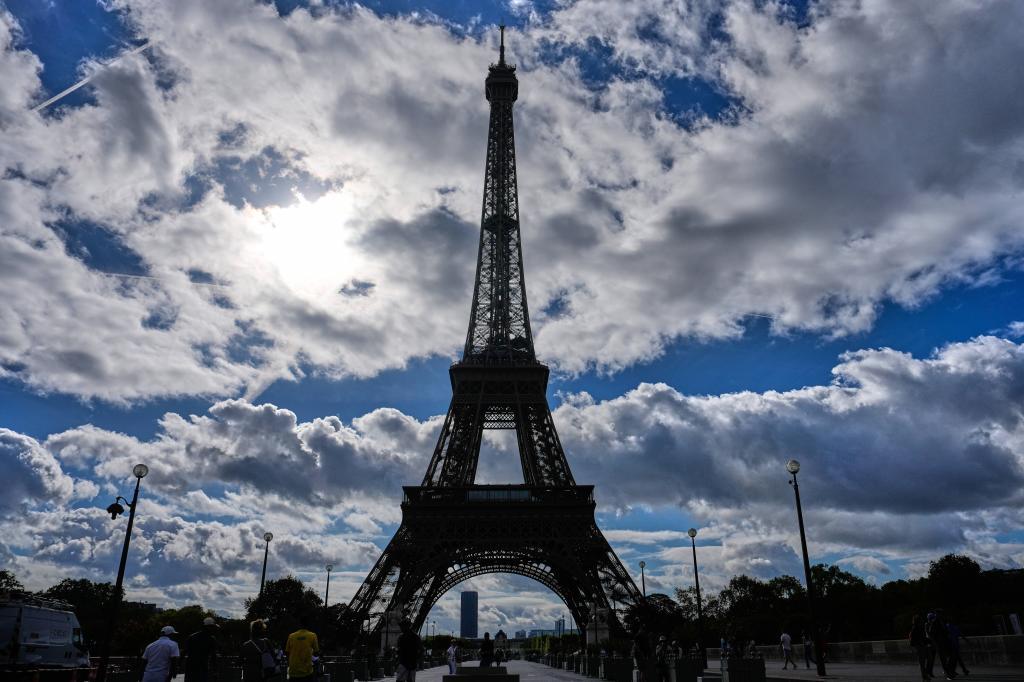
Who instructed the women working at the Eiffel Tower to disappear from view during a visit by the traditionalist Hindu group Bochasanwasi Akshar Purushottam Swaminarayan Sanstha (BAPS), which advocates for strict gender separation? To what extent was there clear discrimination against female staff in the name of a religious sect in the land of equality and secularism?
The controversy had been brewing since September 5, when about a hundred monks and members of the BAPS movement visited the Eiffel Tower and demanded not to cross paths with any women during the visit, in compliance with their strict rules bordering on misogyny.
Surprisingly, the Eiffel Tower management agreed to the request. The monks proudly posed in their orange robes in front of the metal structure before, during, and after the controversial visit without women in sight, which soon made headlines.
Workers denounced the discrimination, and unions called for a protest strike that forced the closure of access to the tower "for operational reasons". The City of Paris, owner of 99% of the tower that welcomes 6.7 million visitors every year, issued a harsh statement warning that "no protocol, cultural consideration, or religious belief can justify breaking the principle of equality between men and women." Mayor Emmanuel Grégoire described the incident as unacceptable and ordered a double investigation.
The controversy even spilled over into the 2027 presidential election campaign. Far-right leader and frontrunner in the polls Marine Le Pen warned that in France, "the limitation of women's presence will never be accepted". "Our principles are not for sale: shame on those who submit," proclaimed Bruno Retailleau, also a candidate for The Republicans and former Interior Minister.
After three weeks, the scandal that shook the Eiffel Tower led to the resignation of the CEO, Patrick Branco Ruivo. "At no time did I instruct to replace women in the path of this delegation," he said when announcing his resignation from the Eiffel Tower Operating Company (SETE), effective at the end of the year. "However, women were kept out of sight during this visit, and I regret it," added Branco Ruivo, appointed in 2018 by then-Mayor Anne Hidalgo, caught in the political and media storm.
Like the case of the theft of the Crown Jewels at the Louvre, the scandal has exposed the problems hidden beneath the imposing facade of the tower designed by Gustave Eiffel for the 1889 World's Fair, which overcame initial rejection by Parisians and became the world's tallest building for four decades, standing at 330 meters.
Security failures, conflicts with its 400 employees, and financial mismanagement following the blow of Covid - with an accumulated operating deficit of 121 million euros over five years - are some of the deficiencies revealed by an investigation by Le Monde ("A postcard monument plagued by scandals"), which also precipitated the CEO's resignation.
"Dysfunctions have regularly gone unnoticed given the political, economic, and symbolic dimension of the Eiffel Tower", denounces Le Monde, providing dozens of testimonies and documents on "deep dysfunction that can endanger the monument itself, its visitors, and the professionals working on-site."
The report highlights failures in alarm systems, inadequate placement of security cameras against possible terrorist attacks, the vulnerability of the armored wall surrounding the tower that cost 10 million euros, maintenance issues, poor preservation of the tower's original elements, and the lack of necessary protection to preserve workers' health.
The use of the tower for commercial purposes has also been questioned, as well as the lucrative "cultural" visits like the one that caused the latest scandal, tarnishing the image of the BAPS movement, with over a thousand temples worldwide, including one inaugurated around the same time in September in Bussy-Saint-Georges, in the suburbs of Paris.
"To our knowledge, at no point was access to the Eiffel Tower denied to anyone," read a brief statement from BAPS on social media. "Given the size of our delegation, the visit was organized in coordination with a team from the Eiffel Tower, at the beginning of the usual opening hours, to minimize any inconvenience to other visitors as much as possible."