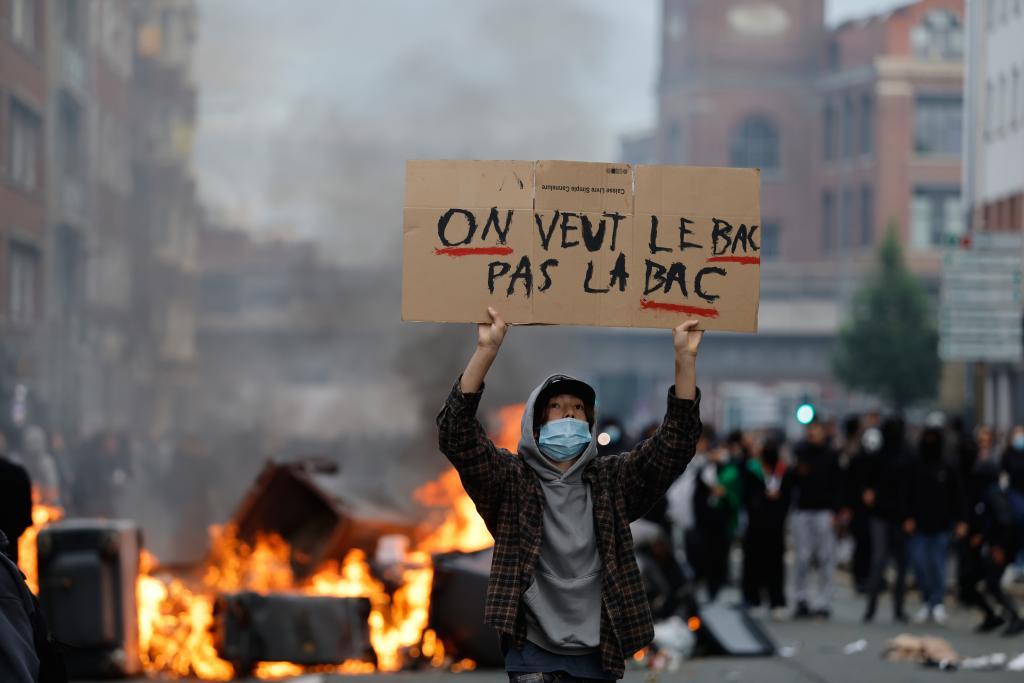
Over 600 young people have been detained in protests outside French high schools, which have led to harsh clashes with the police nationwide and prompted the direct intervention of Emmanuel Macron upon his return from Spain. "Under no circumstances can political leaders legitimize violence", declared the French president amid intense debate over the role of La France Insoumise leader Jean-Luc Mélenchon in the youth uprising taking shape in the streets, with barricades in front of dozens of high schools and even fires like the one declared on Thursday at Nelson Mandela High School in Nantes.
Protests had been brewing since last week in Paris and erupted with full force on September 29, coinciding with demonstrations that brought together over 300,000 people across France, protesting against announced budget cuts of 58 billion euros for 2027. High school students joined in with symbolic blockades of over 300 educational centers, demanding more teachers and resources, fewer students per class, and less strict schedules.
In an instruction to prefects, Interior Minister Laurent Núñez called for "strict proportionality but not inaction" in the face of protests, considering that the majority of demonstrators are minors. However, the police warned of the presence of masked young people and "small, extremely structured and violent far-left groups" in the protests.
In the Paris suburb of Saint-Denis, considered a stronghold of La France Insoumise, Mayor Bally Bagayoko visited Paul-Eluard High School to support the students' "legitimate demands." Speaking to BFM with a burning trash can in the background, Bagayoko even stated that "violence can be legitimate at a given moment, although it is better to avoid it".
La France Insoumise (LFI) leader Jean-Luc Mélenchon directly accused Prime Minister Sébastien Lecornu of having ordered a "police offensive" against the students. "Police brutality is irresponsible and clearly racist," Mélenchon wrote on his X account last Monday. "Leave our youth alone! LFI activists and elected officials, intervene where you can!"
Centrist Lecornu responded, blaming Mélenchon for provoking an "irresponsible escalation." "The duty of any elected official of the Republic is to protect the youth and call for calm. Exploiting their anger for partisan purposes is a mistake." The prime minister has called for a crisis meeting this Thursday and has canceled ministers' trips to focus on the spread of protests, as reported by Ap.
In light of recent incidents, Mélenchon was forced to appeal for "non-violence" on Wednesday. With the student revolt spreading, including serious incidents like the fire at Nelson Mandela High School in Nantes or the burning of a truck in Marseille, Lecornu convened an emergency interministerial cabinet meeting on Thursday to address the situation.
"This is where the so-called revolution promised by Jean-Luc Mélenchon leads us, to acts of violence against teaching staff and law enforcement," wrote Agrupación Nacional (RN) President Jordan Bardella on his X account, who has been besieged in recent days by accusations of antisemitism. Bardella described LFI as "a seditious party that incites chaos and leads young people into a dead end."
RN leader Marine Le Pen also joined the debate with a very direct accusation against Mélenchon: "The far-left seeks conflict at any excuse and aspires to brutalize the political climate to the point of making the atmosphere unbreathable due to its excesses and violence."
The violent protests in recent days have interrupted the 2027 presidential campaign, in which Le Pen is the frontrunner but with only 20% support among voters aged 18 to 24, compared to Mélenchon's La France Insoumise with 40%, currently considered the preferred party of young people.