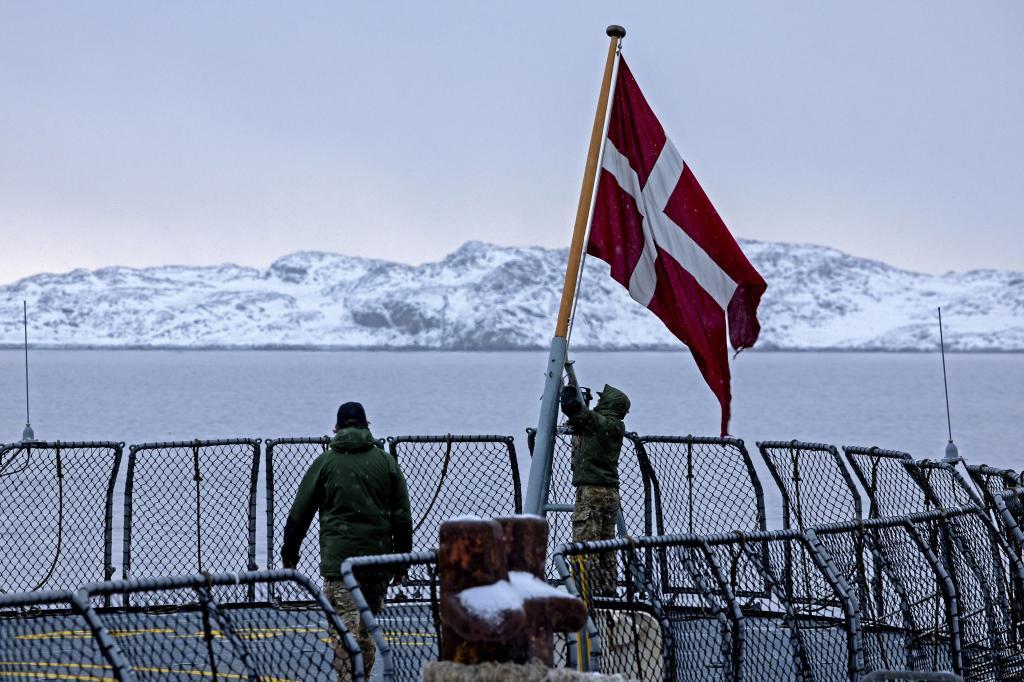
On Saturday, September 12, the surface of the ice sheet covering the Arctic Ocean reached its minimum size of the year: 4.6 million square kilometers, slightly larger than nine Spains.
Last Tuesday, September 22, the ice sheet had increased by 140,000 square kilometers - roughly the equivalent of Castile and León and Andalusia combined - when in New York, the President of the United States, Donald Trump, and the Prime Ministers of Denmark and Greenland, Mette Frederiksen and Jens-Frederik Nielsen, signed the agreement allowing the Pentagon to establish two bases on that Arctic island and granting NATO veto power over military operations and infrastructure projects of non-Alliance countries.
The agreement could end seven years of Trump's territorial claims over Greenland, which at times included invasion threats, and eight months of tough negotiations. In August, Denmark sent replacement soldiers to the island for the first time since 1996, fearing U.S. action, as some reports suggested that the U.S. was demanding similar concessions in Greenland as it had unsuccessfully tried to obtain with another Arctic country, Canada: the right of first refusal on any strategic mining concession and veto power over all investments by third countries in the territory. This was coupled with the demand that their bases on the island be considered U.S. sovereign territory - in a way, Arctic 'Gibraltars' - based on the historical precedent of the United Kingdom with its two bases in Cyprus.
All of that seems to be in the past. With the advance of ice caused by the Arctic winter and the easing of tensions between the U.S., Denmark, and Greenland, the most intense year to date in the 'race for the Arctic' comes to a close. This term can be borrowed from the 'scramble for Africa', which describes the European powers' struggle - led by the UK and France - for control of sub-Saharan Africa between 1870 and 1900. In those three decades, Europe went from controlling less than 10% of Africa to dominating the entire continent, with the sole exception of Ethiopia. First came the explorers, missionaries, and scientists. Then came the traders, settlers, and soldiers.
There are no missionaries in the Arctic. But others are mobilizing under the orders of the eight countries with territory north of the Arctic Circle: Russia, Canada, Denmark, the United States, Norway, Iceland, Sweden, and Finland. China has also joined, despite never having had a presence in the region. Beijing has circumvented this small inconvenience with the argument of 'geographical proximity', revealing a tougher side than the ice of a millennia-old glacier, as the northernmost point of its territory is 1,450 kilometers from the Arctic Circle.
In 2026, all these states have accelerated their movements.
Scientists, in particular, are playing a central role in this 'race', as was evident on August 16 when the Canadian icebreaker 'Louis S. St. Laurent', accompanied by the Swedish 'Oden', reached the geographic North Pole. Their mission included conducting geological and topographic analyses to support Canada's claim that its continental shelf extends literally to Russia. This theory was put forth by the North American country in 2019 and 2023 when it claimed literally two million square kilometers of the Arctic seabed, about four Spains. This would give Canada the right to exploit all resources on the seabed and subsoil.
By claiming the seabed and everything beneath it, Canada directly conflicts with Russia, which in 2001 and 2021 determined that its continental shelf extends 2.1 million square kilometers into the Arctic, reaching Canada, and with Denmark and Greenland, which claim one million square kilometers for themselves. All three seek to extend their sovereignty to the seabed of what is pure 'terra incognita', as there are no reliable data on the potential mineral resources in that subsoil. The Arctic of the 21st century is like Joseph Conrad described the Congo when he wrote 'Heart of Darkness' in 1898, at the end of the 'scramble for Africa': "An immense blank space".
Not only is the seabed in question, but also the ocean itself, especially in the case of the waters separating the 94 large islands - some, like Baffin, as large as Spain but with the population of Calpe - and the 36,469 smaller ones that make up the Canadian Arctic. For Canada, the channels separating these land masses are Canadian territorial waters. All countries in the world accept this claim, except one: the U.S. For Washington, these are international waters, allowing its ships to transit freely, granting them access to the famous 'Northwest Passage' that European sailors sought for 400 years. In 1988, the U.S. and Canada agreed that U.S. icebreakers would always request permission to pass through these channels, which would be automatically granted by Canada.
The agreement did not resolve the underlying issue. Relations between Canada and the U.S. have deteriorated to unprecedented levels in the 97 years both countries have been independent. Particularly when Washington, as Canadian Prime Minister Mark Carney sarcastically pointed out in August, only has a 'heavy Arctic icebreaker' and depends on Canada and Finland to develop the 11 more it has set as a goal to expand its area of influence in what is called the 'high Arctic', a vague term that coincides with the 4.6 million square kilometers covered in ice on September 12.
The lack of U.S. icebreakers brings soldiers into the equation, who in the 'Arctic race', as in Africa's, are playing an increasingly important role each year. The competition for the Arctic has become a practical example of Canadian Prime Minister Carney's famous call in Davos for medium powers to "act together". This, in turn, is proving to be a lifeline for NATO.
The issue of the U.S. lack of icebreakers brings soldiers into the equation; in the "Arctic race," as in the one in Africa, they are playing an increasingly important role each year. The competition for the Arctic has become a practical example of Carney's famous call at Davos for middle powers to "act together." And this, in turn, is proving to be a lifeline for NATO. Six "middle powers" in the Alliance—Canada, Denmark, Iceland, Sweden, Norway, and Finland—are Arctic states. The unilateralism and aggressiveness in Greenland displayed by NATO's seventh Arctic country, the U.S., has led them to rely on that military organization to defend their interests.
As Norwegian analyst Krstren Friis explains in an article published by the British defense think tank RUSI in August, "when President Trump's rhetoric became more explicit, it became necessary to hold discussions [within NATO] without the United States present" to address issues related to security in the 'High North.' In 2026, Sweden and Iceland launched new security doctrines for the Arctic, and Finland, for the first time, presented one. Norway announced its own in November 2025. Stockholm and Ottawa have completely abandoned their reluctance to have NATO play a central role in the Arctic. Even the EU came close to being favored in the Arctic as an alternative to the U.S. in the failed Icelandic referendum on EU membership held four weeks ago.
Russia can export oil from Bukhta because nature works in its favor. The Russian and European Arctic isn't as cold as the North American Arctic due to the Gulf Stream. That makes it more navigable. And that is why, in August, the Chinese shipping company Sea Legend officially launched the "China-Europe Arctic Express" route, featuring seven container ships, which aims to transport cargo weekly from July through September—the only viable months—from the port of Zhoushan to the ports of Felixstowe in the United Kingdom and Hamburg in Germany.
The Chinese "Arctic Express" is not a commercial venture. As Vincent Clerc, CEO of the giant Danish shipping company Maersk, told the *Financial Times*, "there is no commercial aspect" to it. Its objective is strategic. In the Arctic, there is no Strait of Malacca that the U.S. could block, no Suez Canal that Egypt could close, and certainly no Bab el-Mandeb Strait where Yemen's Houthis or anyone else might start sinking ships. That is why South Korea sent its first cargo ship, the PanStar Acro, along that route—a move that caused a stir in Europe because, to complete its voyage, the ship will need Russia's cooperation.