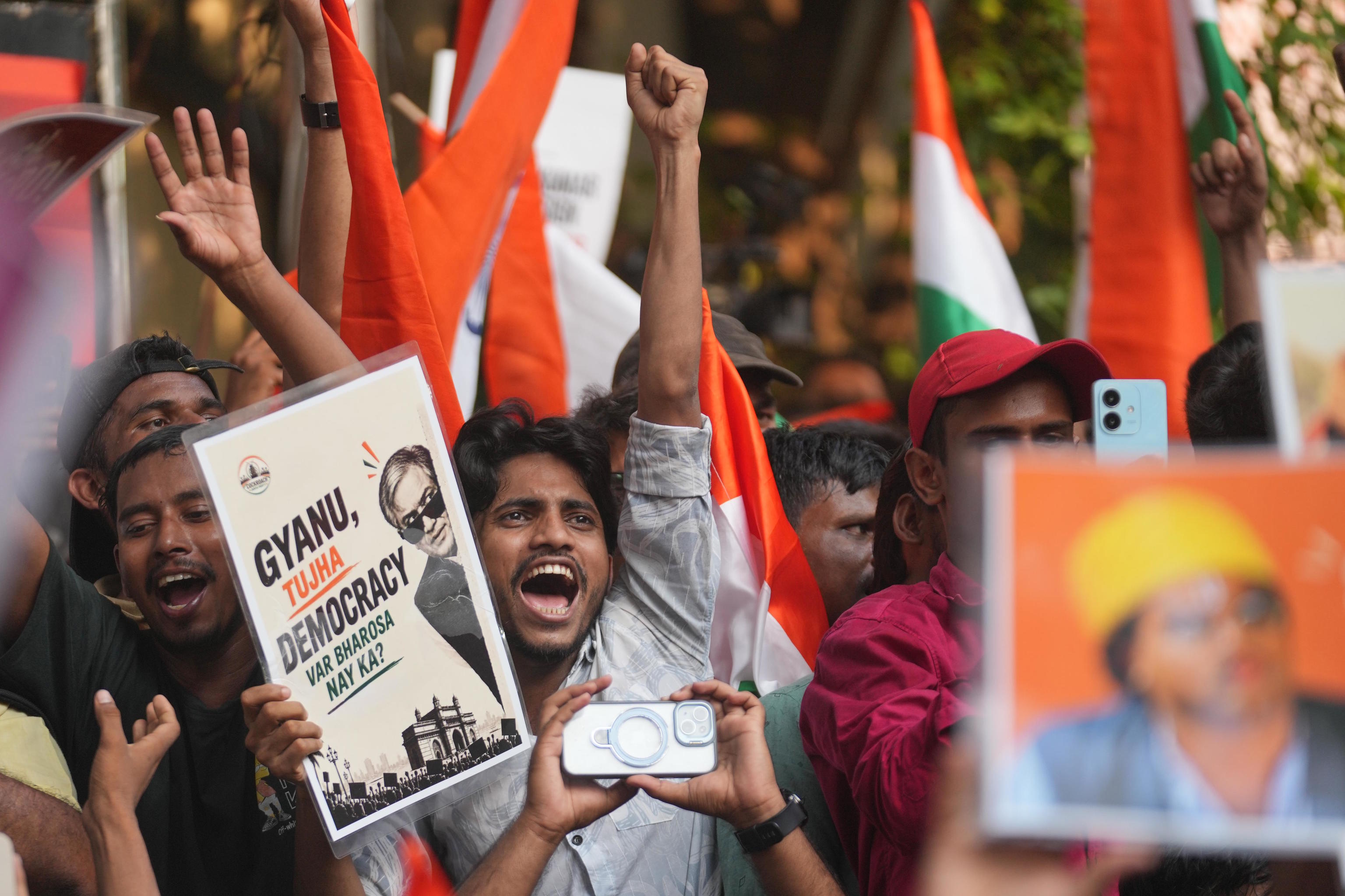
The "cockroaches" already brought down a minister. Now they want to oust the man who guards the country's votes in what is touted as the world's largest democracy. The youth movement that turned an insult into a banner has returned to the streets of India with a new complaint: after seeing how exam leaks compromised their future, their followers fear that the electoral census review is also diminishing their ability to decide who governs.
On Friday and Saturday, with Indian flags and slogans against Gyanesh Kumar, president of the Electoral Commission, thousands of supporters of the Cockroach Janata Party (CJP) gathered in Delhi and Bombay. Generation Z thus launched another national campaign.
In the capital, where student unions, activists, and opposition parties tried to demonstrate at Jantar Mantar, the response was a police deployment, the temporary closure of access to twelve metro stations, and hundreds of detentions.
The controversy revolves around the Special Intensive Revision, known by the acronym SIR, which has removed over 130 million names from the provisional censuses, according to The Indian Express investigation.
The Commission argues that it aims to eliminate duplicate records, deceased individuals, and those without the right to vote. The opposition and protesters allege that legitimate voters are also being expelled and that the process favors the ruling Bharatiya Janata Party (BJP) of Prime Minister Narendra Modi. The Government and the electoral body deny such manipulation.
The Indian newspaper's investigation revealed that Commission members raised objections about discrepancies, omissions, and computer systems. Some decisions, they warned, were made without their knowledge. Their concerns included changes in forms for registering new voters and the centralization of access to the electoral database in Delhi.
The "cockroaches" have once again capitalized on these new protests. In May, Supreme Court Justice Surya Kant likened unemployed youth to these insects. Abhijeet Dipke, a 30-year-old political communication strategist, responded on social media asking what would happen if all cockroaches united. The satire resonated with frustrated youth and eventually evolved into a protest movement. Dipke returned from Boston, where he resided, to lead the mobilization.
That rebellion took off with the Medicine entrance exam scandal. Leaks forced the cancellation of the May test results, affecting over two million aspirants. Anger over a system that thwarted years of family effort filled the streets of Delhi and other cities. After weeks of protests and police repression, Education Minister Dharmendra Pradhan resigned on July 25. The group decided to remain active to demand accountability from those in power.
Now they are trying to replicate that victory, with more parliamentary opposition joining this time. The INDIA alliance, led by the Congress Party, has announced a march of its parliamentarians on Tuesday towards the Electoral Commission. The "cockroaches" are preparing for another major protest in Delhi next Saturday. Dipke has pledged to extend the mobilizations until Kumar steps down.
Amnesty International has denounced the ongoing restrictions on peaceful protests, the detention of hundreds of participants, and internet and transportation suspensions. "The right to protest does not depend on government approval," stated Aakar Patel, chairman of Amnesty India's board. The organization accuses authorities of using temporary emergency powers to prevent peaceful gatherings and demands the release of those arbitrarily detained and the restoration of internet connectivity.
There were new detentions in Delhi on Saturday. A hundred protesters removed police barriers and demanded the resignation of the chief electoral officer before some participants were taken away by officers. Protesters denounce a double exclusion: from the lists and from the right to protest on the streets.
For Modi, the challenge has an uncomfortable precedent: these youth have already shown they can force his government to yield. Their transition from exams to the census now touches on the rules of democracy. The generation that turned a cockroach into a symbol now demands to retain their voice at the ballot box.