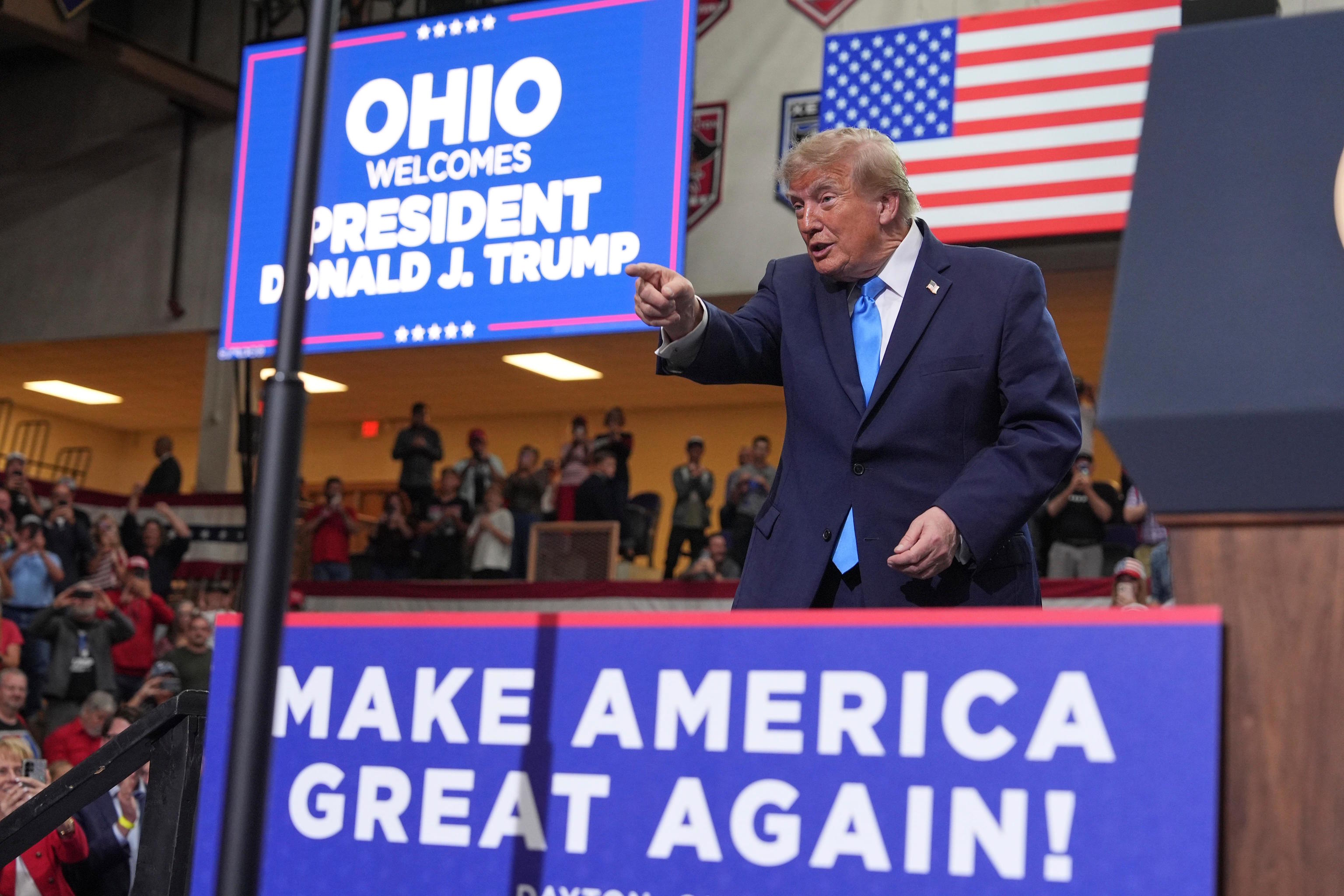
On Monday morning, the President of the United States, Donald Trump, boarded Air Force One on his way to Nebraska. On Tuesday, he will be in Maryland, before returning to Texas on Wednesday, where he was a few days ago. Thursday will be the only day he spends in Washington, as he will pass through New York, Tennessee, Alabama again, and Virginia over the weekend. This is after visiting Ohio and Oklahoma earlier this month. American presidents travel a lot, but not this much. The only reason for this exhausting schedule are the midterm elections on November 3, where all seats in the lower house and just over a third of the Senate are at stake. Or rather, the only reason is that the polls are getting worse for the Republicans, and Trump, who has turned these elections into a referendum on his administration, cannot bear the idea of losing.
Currently, Republicans control Congress, but by a narrow margin. Their majority in the House of Representatives (218-214) and the Senate (53-47) is weaker than it seems. The president had almost absolute control in 2025, but this year he has been unable to keep the ranks completely tight. This, combined with deaths, illnesses, and fights, has led to important losses in votes and has tested the White House's patience. Just last Saturday, Trump published a senator's mobile phone number from his own party, encouraging his millions of followers to harass him because he does not support a law to abolish the daylight saving time change, something that deeply bothers Trump because evenings end too soon and there is little time to play golf.
It's not just that. This week, the latest scandal in the capital has been the administration using public funds to pay for television ads to boast about what they consider their great successes. It's not directly election campaigning because he is not on the ballot, but it's close, as he repeatedly implores his voters that everyone should go to the electoral college thinking they are.
The reasons for his nerves are clear. Most polls give the advantage to the Democrats in key states: Alaska, Iowa, Maine, Michigan, New Hampshire, Ohio, and Texas. Even in Nebraska, where Trump won by over 20 points in 2024, there are doubts. The latest data from Siena/The New York Times indicates that less than a month away, "Democrats have taken the lead or have ties or very close results in five traditionally Republican states where they seek to snatch Senate seats to gain control of the chamber. Democrats lead among likely voters in Senate elections in Texas and Alaska. They have a sufficient advantage in Ohio, a state that has leaned right for years. Republicans maintain a slight lead in Iowa, but Democrats are virtually tied with Republicans in Kansas, a state that has not voted for a Democratic senator since 1932."
It has been assumed for months that Democrats would regain control of the House of Representatives, but a sweep in the Senate also seemed impossible, as it is not just about regaining those three crucial seats, but there is actually at least one more, that of the theoretically independent John Fetterman in Pennsylvania, which they do not currently count on, at least for Trump's main agenda. "Overall, the new polls suggest that Democrats have several paths to regain the majority in the Senate," says the Times/Siena analysis.
One of the weekend's news was that one of the Republican political action committees (super PAC in jargon), the vehicle through which companies and millionaires can inject fortunes into campaigns to fund ads, has decided to withdraw funds from the fight in North Carolina, where winning is increasingly difficult, to put them in Kansas. If Democrats win the popular vote by 10 points (their current average lead in the polls), they would gain an extra 33 seats according to Mindset, a specialized company. This would place this year's gains between the Democratic gains of 2006 (31 seats) and 2018 (40 seats).
According to Nate Silver's models, one of the great electoral gurus in the US, although there is usually a 7 to 8 point backlash against the president's party during midterm elections compared to the previous presidential elections, this year it could rise to 10-11 points against Donald Trump. "These are some of the most consistent elections I have tried to predict, in the sense that practically all indicators are bad for the Republicans. Except perhaps external funding; that is the only point in their favor," he writes in his latest bulletin.
According to this analysis, right now it is more likely that Democrats will win Kansas for the first time in almost a century than Republicans will retain Texas. These numbers increasingly resemble the midterm elections of 2006, where Democrats regained 31 seats in the House of Representatives and 6 in the Senate and obtained the majority in both chambers, due to George W. Bush's unpopularity.
Money, however, is a decisive factor. In the past, Democrats have dreamed of having senators in Texas or Kansas and ended up falling short. This time the numbers are better, but campaigns require huge amounts of money, especially in the last two weeks, and Republican pockets are very full.
However, Trump's popularity, who has insisted that everything revolves around him and not state or local issues, is currently at a low. The CNN's average approval rating for him is only 34%. His average is at -22.7. At this point in his first term, he was at -11.0, and Biden at -8.8. In the Iran conflict, only 28% approve of his management, while 66% disapprove; and in the economy, it's almost the same: 31% in favor and 65% against. According to AP-NORC data, 65% of adults attribute unusually high prices to Trump's policies, and 52% of Republicans believe he falls short on the cost of living. The Wall Street Journal emphasizes that his approval rating, at 37%, is the lowest for a president shortly before legislative elections since George H. W. Bush.