A Chinese military convoy crosses a road leading to Ban Keun airport, about 45 kilometers north of Vientiane, the capital of Laos. "China is always helping us a lot, but I don't like seeing soldiers from other countries here," says a middle-aged Laotian taxi driver in good English who cannot explain what those Chinese soldiers are doing there. "We had a very bad experience with the French during colonial times and then with the United States during the Vietnam War bombings."
The scene summarizes Beijing's latest advance in this small and peaceful Southeast Asian country: after trains, construction companies, and tourists, military facilities arrive. The chosen name avoids the word base. Instead, two friendlier words appear: training and friendship.
The Chinese Ministry of Defense has announced the opening of a "support and training center" in Laos. It has not detailed how many Chinese soldiers will be there, what equipment they will bring, or how long they will stay. But the People's Liberation Army (PLA) gains access to an air infrastructure in the heart of Indochina. Pilot training is the announced mission; the future scope of that presence remains unexplained.
Ban Keun airport has a history of foreign powers. During the Laotian civil war and the Vietnam War, it was part of the network of runways used by the United States. Now China is rehabilitating that space. According to satellite analysis, construction began around October 2025, and the longest runway is about 2,000 meters.
In Vientiane, Chinese influence needs little explanation. A walk through the capital reveals works by Chinese companies, infrastructure financed from Beijing, and many groups of tourists from the northern neighbor. Among temples and avenues leading to the Mekong River, China appears as a builder, lender, and provider of visitors. Its presence has become part of the everyday landscape.
The most profound transformation runs on rails. The China-Laos railway connects Vientiane to the Chinese border and continues to the modern city of Kunming. The project, costing around $6 billion, has shortened trips, opened trade routes, and brought tourists closer. For a landlocked country, it offers a real possibility to overcome its natural isolation. It also increasingly directs its economy towards China.
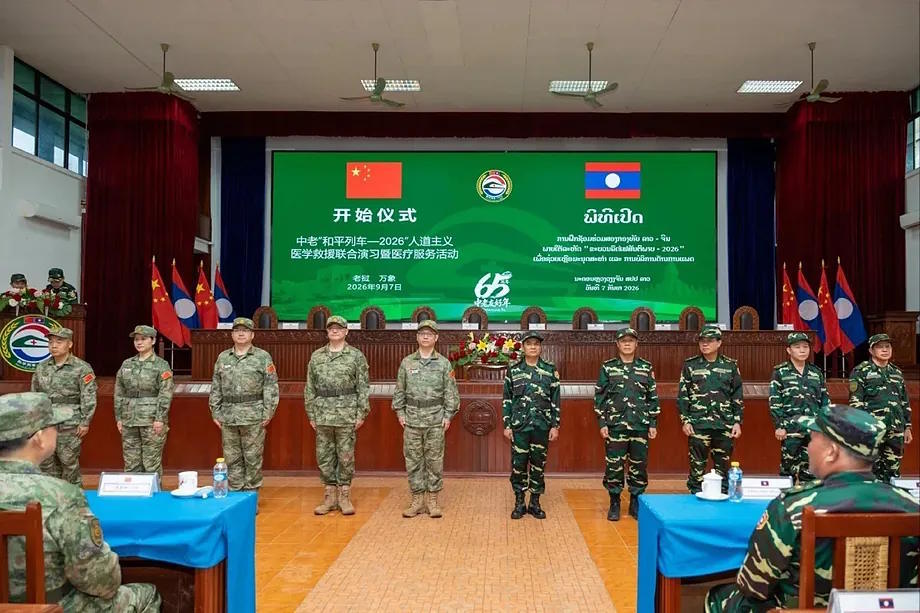
This connection also serves both armies. In September, a PLA medical unit arrived by train in Vientiane to participate in joint maneuvers. The railway that transports tourists facilitates military deployments agreed with the host. Because proximity to Beijing is also supported by a political affinity: Laos has been governed since 1975 by a single-party communist system, the Lao People's Revolutionary Party, which concentrates power and dominates all institutions.
Beneath promises of modernization lies a very weak economy highly dependent on agriculture and informal labor. According to the latest poverty profile from the World Bank, 15% of the population lived below the national poverty line. This fragility is compounded, like in the rest of the region, by entrenched corruption.
Therefore, it is very difficult to oversee the large contracts signed with the powerful Asian neighbor. Laos receives hospitals, connectivity, and now also military training. China gains influence and options to expand its presence in Southeast Asia.
On Wednesday, new information indicated that the new facilities at Ban Keun already have planes and military vehicles. Satellite images taken by the Vantor company and reviewed by Reuters show eight aircraft identified by specialists as possible Hongdu JL-8 (also known as K-8, used for training and light attack) and more than two dozen support vehicles.
The aircraft are seen next to a runway still under construction, surrounded by extensive works, just a day after the official announcement of the joint center's opening. The rapid development of the complex is being monitored by military attaches and regional security experts, some of whom believe it could become China's first fully operational base in the region.
Officially, Beijing only acknowledges one overseas military base: Djibouti, opened in 2017 near the Gulf of Aden to support its naval operations. But that count offers an incomplete picture. In April of last year, it inaugurated another joint logistics and training center at the Cambodian naval base of Ream, on the shores of the Gulf of Thailand.
Cambodia denies hosting a permanent Chinese base and, after the inauguration, received Japanese and Vietnamese ships. However, an analysis by the Center for Strategic and International Studies (CSIS) pointed out that these visits used a different pier from the large dock occupied by the Chinese corvettes. Their researchers believe that Beijing seems to retain exclusive access to some facilities.
The Pentagon's 2025 military report describes a Chinese military increasingly powerful and planning additional facilities to project its naval and air forces. Among the countries that Washington believes China has likely considered as potential military locations are Pakistan, Sri Lanka, Thailand, the United Arab Emirates, and several African states.
It also mentions Chinese interest in Gabon, in the Gulf of Guinea, which would give it a military foothold in the Atlantic. The Pentagon points to interest in the Malacca and Hormuz straits.
Djibouti shows how much a facility born under the guise of logistical support can grow. In a study from September 17, the CSIS identified two new communication complexes that would strengthen PLA links and likely allow for gathering information on military activities. Less than 16 kilometers away operate U.S., French, Italian, and Japanese bases.
The Chinese military convoy leaving Ban Keun on Tuesday now uniforms a relationship between communist regimes that has been advancing for years through concrete, loans, and railways. China builds external military capacity through agreements presented as aid among friends.