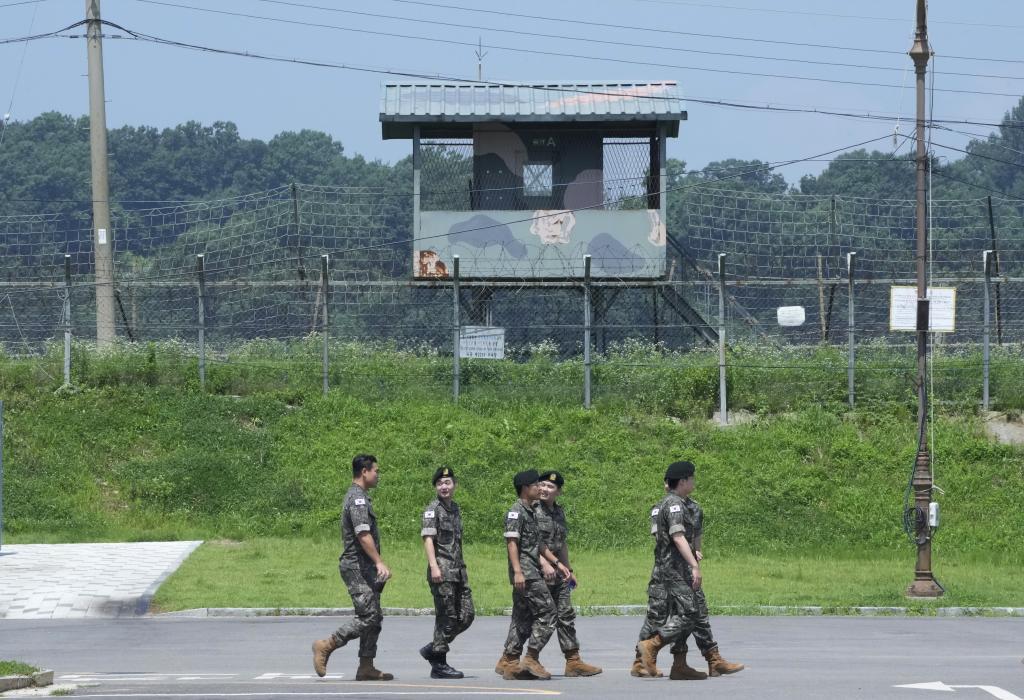
The explosion occurred in the late morning, in one of those places where a few meters can separate a routine patrol from an international crisis. On September 21, several South Korean soldiers were advancing inside the Demilitarized Zone (DMZ) when two mines exploded under their feet, just a few meters south of the line that divides the two Koreas. Three soldiers were injured. Two suffered serious injuries. One lost a foot.
On paper, the incident could have been reduced to another jolt on a border accustomed for seven decades to warning shots, defections, and provocations. However, the joint investigation by the South Korean army and the United Nations Command (a unit led by the US under the UN flag) has turned the explosion into the latest front between Seoul and Pyongyang.
Investigators concluded that the mines were North Korean and had been deliberately placed about ten meters inside the territory that South Korea considers its own. Seoul now demands an apology and their removal. Pyongyang denies everything.
The Military Demarcation Line was born with the 1953 armistice that halted the Korean War without formally ending it. It runs about 250 kilometers through the center of a 4-kilometer-wide DMZ. It was never intended as a definitive international border. It was marked with 1,292 posts placed approximately every 200 meters. More than seven decades later, most have disappeared under vegetation or are destroyed. Only about 200 remain recognizable.
South Korea's Ministry of Defense itself acknowledges discrepancies in much of the route used by its military and that managed by the United Nations Command. And Pyongyang maintains its own interpretation. Soldiers who believe they are working within North Korea can appear, according to South's coordinates, 20 meters on the other side of the line.
It is precisely there where Kim Jong-un is building a new frontier. Since 2024, the North has deployed thousands of soldiers to transform the DMZ. They have cut down trees, opened roads, built walls, fences, and planted new minefields.
This year, according to South Korean authorities, up to 7,000 North Korean soldiers per day have participated in these works. Northern troops have crossed the line recognized by Seoul more than 50 times, compared to 17 incursions detected last year. In some points, they would have advanced about twenty meters while installing mines and fortifications.
It is not just about cement, wire, and explosives. International analysts argue that it is the materialization on the ground of one of the biggest ideological shifts of the Kim Jong-un era.
For decades, the two Koreas held irreconcilable versions of the same idea: there was only one Korea and someday it would be reunited. Each considered itself the legitimate representative of the entire peninsula. In late 2023, Kim broke with that fiction and began to define the relationship as that of "two hostile States". He then ordered the removal of historical references to reconciliation and reunification from official rhetoric. South Korea ceased to be the separated brother to be recovered someday and simply became another enemy country.
The new mines are the physical translation of that doctrine. Kim Yo-jong, sister and main political spokesperson of the North Korean dictatorship, explained it bluntly after the explosion. The aim of the fortifications, she said, is to permanently close the border and break any link with the South. She even ridiculed the attempts at détente by South Korean President, Lee Jae-myung, calling them a "farce".
The South Korean leader came to power defending exactly the opposite strategy. Against the confrontational policy of previous conservative governments, this progressive leader has tried to resume dialogue, reduce military tensions, and offer Pyongyang a gradual way out of the nuclear deadlock.
In September, Lee even suggested that Washington consider easing sanctions in exchange for North Korea freezing the development of new nuclear weapons and intercontinental missiles. He presented himself to the UN as a possible "pace-setter" to also reactivate talks between Donald Trump and Kim Jong-un.
But the mines have put that policy to its first major test. The conservative opposition demands greater firmness and, as reported by local media, tensions are increasingly emerging within the government on how to deal with the new challenge from the neighboring regime.
Pyongyang this week described the investigation into the mines as a premeditated setup and warned of a strong response if South Korean troops penetrate the territory that North Korea considers its own.
"If a military boot or a spark of fire from the Republic of Korea crosses even a millimeter into our territory and invades our territory, the border guard forces of the DPRK will take immediate and strong countermeasures," declared the North Korean Ministry of Foreign Affairs on Tuesday, referring to both countries by the acronyms of their official names. The threat came after the South began removing the explosives in the incident area.