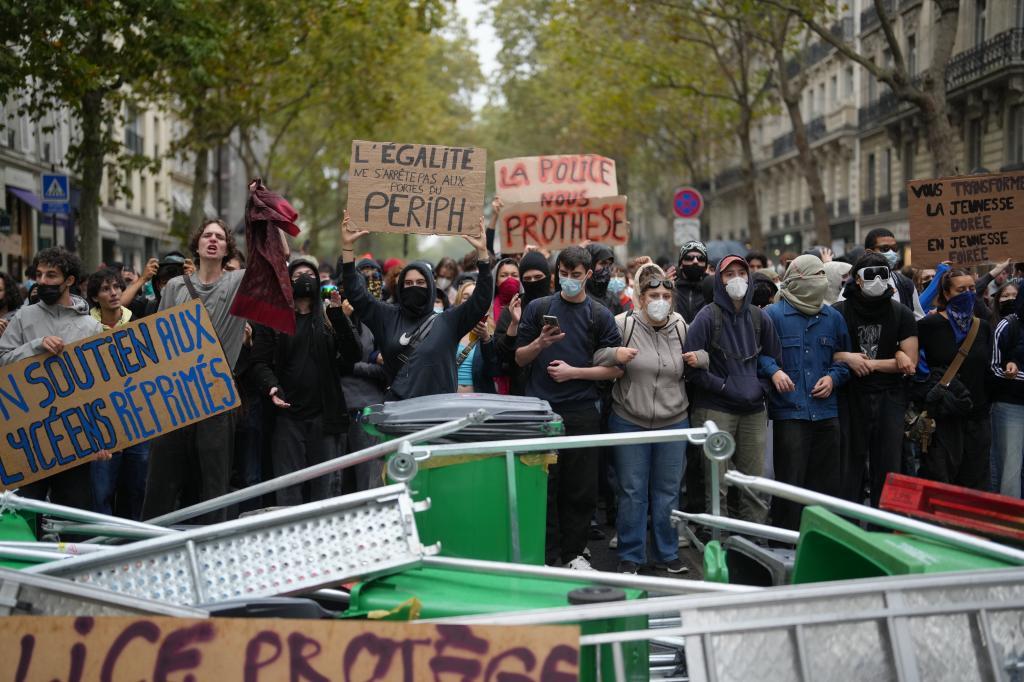
Social protests, political instability, and the snowball effect of deficit and debt have triggered a triple crisis in France, which analysts are already calling "the new sick man of Europe." The concern is such that Prime Minister Sébastien Lecornu was forced to appear on television on Wednesday. This came a day after President Emmanuel Macron called his ministers to order and asked for "empathy" towards the students and "proportionality" in the police response, concerned about the chaotic image the country has projected in the past week.
Centrist Lecornu, who took office a year ago after his predecessor François Bayrou's fall, is facing an unprecedented "polycrisis." This crisis is exacerbated by the energy crisis, rising fuel prices, and an increasingly polarized political landscape. In the midst of the 2027 presidential campaign, Marine Le Pen's far-right leads the polls, while Jean-Luc Mélenchon's radical left hopes to take full advantage of the "autumn of discontent."
"I understand the fatigue of those who feel that, as soon as one difficulty is overcome, another arises," acknowledged Lecornu, in his unusual address from his official residence in Matignon, taking stock of the critical situation in France, starting with the social protests. "Law enforcement has not been instructed to confront the students, but to act in a proportionate manner in a difficult context," he emphasized. "But we have also seen violent acts, against teaching staff, assaulted students, vandalized schools, and hundreds of lost hours."
In an unusual speech from Matignon, his official residence, Lecornu stressed the need to bring order to public finances to approve the 2027 budget, which includes severe spending cuts of up to 54 billion euros. The Prime Minister condemned the scenes of "urban violence" in recent days and committed to listening to the students' demands, in a process of "internal democracy," hoping to end the school blockades.
With Macron in Croatia, attending the MED9 summit of southern EU countries, Lecornu took on the role of a "good soldier" and tried to defuse the tension caused by the police response to the student revolt. According to Le Parisien, the president himself criticized that response after the violent clashes on Tuesday.
It was Macron's intervention that led to the ban on using stun grenades against protesters, like the one that resulted in a student losing a hand in Lens. Le Pen accused him of "taking the side of those who attack the police."
Analysts agree that Macron, focused on foreign policy and at his lowest popularity levels, will have to face the French sooner or later. He will have to explain how he plans to address, at the end of his term, this triple social, economic, and political crisis.
Europe's weakest link
With a public debt of 119% of GDP and a deficit exceeding 5% in the last three years, the British newspaper The Daily Telegraph has renamed France as the "new sick man" of Europe. It compares it to the UK in the seventies or to Greece just over a decade ago. Alarms rang again this week when the risk premium of the EU's second-largest economy soared to 133 basis points, its highest level since the 2012 debt crisis.
"Macron's decade has turned France into the weakest link in the Old Continent," argues Bloomberg. The Wall Street Journal warns that the country "has lost touch with budgetary reality."
When Macron took office, public debt was below 100% of GDP and the deficit was at 2.8%. Under the president's supervision, a former Finance Inspector, successive centrist governments implemented the policy of quoi qu'il en coûte —"whatever it takes." To quell the yellow vests crisis and cushion the impact of the pandemic, France resorted to unprecedented public spending. Now it is paying the price.
In recent years, all attempts to balance the books and cut social spending have fallen on deaf ears or even brought down prime ministers. Lecornu has once again faced the challenge this year of passing a budget without a parliamentary majority, lost, also "courtesy" of Macron, in the early elections of July 2024.
Lecornu presented his 2027 budget amidst the student protests. His proposal, a cut of between 43,000 and 54,000 million euros, includes freezing civil servants' salaries, higher taxes on higher pensions, and fewer study and housing grants. It has landed like boiling oil on protests denouncing the deterioration of public education.
"France has been a stowaway in Europe for years, if not decades," warns Kevin Thozet, an analyst at the French asset manager Carmignac. "It got away with its fiscal excesses, and the strategy worked as long as no one noticed. Now people have started to notice."
Meanwhile, social demands and budget adjustments are pulling in opposite directions in the presidential campaign. "It has become impossible for candidates to ignore the issue of French debt, but most of their responses lack credibility," warns the Financial Times. "The worst-case scenario for bond investors is a runoff between Marine Le Pen and Jean-Luc Mélenchon."
Faced with social and economic chaos, the leader of National Rally (RN), Marine Le Pen, a clear favorite in the polls, presented her "counter-budget" this week, with an estimated saving of 140,000 million euros. "France is becoming the object of all investors' concerns," acknowledged Le Pen, who promises to reduce the 5.4% deficit to 3% by 2030.
Analysts question those figures because Le Pen aims to simultaneously cut taxes by over 53,000 million euros. Among her measures are reducing VAT on energy and basic products, exempting young workers from income tax, and suspending pension reforms and the retirement age increase.
Le Pen has distanced herself from the student protests, denouncing the infiltration of "ultra-left elements." With her proposal, the RN leader seeks to gain economic and political credibility, supported by her protégé, Jordan Bardella, tainted by the scandal of allegedly making anti-Semitic comments when he was a young National Front activist.
Nevertheless, Le Pen continues to soar in the polls. She has a 36% voting intention in the first round, compared to 15% for Mélenchon, leader of La France Insoumise, and 12% for former centrist Prime Minister Édouard Philippe. The Toluna Harris poll published this week predicts an increasingly likely runoff between Le Pen and Mélenchon in the second round, which the far-right leader would win by a wide margin: 69% to 31%.
Mélenchon, on the other hand, is making the most of social unrest and student protests. According to another survey by Odoxa and Backbone for Le Figaro, 78% of the French believe the radical left leader is "manipulating young people for electoral purposes." However, 62% consider the protests justified.
The rebellious candidate was greeted with chants of "President, President!" at Tuesday's rally in Paris, which ended in violent clashes with the police. Most political parties accuse Mélenchon of instigating the protests and of having "legitimized" the violence. The candidate for The Republicans and former interior minister, Bruno Retailleau, renamed Mélenchon's party "Incendiary France" and said he would consider banning it if he becomes president.
In any case, the student protests have substantially disrupted the race for the Élysée Palace and given Mélenchon an extra boost against moderate left-wing candidates such as Raphaël Glucksmann and Ségolène Royal, who this weekend are competing in the primaries of an increasingly marginalized Socialist Party.