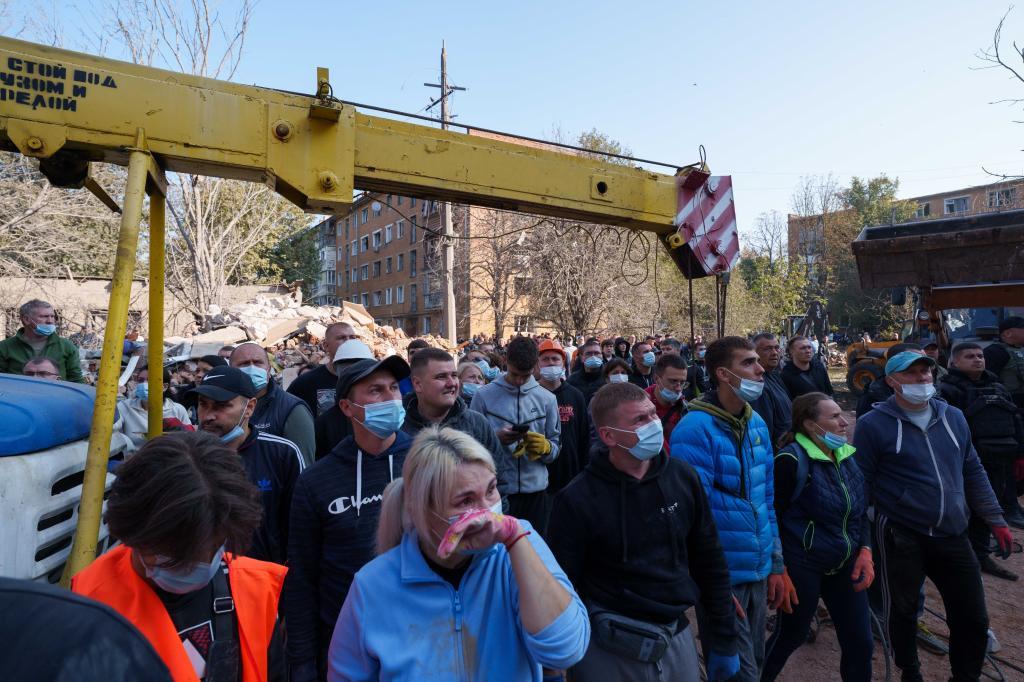
Vladimir Putin's Russia is already advancing its strategy of terror for this autumn-winter in Ukraine. Russian missiles and drones attacked densely populated areas early yesterday in Kiev and 12 other regions of Ukraine. They killed at least 21 civilians, including four minors, and injured about 60, according to Ukrainian authorities. The hardest blow fell on the town of Pryluky in the Chernihiv region, where a residential building was destroyed, resulting in the deaths of 15 people, including four children.
There were also casualties in Kremenchuk, Kiev, and two other cities. The attack coincided with Vladimir Putin's 74th birthday, and Kiev was expecting it: a day earlier, Volodymyr Zelensky had warned that Ukrainian intelligence anticipated a "massive" offensive. Ukraine can detect it through the movements of Russian strategic bombers from the Eastern regions to the airfields closest to the war, from where they launch their deadly payload.
As has been the case for months, Ukraine could not stop the attack. It barely has ammunition for its Patriot systems, which are scarce due to the war with Iran, and still lacks interceptors capable of reaching the new Russian jet drones. "Russian ballistic missiles remain the biggest challenge," said Zelensky, emphasizing that anti-aircraft defense is a "vital necessity" for his country. The Russian Ministry of Defense claimed that their targets were industrial facilities dedicated to manufacturing and storing missiles and drones, as well as ports and ships in the Odesa region. The images once again contradicted their words.
The attack illustrates a war that, more than four and a half years after the invasion, has barely moved on the front lines and is mainly fought from the air. Ukraine responds with drones and long-range missiles against the Russian oil industry. Yesterday, Zelensky claimed to have hit two oil facilities and a training camp in Perm, Samara, and Astrakhan, and released images of a tanker ablaze near Sochi. However, the strain is much greater on the small country.
The President of the European Commission, Ursula von der Leyen, accused Moscow of pursuing "a deliberate strategy of terror" to "make the daily life of Ukrainians impossible." There is no indication that relief will come soon. Negotiations led by the US have failed, and according to Western analysts, Vladimir Putin remains convinced that Ukrainians will eventually give in and that their Western allies will eventually tire.
Russia is preparing for this winter the toughest campaign against Ukrainian cities since the start of the large-scale invasion. This is indicated by a Russian military document dated August and intercepted by Ukrainian intelligence, which Vice Prime Minister and Minister of Energy Denis Shmigal presented to European partners in Paris a few weeks ago. The plan, published by The New York Times, involves launching up to 1,000 missiles, drones, and guided bombs against the country's energy network. The goal is to cut off up to 90% of electricity and heating supply in Kiev, Kharkiv, and Odesa, severely damaging their sewage systems. "Our partners, like us, were impressed by their cynicism, by that cold terrorist calculation on how to destroy our energy sector," said Shmigal.
The document divides the offensive into three phases. The first targets the substations near the western border, where Ukraine imports electricity from Europe. The second targets hydroelectric power plants. The third, the most alarming, targets the power parks that connect the three operating nuclear power plants to the grid, some less than two kilometers from the reactors. The list includes thermal power plants, boiler rooms, pumping stations, and water treatment plants, against which Moscow would use ballistic missiles and gliding bombs. In total, the Kremlin aims to eliminate about 15 gigawatts of generation capacity, almost all that Ukraine had available at the end of the summer.
The objective is not only military. According to the Financial Times, citing assessments from Ukrainian intelligence shared with European officials, Moscow aims to isolate the major cities - Kiev, Kharkiv, Odesa, and Lviv - from the rest of the country and force Kiev to accept its conditions by early 2027. The plan also seeks to trigger a new wave of refugees towards the European Union and fuel anti-immigration sentiment in several countries on the continent. It is essentially the strategy of previous winters, but on a larger scale and with more difficult-to-down weapons.
The New York Times warns that it has not been able to independently verify the authenticity of the document, written in Russian, or to what extent Moscow will implement it. But recent events point in that direction. The preliminary attacks on the energy network began on September 30, and since October 1, Russia has been daily targeting the bridges of Kiev over the Dnipro, something it had not done in over four years of war. On the brink of its fifth winter under bombs, the Ukrainian civilian population is once again the main target.