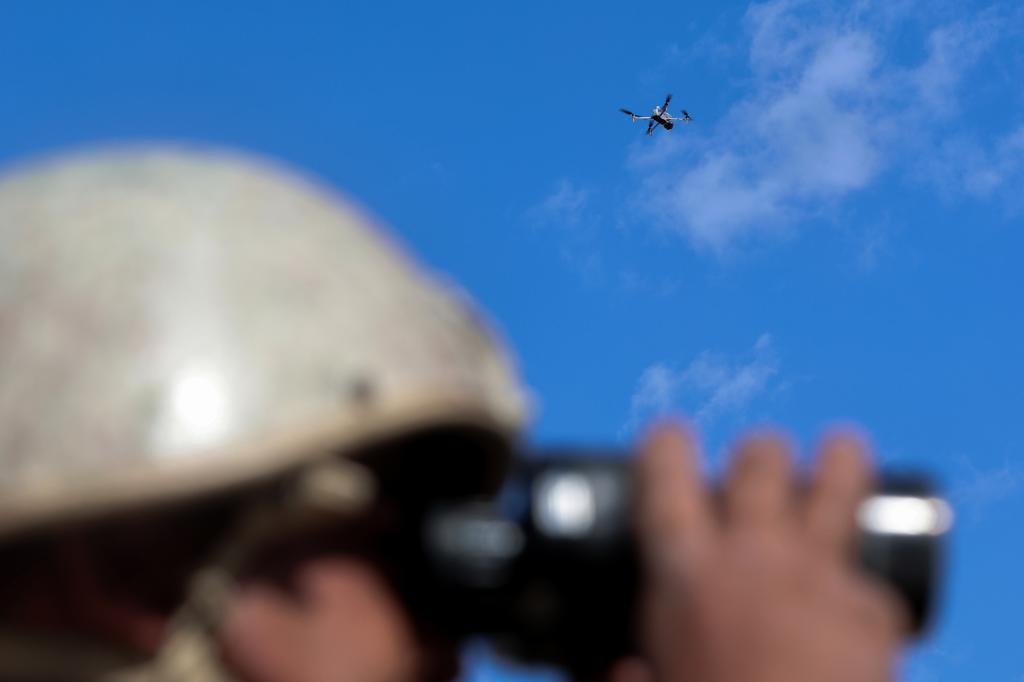
From the aviation training center, one witnesses the aerial duel that Kiev has been facing for weeks. Just before the practices begin, a Russian jet drone flies over pursued by a local fighter before disappearing into the sky. What follows is a massive explosion.
"See? Even the environment resembles a real combat situation," points out Victor, the chief instructor giving orders to the half-dozen soldiers.
The scenario is expressly set up for the struggle against the feared unmanned aerial vehicles (UAVs), but the smaller ones: the FPV drones. There are barricades made of wheels, shelters covered with nets, tunnels also protected by these meshes, and a simulation of vehicles built with wooden planks.
The facilities are adorned with posters displaying a list and photos of a large part of the UAVs used by Russians and Ukrainians, and another one offering "tips" for "protecting oneself from drones while driving" in a military vehicle.
"They are not only trained in shooting down FPV drones but also in the use of electronic interception measures and other anti-drone techniques," says Victor.
The session of this day unfolds as if it were one of those laser games thanks to a new system developed by a local company that allows equipping the soldiers and the FPV drones themselves with sensors. The UAVs also launch grenades equipped with the same technology.
"If the drone gets too close to the soldier, about two meters, the bracelet they wear on the wrist gives them an electric shock. They are dead," adds Victor.
"You have to advance and cover them!" shouts another expert while half of the group runs to take cover from the drone circling above them. Someone has thrown smoke grenades to add more realism to the exercise.
"Move the rifle, slowly, to correct the aim! Come on, come on!" adds the trainer.
"You can only run when it's turning!"
At the end of the first session, the monitor explains their mistakes. "Several of you have died. You don't run in groups of two but one by one. You shoot several times and do not stay in the same place," he clarifies.
The shotgun they use is a replica of the one that is now part of the equipment of a large part of the Ukrainian units deployed in the so-called "death zones," plagued by drones.
The omnipresence of these devices in the new battlefield scenario is leading to the emergence of a whole array of new weapons, mainly equipped with cartridges, fragmentation ammunition, or nets, designed solely for this purpose, which are also being incorporated into the basic arsenal of the local army.
A process as historic as those first rifles, machine guns, or anti-tank cannons used in the final years of World War I when armored vehicles made their appearance.
Feder, a police officer from Kramatorsk, displays a Czech CZ Bren 2 rifle, one of the most popular weapons in Ukraine because, being a normal rifle used by infantry, it becomes an anti-drone weapon when equipped with fragmentation ammunition.
"We use them to shoot with normal ammunition against larger drones and with special ammunition against FPV drones," explains the Ukrainian.
Members of the Khartia Brigade also regularly undergo practices focused on shooting down FPV drones.
A few weeks ago, a group of soldiers gathered at a shooting range on the outskirts of Kharkiv, where the soldiers dedicated themselves to trying to hit colored balloons hanging from a UAV.
The soldiers hurried to hide while the drone tried to bring the plastic sphere closer at high speed.
The first soldier had to resort to seven shots to make it explode. "You're dead," the instructor, Sergeant "Soltero" -he identified himself with his nickname-, 29 years old, told him.
"You also have to look up"
"We started implementing this specific training in 2024. They come once a month. Realize that everything has changed. For example, when advancing, we not only have to look ahead, to the right, or to the left. We also have to look up," said the non-commissioned officer.
The incorporation of FPV drone training into the basic instruction of Ukrainian military personnel is also part of the spectacular technological and strategic revolution promoted by the war in Ukraine.
The increasingly massive presence of UAVs, ground robots (UGVs), or unmanned marine vehicles has subverted all military knowledge of the past decades.
For several months now, the Ukrainian scenario has witnessed the increasingly common symbiosis of aerial and ground drones, as recently happened in the local army's offensive against Russian troops in the Lyman region.
"The description of the modern Ukrainian battlefield is starting to sound more like a science fiction movie than a conventional war," wrote the newspaper The Kyiv Independent.
Mykola Zynkevich, head of NC13, a UGV group that was decisive in the Lyman offensive, explained that the robots were a key element in the Ukrainian advance.
"Close to 80% of logistical tasks and 90% of the evacuation of the wounded were carried out by robotic complexes," he said in an interview published in a local media outlet.
The Ukrainian military used a new tactic, airborne robots, which were transported by aerial drones behind Russian lines causing chaos. "They landed more than 10 kilometers in the enemy's rear area," said General Andriy Biletskyi, commander of the Third Corps of the Ukrainian Army, in charge of that operation.
The videos released by the soldiers themselves show the ground machines equipped with grenade launchers firing their projectiles and then exploding in a building.
Shamil Krutkov, commander of the 93rd Mechanized Brigade, confirmed to this newspaper last September that his forces have been using this tactic since last spring. "We have seen that it creates chaos among the Russians," he pointed out.
His subordinates have even designed a type of UGV specialized in this type of airborne assault and another that can already carry out amphibious operations.
In a conversation with EL MUNDO in August, the number two of the NC13 unit, Bar, the military explained that their soldiers already use an average of between 70 and 100 of these kamikaze robots per month.
According to his superior, Zinkevych, in the last nine months, their UGVs have managed to replace missions that would have required the presence of 6,000 infantry soldiers.
Facing the progression of technological advances on the battlefield, warnings about the delay of European armed forces in developing these capabilities are a constant in Ukraine.
The former Defense Minister of this country, Andriy Zahorodnyuk, was unequivocal just a few days ago: "Europe is not prepared to defend itself. It is clearly lagging behind in technological terms. In case of a Russian escalation, they will suffer defeat," he declared to the local publication NV.
"The drone revolution completely changes the security architecture. Europe has begun to realize it, but it is not prepared for that change," he added.
As reported by The Wall Street Journal, Ukrainian forces defeated a group of American soldiers again last spring, in maneuvers carried out in Germany, highlighting the inferiority of Western armies against this new type of warfare.
The Americans mobilized around 3,500 troops from a Cavalry Division, who were supposed to attack a position of NATO troops reinforced by Ukrainians from the Nemesis group, one of Ukraine's elite drone units.
The Washington military launched the attack using armored vehicles that were detected and eliminated so quickly by the Ukrainian drones that they had to be reintroduced into the exercises to avoid having to end them prematurely.
Almost at the same time, another group of Ukrainian pilots easily outperformed Swedish soldiers in other NATO maneuvers playing the role of an aggressor army.
"They stopped the training three times" so that the Swedish soldiers could figure out how to respond to the UAVs, but if it had been a real-life situation, they would have died, a Ukrainian military officer explained to the AP.
"Every time NATO troops go up against the Ukrainian military, they lose. They can't learn from just a single visit to our forces. They have to spend time here, immersing themselves in all the strategic changes the war has brought about. It's not just about learning to operate a drone—it's about transforming the way of thinking," said Lieutenant Colonel Shamil Krutkov, commander of the 93rd Mechanized Brigade.