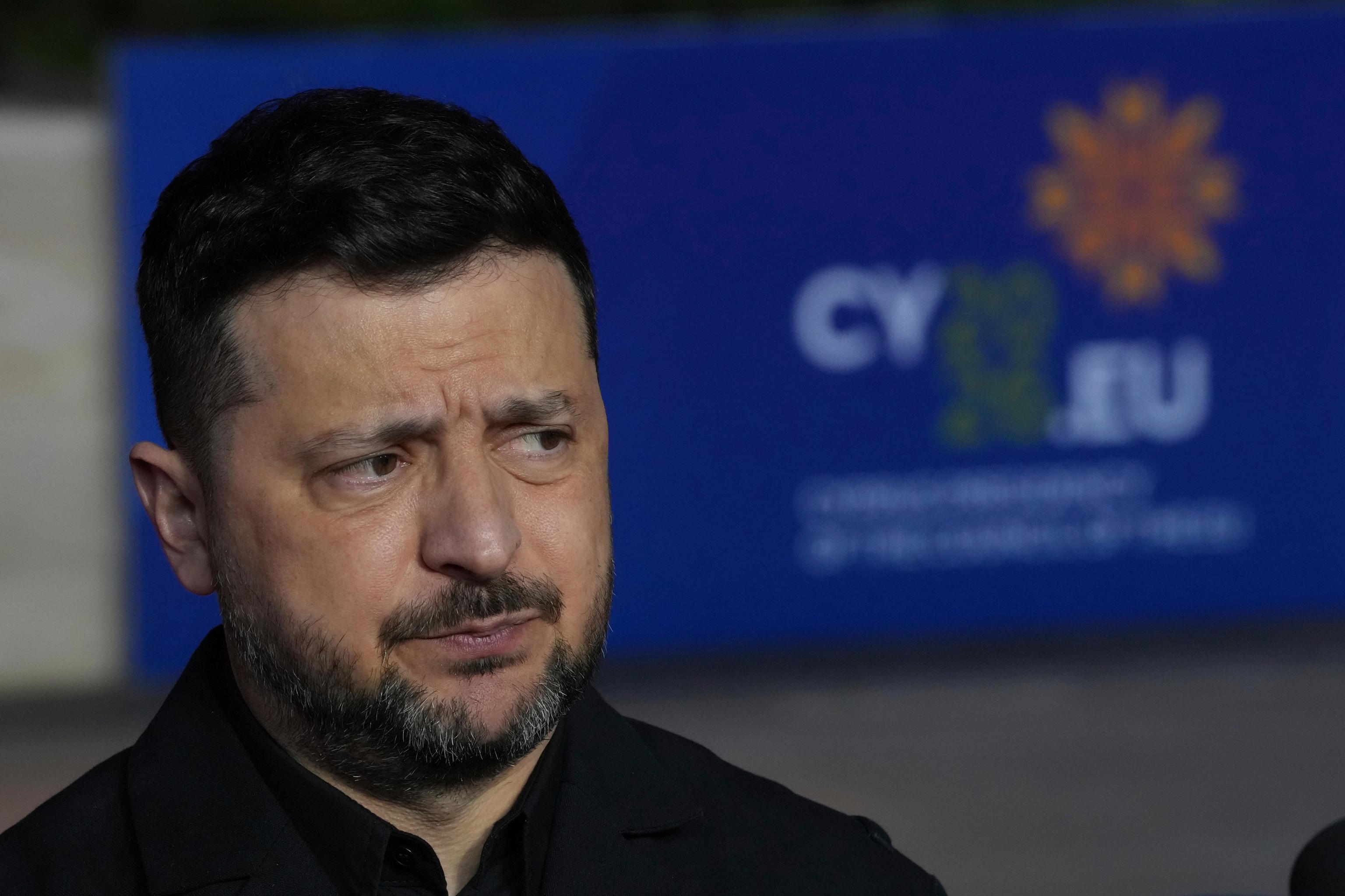
Volodymyr Zelensky won his election with 73% support over former President Petro Poroshenko. In other words, it was a resounding victory that no one disputed in Ukraine. The early days of his presidency were erratic, but the Russian invasion completely changed the profile of this former comedian, also a regular on Russian television during his acting days, transforming him into a bold figure embodying resistance against the ruthless aggression of a nuclear power. The actor traded his suit and tie for military green. From February 2022 to today, his defiant image has not faded, although it has worn out.
Ukrainians' trust in Zelensky is currently at one of its lowest points since the start of the large-scale invasion. According to the latest survey by the International Institute of Sociology of Kiev (KIIS), conducted between August 21 and September 10, 54% of citizens trust the president while 41% do not.
This is just two points above the war's minimum of 52% recorded in December 2024, and far from the 90% he reached in the spring of 2022 when he decided to stay in Kiev as Russian tanks advanced towards the capital. His popularity has been a rollercoaster: it declined throughout 2024 due to war fatigue and setbacks on the front, rose to 74% in May 2025 after his clash with Trump in the White House, and then dropped again due to two thorny issues: corruption cases in his inner circle and the dismissal last summer of his charismatic Minister of Defense, Mikhailo Fedorov, considered by many as the great technological wizard of drone warfare.
Intransigence towards rivals
One of the criticisms against Zelensky in Ukraine is his intransigence towards political rivals. He reassigned General Valery Zaluzhny, the Army chief in the early stages of the invasion, as the UK ambassador to get him out of the way. He does not even speak to the Mayor of Kiev, former boxer Vitali Klitschko. Petro Poroshenko is under sanctions, while Fedorov was dismissed when Zelensky sensed he could be a political rival in the future. Despite this, Zelensky is not a "dictator without elections", as Donald Trump called him last year, since the martial law currently in place in Ukraine prohibits holding elections during wartime.
This is something that the vast majority of Ukrainians understand: it is impossible to vote under Russian bombs and with millions of citizens as refugees in Europe or displaced within the national territory. Therefore, the blonde magnate's words last Sunday asserting that Zelensky should be replaced only serve to increase support for the Ukrainian president within his own territory. What Ukrainians hate the most is someone dictating who should govern them, whether they live in Moscow or Washington.
According to Olga Tarnovska, a translator, "no one here will support Trump and his idea of replacing Zelensky. We may or may not like Zelensky, but he is our president in the midst of war, and we will support him. There may be politicians who try to play on people's fatigue to reject Zelensky and call for elections, but that will not work with Putin."
Donald Trump has never been neutral in his stance on peace talks involving Russia and Ukraine. While he never misses an opportunity to praise his "friend" Vladimir Putin, even amidst this carnage, he publicly despises Zelensky.
His distrust towards Zelensky dates back to the summer of 2019 when the newly elected Ukrainian president had been in office for just two months. In a phone call on July 25, Trump asked him to investigate Joe Biden and his son Hunter (an advisor to the Ukrainian gas company Burisma) while the White House withheld around $400 million in military aid destined for Kiev. Zelensky responded evasively and never announced the investigation: the scandal broke out earlier, the aid was unblocked, and that episode led to the first impeachment against Trump, who always maintained that the conversation was "perfect."
But the mistrust existed before (his 2016 campaign blamed Kiev for the downfall of his campaign manager, Paul Manafort, after opaque payments from the pro-Russian party of Viktor Yanukovych came to light) and worsened in September 2024 when Zelensky visited an ammunition factory in Pennsylvania with a Democratic governor during an election campaign. Added to this is a fundamental view: Trump sees aid to Ukraine as an expense without return and considers Zelensky the main obstacle to a quick agreement with Vladimir Putin. All of this erupted in February 2025 when he tried to humiliate him in front of the cameras in the Oval Office.
But Trump is mistaken: if Zelensky were to leave, his successor would be much tougher than him in making concessions to the Russians. According to the latest internal survey by KIIS, 62% of Ukrainians are prepared to endure the war for as long as necessary. Additionally, 79% of respondents believe that Ukraine will ultimately defeat Russia.
According to Valeri Petrenko, a Ukrainian language professor in Lviv, "it is about maintaining sovereignty over our own decisions. Ukraine is at war to preserve its freedom against Russian imperialism. We neither allow Putin to change the president nor will we allow Trump to do so. We will only do it ourselves when we can."
At this moment, no one in Ukraine believes in Trump's announced ceasefires, never negotiated with Kiev, or in Putin's goodwill. Residents of cities like Kiev, Kharkiv, or Dnipro, visited every night by Russian drones and missiles, know that for the US President, his personal businesses and those of his negotiating team with the Kremlin (Witkoff and Kushner, who do not even hide being much closer to Russian positions) are more important than their own lives.