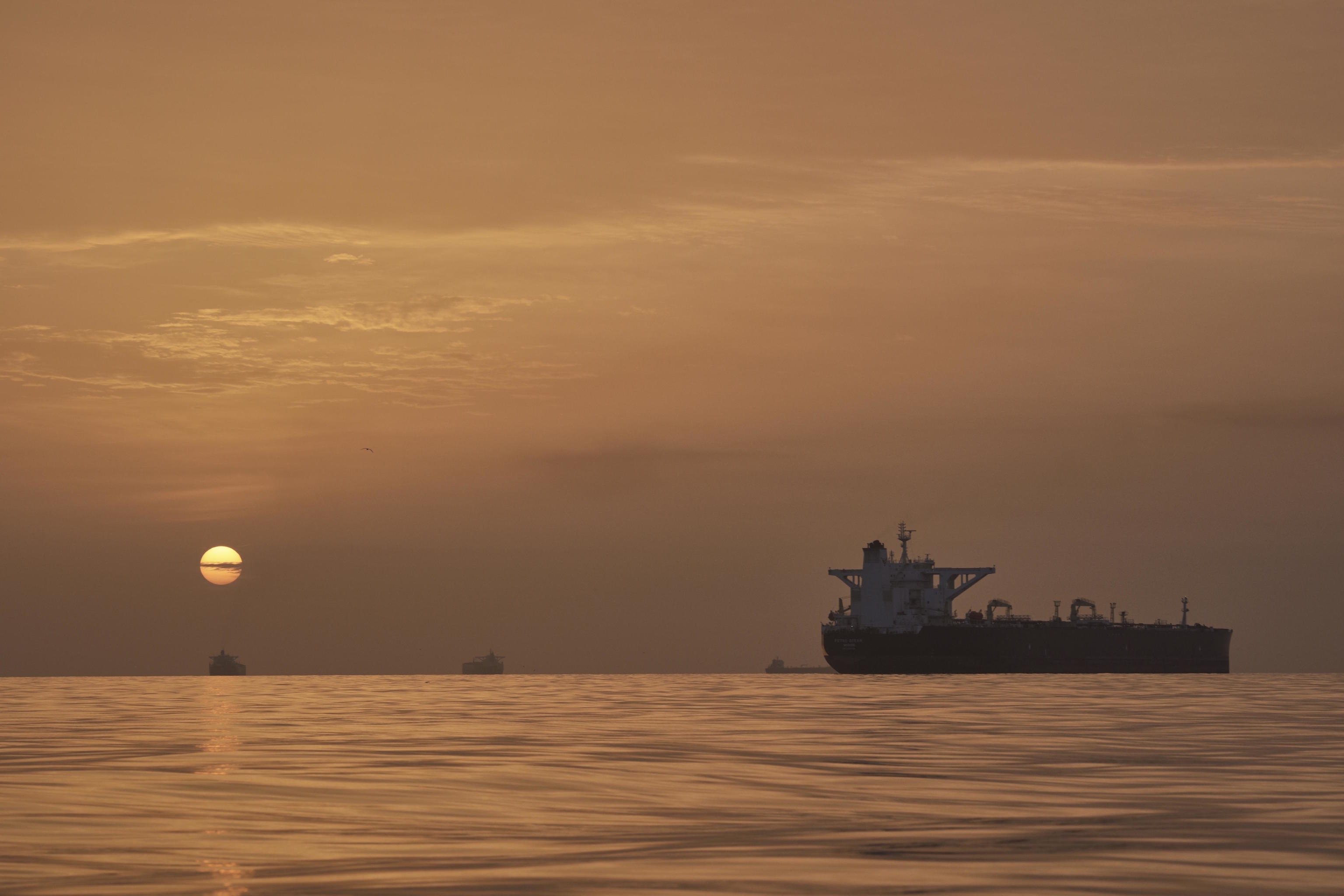
If tanker traffic through the Strait of Hormuz is 80% of what it was before the war, why doesn't gasoline drop? For several reasons. One: ships pass through Ormuz in nighttime convoys before transferring their cargo to other waiting ships outside the war zone, which is very expensive. Two: Michelle Brohard, chief political risk officer at the commodities and maritime transportation data giant Kpler, suspects that several Gulf countries are already paying the equivalent of 10% to 20% of the cargo of ships crossing the strait to Tehran. Three: insurance and freight costs for a tanker passing through Ormuz have increased by 40 times since the war broke out. And four: ships mainly carry crude oil, as the region's refineries are damaged and cannot process gasoline, diesel, kerosene, and heating oil, which is what we consume.
Palantir: many friends and, in Burnham's UK, some enemies
So far, Palantir, the software and Big data company co-founded by Peter Thiel ("I do not believe that democracy and freedom are compatible") and led by Alex Karp ("we have a lot of ethics... but don't believe what I just said") had been benefiting from its proximity to Trump and Netanyahu. But that is changing. British Prime Minister, Andy Burnham, wants to cancel Palantir's £330 million (€390 million) contract with the National Health Service of England partly due to the company's ideological affinity to Trump - who sympathizes with the dismemberment of the United Kingdom - and partly due to its mismanagement, revealed by the Financial Times. It also doesn't help that the British division of Palantir is led by former conservative politician Louis Mosley, whose grandfather, Sir Oswald Mosley, not only founded the British Union of Fascists in 1932 but also got married at Joseph Goebbels' house, with Adolf Hitler as the guest of honor.
For AI to be profitable, as much must be spent on it as on eating
The US economy partly relies on investment in Artificial Intelligence. But the AI figures don't add up. According to University of Columbia Professor Stijn Van Nieuwerburgh for the Brookings Institution think tank, between 2025 and 2031, US AI companies will invest around $10.3 trillion (€9.2 trillion) in that technology. But for all that capital spending to be profitable, Americans - companies and consumers - will have to spend on AI as much as on eating: 8.8% of GDP. This figure is nearly 7 times the 1.35% of GDP that computer spending reached at the peak of technology adoption, which also coincided with the arrival of the Internet in the nineties. To put it in current terms, 9% of the US GDP is now €2.5 trillion annually, more than the economies of Spain and Belgium combined. Does anyone believe these figures can add up?
China imposes a copper toll on Anglo American and Teck's merger
"If you don't give me special treatment as a customer, I won't approve your merger." That's China's message to two of the world's largest mining companies, Canadian Teck and British Anglo American, who expect to conclude their merger before March 2027. The resulting company will control 5% of the world's copper, well below the 10% to 15% levels that usually trigger competition actions. So China's demand is protectionist. The country produces 60% of copper cathode - the main form of commercialization of that mineral - and its companies are struggling to source the raw material, which is copper concentrate. Beijing's solution is to demand special treatment from the future Anglo Teck to save its sector. China's competitors, especially those dependent on importing copper concentrate - the EU, Japan, and Korea - will end up paying the price.
Ukraine's peace - and Russian refineries - depend on Trump's son-in-law
Two weeks ago, this section dedicated one of its segments to the US bureaucracy's inability to allow the foreign assets of the Russian oil company Lukoil to pass to the Washington private equity fund Carlyle. Now, the New York Times has provided another possible explanation, not related to bureaucracy or geopolitics, but to Trump's circle's ability to profit from everything. According to the newspaper, the US government wants Lukoil's assets outside Russia - except Kazakhstan - to be controlled, with the help of a US state agency, by a group of entrepreneurs including several from the Middle East linked to Trump's old friend Steve Witkoff and his son-in-law, Jared Kushner, who happen to be Trump's special envoys for peace in... Ukraine and the Middle East. While the dispute is resolved, Lukoil's facilities will remain in legal limbo, and we will have less gasoline.
India seeks 'rare earths' with its coal giant
India's largest coal company has decided it must also search for the minerals of the future. The problem is that it's easier said than done. The company is Coal India, state-owned, which has requested authorization from the Singapore government for its first commercial office outside its country in that city-state. Its goal is to track opportunities in lithium, rare earths, bauxite, and iron, including acquisitions of companies in Chile, Argentina, Canada, Australia, and Ghana. Although India is the world's second-largest coal consumer, with a remarkable 13.9% of the global total, its economy is transforming and increasingly needs more strategic minerals. The geopolitical factor also plays a role: Delhi is very independent and fears China's control of these raw materials. But the project has faced regulatory hurdles in Singapore, which have not yet approved Coal India's plans in their territory.