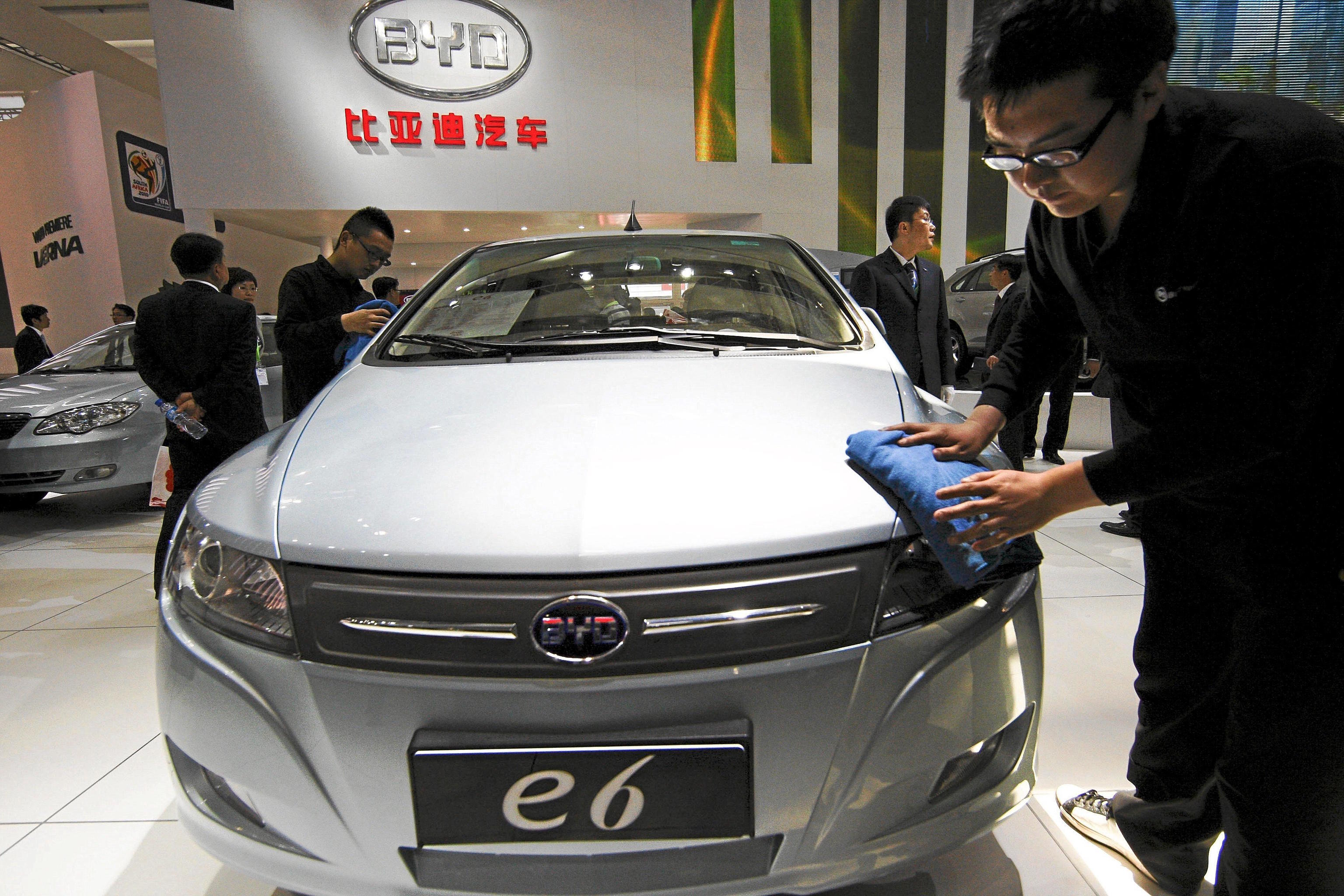
The hybrid car had become China's latest backdoor to conquer the European automotive market. When Brussels imposed additional tariffs on Chinese electric vehicles in 2024, manufacturers like BYD, Chery, and SAIC found an alternative: to increase exports of hybrid cars, which were not subject to those tariffs.
The strategy worked. In the first half of this year, the value of Chinese hybrids sent to the European Union tripled to reach $7.5 billion. Beijing had found a new lane for its commercial expansion. But Brussels has just set up a barrier.
After months of negotiations and two intense days of meetings in Beijing, European Trade Commissioner Maros Sefcovic and Chinese Minister of Commerce Wang Wentao reached an agreement last Friday that will allow the EU to reduce imports of these vehicles by more than half.
More details have been revealed this Monday: the flagship measure is a quota of 350,000 hybrid and plug-in hybrid cars per year from China, compared to the approximately 800,000 that were expected to enter the European market during 2026.
The limit will increase by 6% annually and will be maintained for four years. If the entire European bloc supports the mechanism, it could start being implemented on December 1. It will not simply be a tariff that raises the price of vehicles: once the annual quota is exhausted, additional cars will not be able to enter the European market. Brussels will resort to a commercial safeguard instrument with quotas distributed by countries of origin.
The formula has an important particularity: formally, it does not discriminate against China, as it will also apply to other exporting countries. But none come close to the production volume that the Asian giant sends to Europe. In addition, the rules of origin offer an outlet for Chinese manufacturers.
A Chery manufactured in Spain would not be considered an import of Chinese origin. The foreseeable consequence is an acceleration of Chinese industrial investment within Europe and in countries with preferential access to its market, such as Spain.
European officials are presenting the agreement as a political and commercial victory. Their goal was to reduce Chinese penetration in the European hybrid market by approximately half and protect manufacturers like Volkswagen or Renault. European authorities estimate that over the next four years, they could prevent the entry of several million Chinese vehicles.
The European industry has long been warning of tough competition against manufacturers that benefit from huge economies of scale, lower production costs, and a powerful battery ecosystem.
The Asian giant has agreed to moderate its exports in exchange for avoiding new trade retaliations. Additionally, it will reduce tariffs on various European products, including car components, olive oil, footwear, and ice cream.
Brussels estimates that these market access improvements will benefit EU exports by close to €4 billion. They have also committed to streamlining export licenses for rare earths and permanent magnets, strategic materials on which much of the European technology and automotive industry depends.
China's Ministry of Commerce presented a less triumphant interpretation for Brussels this Monday. According to Beijing, the commitment ensures that Chinese companies retain growth opportunities and that European restrictions are not discriminatory.
Authorities point out that China exported 107,000 hybrids to the European market in 2024 and 302,000 in 2025. From this perspective, an initial quota of 350,000 vehicles represents an increase from the last full year, although it implies a drastic cut in expectations for 2026. China also reserves the right to turn to the World Trade Organization if it deems its interests violated.
Another novelty of the day is that the Chinese Ministry of Finance has announced that, starting April 1, 2027, it will reduce the export VAT refund for new energy vehicles, a category that includes electric and plug-in hybrids, from 13% to 9%.
In practice, Beijing is cutting a fiscal incentive that favored the international expansion of its manufacturers. The decision comes as domestic consumption continues to lag, and many companies increasingly rely on foreign sales.
The rapprochement between Beijing and Brussels comes after France and Germany called for new tools to quickly cut off access to the European market against certain trade threats. European leaders will discuss new defensive measures this week, while Sefcovic and Wang are scheduled to have another conversation in January and meet in person in March.
The agreement seems to establish a controlled truce for now. Europe gains time to defend its industry, and China sells to its public that it can accept restrictions without giving up its international expansion.