The road to the new Chinese Silicon Valley begins under an immense roof. A Japanese architect covered the reading and exhibition rooms of an artistic center with it, baptized with a name so long that neighbors simply call it the Great Roof. Next to it stands another lovely bookstore, also with an official name too solemn for daily use. There, everyone calls it the Barn, although no one really explains why. Between these two buildings, where people go to read, walk, or have coffee, the first peculiarity of this particular technological village is understood: here, the artificial intelligence revolution did not start in a business park of glass towers, but in bookstores, terraces, and shared tables.
Liangzhu, in southeastern China, has become one of those places where the Asian giant experiments with the future with its very own mix of official planning, youthful enthusiasm, and accelerated capitalism. It is a village nestled between mountains, next to the remains of an archaeological site from five millennia ago. But among the ruins of an ancient civilization and the designer cafes, another tribe now moves: twenty-something programmers, startup founders, investors, and senior engineers who have worked in major tech companies.
"In bookstores and cafes, many young people gather daily to develop AI projects," explains Lin, a programmer who works with two friends on an AI agent for medical consultations. At a nearby table, among laptops, cold coffees, and charging cables, his colleague Min explains that this year they launched the "crazy code Thursdays," an initiative that has been very successful. "It all started as a weekly meeting to share ideas among engineers from major tech companies. But now, entrepreneurs from many cities eager to develop new applications are showing up."
The latest hit to come out of this ecosystem is about divination. It's called FateTell and is an application that interprets bazi, a Chinese system for reading destiny based on date and time of birth. In Liangzhu, the future can arrive wrapped in ancient superstition and written with cutting-edge code.
Another common meeting point is the garden of a townhouse owned by Tao Fangbo, founder of the tech company Mindverse. Once a month, he organizes a Demo Day there: hundreds of AI scholars gather to showcase prototypes while groups of investors listen attentively, take notes, and look for the next project that can scale up.
"As the local government has seen successful companies emerging from here, it has started funding entrepreneurship programs in Liangzhu, with grants for renting coworking spaces or shared apartments," says Lissa, an engineer from Shanghai who has moved to one of these entrepreneur apartments.
"These houses function as talent incubators. For six months, four young technicians live and work together to start a company related to AI. Then we rotate to other apartments and mix with new teams," she adds. Lissa pays 1,200 yuan per month, about 150 euros, for her room. Another newcomer to one of these apartments, Chen, boasts of having launched eight AI programs in the last year and a half. "The most successful one is an assistant for the elderly that a couple of companies are already using to train assistance robots in nursing homes," he explains.
For decades, the dream of these ambitious engineers was to cross the Pacific and try their luck in California. But the brightest Chinese researchers no longer look at the original Silicon Valley with the same fascination. Most now prefer to develop their careers in places like Liangzhu, attracted by a technological circuit that offers significant projects, competitive salaries, and companies capable of challenging American leadership in the sector.
This trend has allowed China to overtake the US as the main destination for elite global AI talent, according to a recent study by the Carnegie Endowment for International Peace think tank. The data indicates that the Asian country employs 41% of the world's most prominent researchers, compared to 34% working in the US. The shift has been rapid. In 2022, the US still concentrated 46% of these specialists, while China gathered 27%.
"China has built a formidable national AI industry, where salaries are already quite comparable to those in Silicon Valley," explains Damien Ma, co-author of the report. "At the same time, the tightening of immigration and visa restrictions in the US reduces the appeal of starting a professional career there."
About an hour's drive from Liangzhu is the other stop on the Chinese technological revolution. Hangzhou, the city where Alibaba was born, has become one of the capitals of the new race for AI and robotics. From here came the phenomenon DeepSeek, which shook the industry last year with a reasoning model whose parameters could be downloaded and adapted. Its emergence questioned a deeply rooted idea in Washington: that only US laboratories, with gigantic budgets and privileged access to the most advanced chips, could produce competitive systems.
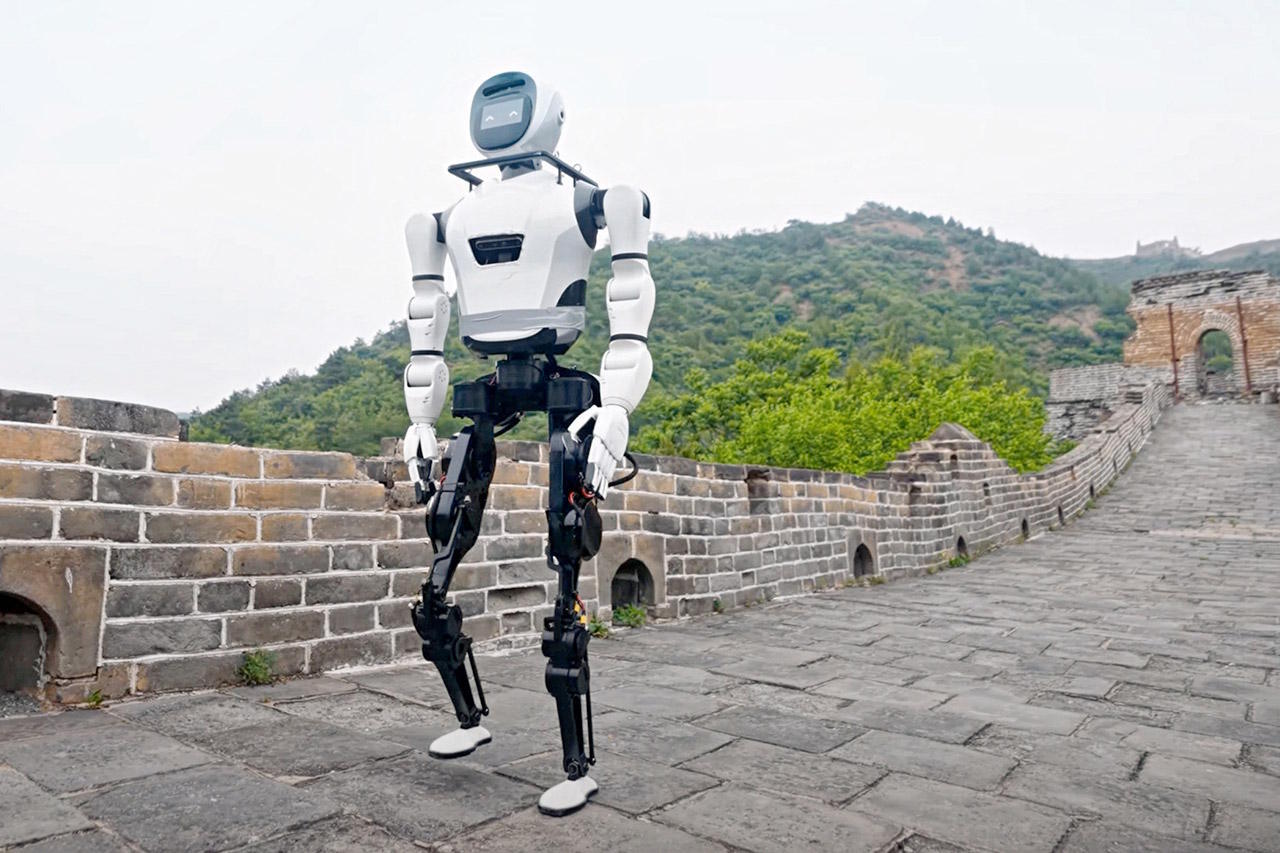
In Hangzhou, Unitree was also born, the world's largest manufacturer of humanoid robots, which debuted on the Shanghai Stock Exchange in August with a 629% increase. The company's popular showcase came in the last Chinese New Year galas, the country's most-watched TV program. Its androids appeared on screen with martial arts displays that went viral worldwide. In a China obsessed with proving that it no longer only manufactures for others, Unitree's robots became a perfect image.
Unitree's leap also has a strong symbolic significance as it comes at a time when robotics and AI have become one of the main fronts of technological competition between China and the United States. The AI Index from Stanford indicated a mere 2.7% difference between the best AI models of both countries in March 2026. The US retains advantages in cutting-edge models, advanced chips, and data centers. China stands out for research, patents, open models, and the deployment of industrial robots.
Chinese President Xi Jinping considers AI a strategic priority and a tool to reduce technological dependence on foreign countries and increase productivity. The official plan is for China to be the world's leading innovation center in artificial intelligence by 2030. Xi has called for open models and applications for all sectors, but also for the systems to remain "under human control."
This opens up one of the most revealing gaps between the two superpowers. In Silicon Valley, the most prevalent fear in recent months is that of an AI so advanced that it could escape human control and trigger cyberattacks or automated wars. In Beijing, this apocalyptic scenario is met with considerable skepticism. "For the Chinese apparatus, the idea that the Communist Party could lose control over this technology is inconceivable," frankly summarizes a former technological advisor to the regime's main advisory body. "China has already demonstrated that it can control the internet, monitor hundreds of millions of citizens, or paralyze entire cities if it deems stability is at stake."
This difference in approach explains why many of the recent warnings from Washington are viewed with suspicion in Beijing. Several Chinese observers interpret Western calls to curb or regulate AI as a form of "fear marketing": a useful narrative for major US companies to justify new technological restrictions against their Chinese rivals. "We still see AI as a technology in a very early stage. The focus is clearly on opportunity and innovation," argues Jie Cai, an AI security researcher at Tsinghua University (Beijing). "For many industry players, existential risk still seems like a very distant priority."
But skepticism does not mean indifference. Chinese authorities are tightening their regulations on AI and regularly publishing new security guidelines. China also has some of the strictest rules in the world for controlling generative AI: contents created by algorithms must be labeled, models must be registered, and companies need official approval before launching their systems to the public.
"Beijing is not ignoring the risks; it just frames them differently," points out Liang Fang, head of AI security and governance at Concordia, a consultancy based in Beijing. "In Chinese political tradition, technology tends to be seen less as an external force destined to destroy social order and more as a tool that can be used to serve the State's objectives."