When Donald Trump returned to the White House in January 2025 and handed over the Department of Governmental Efficiency (DOGE) to Elon Musk, tens of thousands of officials lost their jobs. Professionals with long careers and good salaries who had to leave Washington DC in a matter of weeks. It's not that they preferred to do so, or quickly refocused their lives elsewhere with better opportunities, but they had no choice but to emigrate because in U.S. big cities, if you lose your job, your savings cushion evaporates instantly.
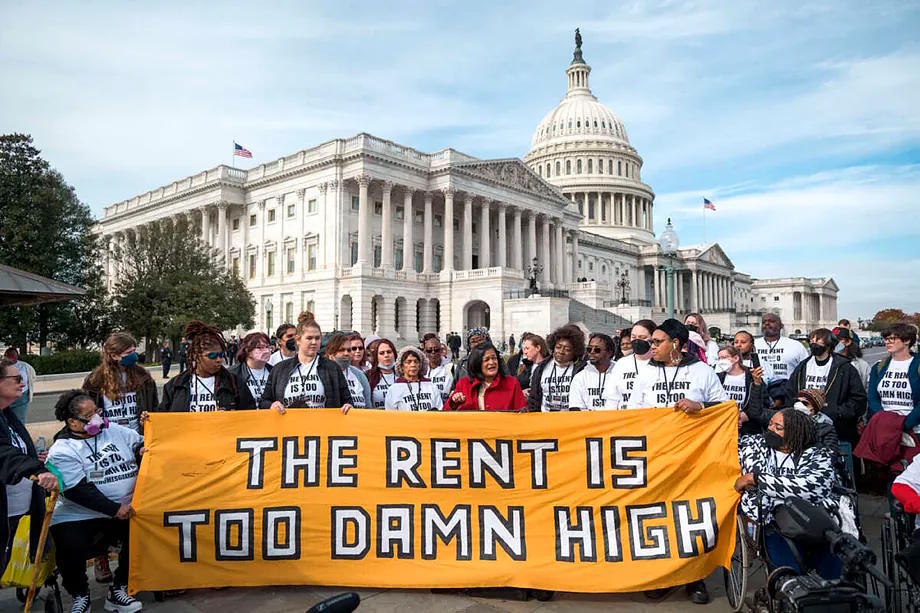
Washington DC is a city of renters. Barely 41.5% of occupied homes are inhabited by their owners, meaning that approximately six out of every 10 households live paying rent to a landlord each month. And a two-bedroom apartment, in a quiet area and building, not luxurious, can easily exceed $4,000 or $4,500, with an annual increase of at least 3% to 5%. Not to mention that a high credit score is essential.
The median gross rent in the capital reached $2,000 per month in the period 2020-2024, according to the Census Bureau. According to Apartments.com or Zillow, the average rent in DC was around $2,300 - $2,500 this summer, 37% above the national average. But the figure is very misleading, downwards, due to different factors. For example, because a huge percentage of the population lives alone, in studios or one-bedroom apartments. Two-bedroom apartments are usually very small, but some buildings have gyms or coworking areas that save other expenses for the tenant. In this city, three-bedroom apartments are almost non-existent, and those available quickly go above $6,000 (the striking thing is that entire three-story houses, which could be rented for $6,500 or $7,000 per month, are sold for just a million).
Secondly, because families tend to leave the city as soon as they have children, seeking larger houses, gardens, and better (and above all safer) schools in residential areas of Maryland or Virginia, a half-hour drive away. Those who stay assume that they must pay a significant extra to be where schools can offer more guarantees and not close to troubled neighborhoods. In 2024, median incomes (not averages) per household were around $110,000, and very high salaries are paid, not to mention international institutions or lobbies. But according to the MIT Living Wage Calculator, a family with one child needs around $120,000 in the capital to cover basic needs (housing, food, transportation, health, taxes), not necessarily including luxuries or a great capacity for savings.
Thirdly, because there are interesting neighborhoods or neighborhoods in the process of becoming so with currently very competitive prices that lower the average, but are areas where less than a decade ago few ventured due to gangs and shootings. Even in wealthier areas, there can be dangerous streets or entire blocks. The city has a very high murder rate, and although most are concentrated in very specific areas, word of mouth to newcomers always ends with a warning: if you live there, you will hear (or witness) shootings.
Furthermore, another key element is that approximately half of traditional multifamily rentals are subject to rent controls, not like the old Spanish rent control, but along those lines. A recent study by the DC Policy Center estimated that in 2024 there were 138,392 rental units in 3,006 apartment buildings. Of these, approximately 53% were subject to rent restrictions. Another 22% were subsidized through public programs, and another 3% were created through Inclusionary Zoning. So, in reality, this left only around 21% as truly market-rate rentals.
The Washington market is subject to clear pressures and regulations that make it very difficult, expensive, and slow to build. The outgoing mayor, Muriel Bowser, presented new proposals this year to facilitate investment and construction, stating that the city needs to preserve and expand its affordable housing stock. And there are many companies trying to redevelop entire blocks of office buildings near the center that have been vacant since the pandemic. But due to bureaucracy, necessary permits, environmental requirements, parking, the enormous obstacles for companies, and the zeal of administrations, it is very difficult or nearly impossible. Building units similar to public housing costs around a million dollars per unit, something unaffordable on a large scale.
Although in the U.S., evictions are usually immediate, with the landlord being able to evict those who do not pay rent in a matter of days or weeks, and with almost free rein to determine the price, in the capital, there are many more requirements. A landlord cannot change the lock or demand that the tenant vacate the property. The city establishes 10 legal reasons for an eviction, including non-payment, certain contract violations, illegal activities, reclaiming the property for personal use, certain rehabilitation works, or demolition. Except for specific exceptions, the process requires judicial intervention and a court order.
In 2025, nearly 13,000 eviction cases were filed, according to an analysis by the Future of Land and Housing, and 1,933 were completed, the highest number in seven years and 23% higher than in 2019. But the distribution shows inequalities: Ward 8 (which includes areas with historical problems of violence and drugs) accounted for around 30% of eviction demands, despite housing only 16% of the city's tenants.