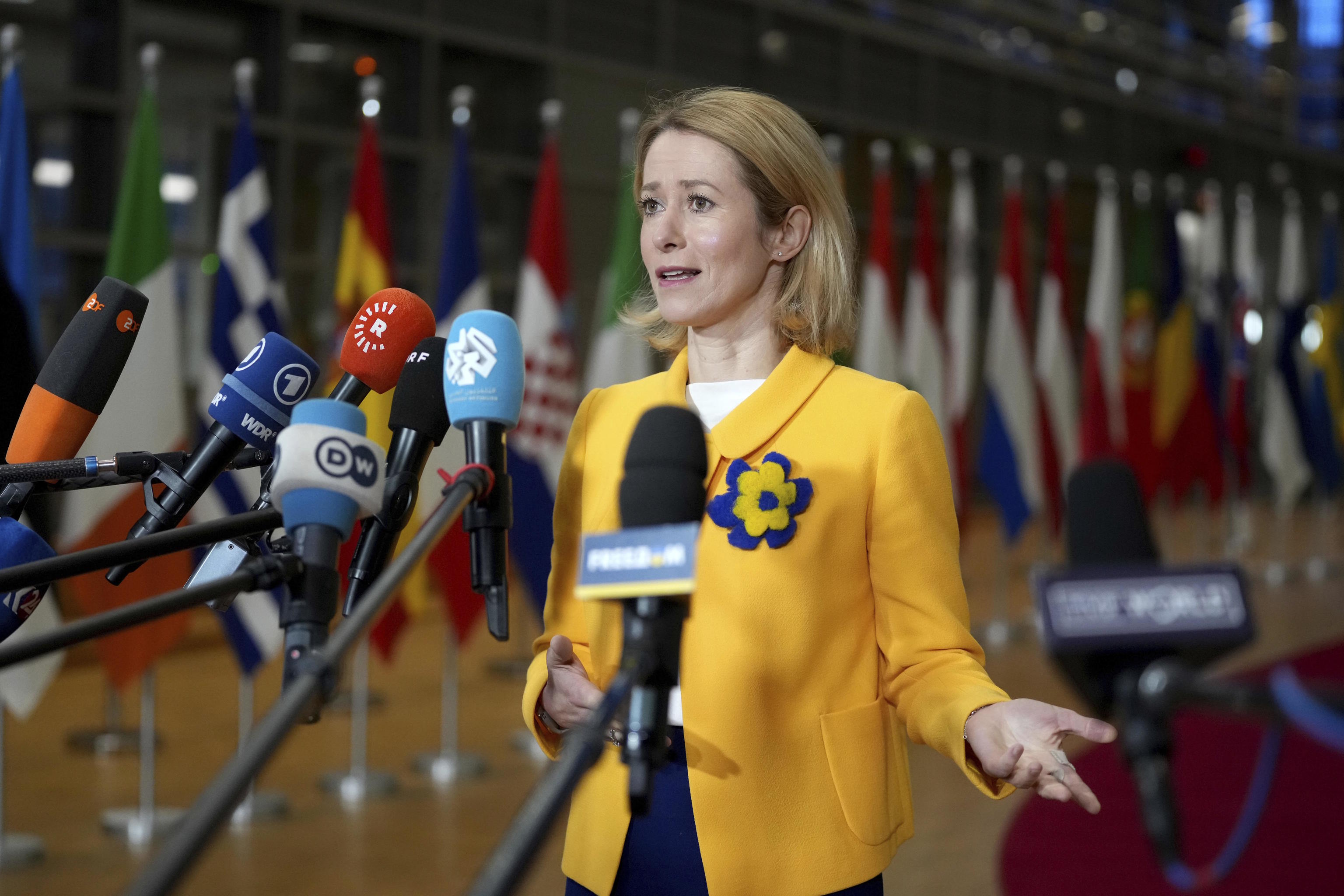
The European Union completely distrusts the energy truce between Ukraine and Russia proposed by U.S. President Donald Trump. This is because, on the one hand, they are wary of the magnate's plans, but above all because Vladimir Putin has already shown no intention of respecting it. Therefore, at the meeting of EU Foreign Ministers held this Monday, they have agreed to sanction 1,600 individuals and entities linked to the Russian military-industrial sector, the largest package of targeted sanctions approved to date.
"This is the largest individual expansion of our sanction lists since the war with Russia began. Europe has shown a united front today. More than half of these sanctions are directed against the ballistic missile production chain. We are making it significantly more difficult, slower, and more expensive for Russia to produce the weapons they use to kill Ukrainians," explained the High Representative of the European Union for Foreign Affairs, Kaja Kallas, at the press conference following the aforementioned meeting.
She also emphasized that it is not the time to "make concessions" to Russia but to "increase pressure." Because the EU "supports a ceasefire in attacks on energy infrastructure between Ukraine and Russia, provided that Moscow respects it," but the problem is that "the ceasefire cannot work if only one party complies."
"Just in the last week, Russian attacks have killed over 150 Ukrainian civilians. Russia has targeted bridges in Kyiv, bulk carriers in the Black Sea, power plants, and has bombed the National Academy of Sciences in Kyiv. These are not the actions of a country seeking peace," continued the European diplomatic official. "They are killing more civilians than ever," she stressed.
Kallas also sent a message to Trump showing a certain wariness towards agreements between the U.S. and Russia, including the release of thousands of barrels of Russian diesel to stabilize prices in the markets, as well as this alleged energy truce. "We would be much stronger if we acted jointly with the United States. Our message to the United States is also that the only thing that works with Russia is pressure. They are reaching these agreements and easing pressure on Russia. And we see how Russia responds: with more attacks and, in fact, with an escalating level of aggression," pointed out the High Representative.
In a very similar vein, German Chancellor Friedrich Merz also expressed today: "Russia will only negotiate seriously if pressured, and therefore we maintain our sanctions against Russia, because following Moscow's ruthless attacks on Ukraine's civilian energy supply, we must even tighten them."
Yesterday, European Commission President Ursula von der Leyen explicitly supported the President of Ukraine. "Good conversation with [Volodymyr] Zelensky today. I fully supported President Zelensky's call for a ceasefire that would protect global food supplies and energy infrastructure in Ukraine and Russia," she posted on her social media.
This support is significant in itself but also comes after certain tensions between them. Commission sources publicly deny it, but it is true that in some areas of the EU Executive, they do not deny that Von der Leyen and Zelensky had a confrontation during the United Nations Assembly, as reported by various media outlets. The reason is that the Commission President demanded progress on certain measures to continue receiving EU financial support.
In addition, Ukraine has also not liked the Commission's proposal to limit aid and market access for grain and wheat to this country if it eventually joins the Union. Therefore, relations between Brussels and Kyiv do not seem to be at their best, although publicly, as mentioned, the EU always shows its full support for Ukraine.
This will be the case again this week during the EU Council meeting, where Ukraine will remain one of the main issues discussed by presidents and prime ministers, and where Zelensky will arrive with new reforms. In this case, to open new negotiation chapters in the long path to EU accession.