The scene is reminiscent of the first weeks of the Russian invasion of Ukraine. Thousands of people, mostly women and children, arrive every day by train, bus, or in their own cars from all parts of the country fleeing Vladimir Putin's missiles and a winter that, according to analysts, will be even harsher than the previous one. And not because of the cold.
Lviv, the stately cultural capital of the country, is once again filling up with Ukrainians trying to seek refuge here or make this city their last stop towards Europe. According to Russian plans leaked last week by Ukrainian Intelligence to The New York Times, one of the Kremlin's objectives is to create a second major wave of refugees to Brussels that would overwhelm current care services. The vanguard is already here, filling its squares, hotels, and streets with their suitcases and baby strollers. Meanwhile, scheduled power outages have already begun neighborhood by neighborhood in cities like Kyiv or Kharkiv. At this point, no one in Ukraine believes in Donald Trump's energy truces or in Putin's uncertain pacifist intentions. In the fifth year of war, there is not a single Ukrainian who trusts either one's mediating capacity or the other's empty words.
Survival is now the priority in a campaign to make the cities of the invaded country uninhabitable by cutting off their energy supply, water, heating, and internet. The absence of Patriot interceptors, depleted by the US in its failed war against Iran, has left Ukraine at the mercy of Russian missiles.
The memory of last year's winter is still fresh, with neighborhoods on the left bank of Kyiv enduring two cold spells with 20 degrees below zero for several days without heating, with frozen water bottles on their nightstands, as this reporter witnessed. Even the Mayor of Kyiv, former boxing champion Vitali Klitschko, has urged the population to seek alternatives outside the capital due to the lack of resources.
This not only refers to migrating to rural areas, where the chimneys of old brick and wood stoves at least ensure a few hours of warmth but also to traveling to Europe, where about six million Ukrainian refugees already reside.
Alarms for drones and missiles are sounding throughout Ukraine, and every night its cities suffer increasingly bloody attacks on civilian targets. Hundreds of civilians die each week, many of them while sleeping in their homes.
Although there is no data yet on occupancy in Lviv, the streets, restaurants, and hotels are full once again. In the surroundings of Rynok Square, an architectural gem owed to its historic Austro-Hungarian-style buildings, outdoor concerts are held, a period film shoot with horseback soldiers halts the passage of old trams, and cafes buzz with customers. Inside, Ukrainians are not discussing peace, which still seems distant, but rather the new light restrictions, the Turkish soap operas that everyone wants to watch every night, or the asylum conditions in each European country and the affection or rejection that their inhabitants show towards Ukrainian refugees.
"Another winter like the last one"
Natalia, a resident of Kyiv, holds the hands of her two young children, Mikola and Katia. Her goal is to find a cheap rental in this city in the next week. If she doesn't succeed, she will travel to some friends' house in Poland. "I can't go through another winter like the last one. The worst part is not the missiles, but being left without light or heating. Our house reached zero degrees last February, and we had no way to warm up. I will not let my children go through that experience again." When it comes to the sense of danger, the city is no longer a sanctuary of safety as it has been until now. The new Shahed 5 jet drones arrive in swarms more and more frequently to attack its neighborhoods.
European diplomatic sources assure EL MUNDO that, although they have no immediate intention of fleeing Kyiv due to Russian threats, several embassies have already prepared contingency plans in case conditions worsen this winter and they have to move to Lviv, as some did in the early stages of the invasion, where some rooms at the Grand Hotel served as a provisional consulate at the beginning of the invasion.
In the city streets, war wounded are also visible, strolling in their uniforms, many of them already using prosthetics. The city is the main center for the rehabilitation of war wounded in the country, with specialized hospitals in prosthetics and recovery for amputees: Unbroken, the largest center of its kind in Ukraine, is located there.
Since 2022, Lviv has absorbed hundreds of thousands of internally displaced persons from occupied areas and front-line cities, increasing its population by about 250,000 above its pre-war population (750,000). Its population has surged, putting pressure on housing, healthcare, and schools.
But the raw numbers are deceiving because there is constant movement in both directions: people arriving from the east, people leaving for Poland and the EU, people returning to their hometowns when attacks subside, and people leaving again. What has changed in 2026, according to a recent analysis by New Eastern Europe, is that Lviv has ceased to be a place where people waited to return home: many displaced individuals who arrived thinking they would stay for weeks have now been there for four years and are building permanent lives. The city's challenge is no longer to absorb those who got off a train in an emergency but to integrate a population that will never return to their hometowns.
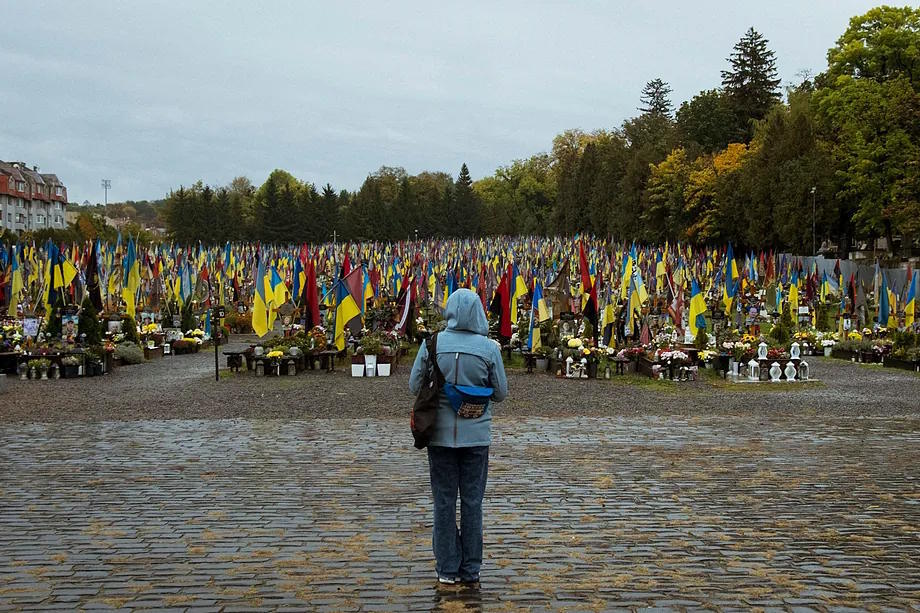
Lviv embodies the heart of historical Ukrainian nationalism, predominantly Ukrainian-speaking, with a memory deeply marked by Soviet occupation. It is where the most symbolic funerals of fallen soldiers are held, and where Lychakiv Cemetery has become the great pantheon of the war.
This reporter was at that cemetery during the first days of the February 2022 invasion when a nearby hill was used to expand the old cemetery and the first graves were opened. Now, those initial graves have turned into a sea of flags, one for each fallen soldier. That place best exemplifies what is known here as "the price to pay," the human cost of the Russian aggression.