Hello, how are you? Your goal today is to pilot a spacecraft bound for the Moon." This is the simple plan recounted by four astronauts from the European Space Station (ESA) to students who wish to emulate their feats by venturing into LuneXplorer, the simulator that allows experiencing a pressure of up to 2G, the same as during a real mission to the Earth's only natural satellite, equivalent to twice a person's body weight.
This prevents them from moving their own hand freely or separating their back from the capsule seat in which they have previously entered with three other brave individuals. Confirmed live by the four after being amazed by the launch, powerful braking, moon landing, the sensation of up to six times lighter than on our planet, the discovery of the lunar surface, and the return to reality, of course, with a certificate of astronaut apprentice included, detailing personal flight data such as altitude, speed, duration, pressure level...
And all this in 40 minutes, enough to "enjoy an experience that can be described in words, but must be lived to understand what astronauts really feel aboard a rocket," says Christophe Chaffardon, Director of Educational Activities at the City of Space in Toulouse, the largest European center dedicated to this subject.
Not surprisingly, the capital of the Occitania region in southern France is also known as the space city, hosting 25% of the sector's jobs in the Old Continent, with 13,000 residents working in it, whether in its two satellite manufacturing companies (Airbus and Thales Alenia Space), the Institute of Research in Astrophysics and Planetology, or one of the world's leading users of space technology, Météo France.
Thus, it is not surprising that the City of Space is located on the outskirts of Toulouse, where over 4,000 m2 of exhibition space and four hectares of scientific gardens are spread out. During the visit, permanent and temporary exhibitions, immersive activities, laboratories on Mars, workshops, events, two planetariums with some of the most advanced astronomical simulators in the world, an IMAX room screening films like Asteroid Hunters 3D, immersing viewers in the backstage of scientific research to protect our planet from the impact of these rocky celestial bodies.
The list continues with animations like The Eagle Has Landed to discover the challenges of the Apollo missions or how the ESA recruits its astronauts. Children aged four to eight also have their City of the Little Ones, with cultural initiatives for those who cannot read yet or are still learning.
There are also stories of pioneers: Sputnik 1, Laika, Yuri Gagarin, and Valentina Tereshkova, the first artificial satellite, animal, man, and woman launched into outer space. Not to mention the achievements reached later by Neil Armstrong, Michael Collins, Reid Wiseman, and other crew members of programs like Mercury, Gemini, Soyuz, Apollo, or Artemis.
It is also an opportunity to see up close a 3.3 billion-year-old lunar rock collected by NASA in 1971. "It has never been exposed to Earth's atmosphere and is stored in nitrogen to prevent oxidation," explains Laurene Poirier, a guide at the complex.
There is also a Martian crater of 900 m2 and 250 seats with two rovers (robotic vehicles to move on the planet's surface) and a dome with a 40-centimeter telescope and a telescope to observe the sun.
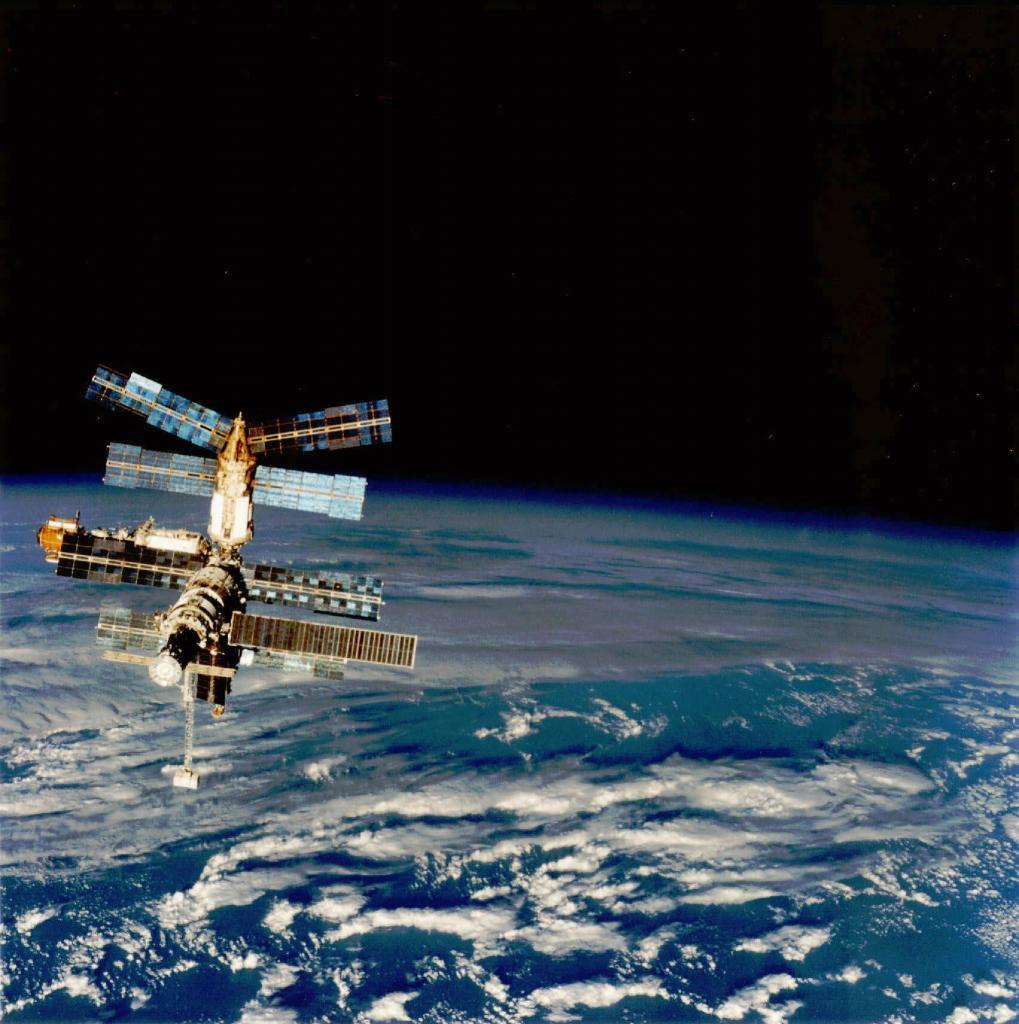
Throughout the complex, there is room for 27 life-size space objects, including a replica of the Ariane 5 rocket, Soyuz spacecraft modules, or a complete (real) MIR station, immersed in the gardens. The latter can be toured to see what astronauts eat out there and how they groom, train, research, have fun, and sleep.
"It's from 1986, so the current ones are much more modern. Still, it is one of the experiences that visitors enjoy the most because you see what their daily life was like with objects like cans of liver pâté, sturgeon, chicken with rice, and even special bags in which they injected hot water to have soup," says Poirier.
There is also the bike they used for exercise, the standing sleeping bag, the plastic toilet they had to hold with both hands while floating, or authentic astronaut suits. However, part of the design for those traveling to the Moon next, the Artemis III, is by Prada.