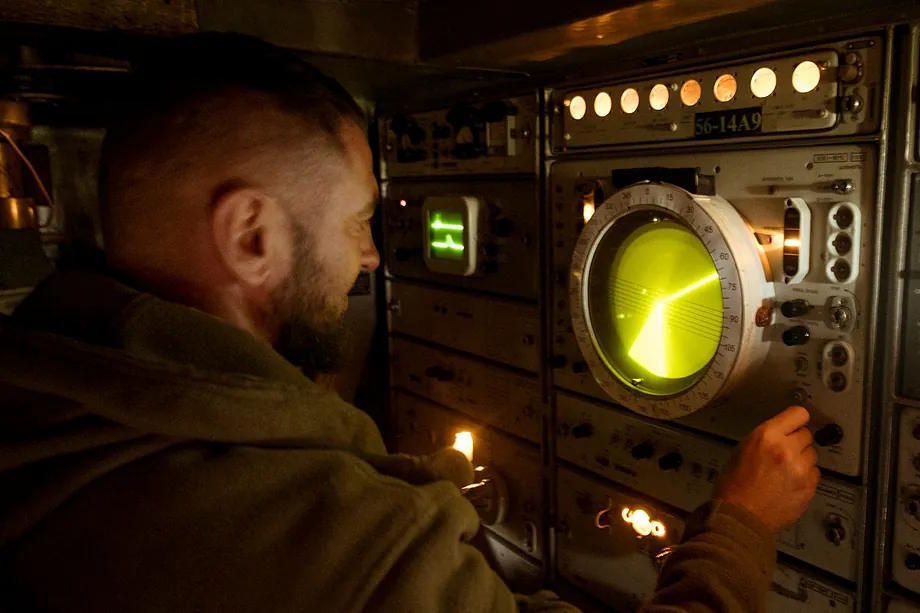
Despite being sleepless for two days and having nearly five years of war behind them, they still move swiftly, jumping into the vehicle to position their huge antenna for combat. Next to them, in the missile launchers, only one projectile remains. The others were launched hours earlier to target the Shahed jet drone, the new nightmare for Ukrainian civilians, marking the 50th downing since August.
The usual crew of the 9K33 Osa air defense system consists of five people, but the shortage of personnel at this stage of the war means they can only rely on four. The driver, nicknamed Turbo, thin and sinewy like hemp, steers the old Soviet monster to its position along the defensive ring roads of the Kiev region, leaving a trail of white smoke and two huge tracks in the mud. Their mission: to defend the capital's residents when they are most threatened. Hranit, the commander, scans the sky for drones or to clear his own thoughts.
- How does it affect you that Donald Trump cuts off U.S. Intelligence information?
- U.S. satellites can observe the takeoff of drones from the Russian side well in advance. If they warn us, we can be prepared and even anticipate their trajectories to shoot them down. If they don't provide us with that information, then we only see them when they are upon us.
- Is this old Soviet system really effective against the new jet drones?
- Yes, it is. We spent most of the war bored, hardly firing, and now we are essential to shoot down these drones. Since summer, we have taken down about 50 units, with the latest one last night. If the radar locks onto the target, the missile never misses.
The sense of discouragement among these soldiers mirrors that of the Ukrainian civilian population, especially after Donald Trump's new turn towards Vladimir Putin's positions. His new plan to purchase diesel from Moscow has been accompanied, in three days of madness, by two unexpected and even more unsettling events for Volodymyr Zelensky's government: the cutoff of Intelligence information on missile and jet drone attacks from Russia and the disruption of high-speed Starlink service.
The first, satellite Intelligence, is crucial for early warning and alerting Kiev residents in time about the dreaded ballistic missiles approaching from beyond the Russian border. This U.S. information has been vital since the beginning of the invasion, providing essential minutes for people to seek shelter, for example, in the Metro. Without it, the consequences are not hard to predict: many more civilians will die.
The second event is the slowdown of the Starlink satellite internet service, essential for guiding Ukrainian drones attacking Russian logistics in occupied territories or intercepting the formidable Shahed 5 in Kiev's skies. These jet drones reach speeds of about 500 kilometers per hour. If the usage speed is limited to 70 kilometers per hour, as was done, they stop receiving signals, allowing the Russian army to launch jet drones over Kiev knowing there are no interceptors capable of shooting them down and freely move along the roads of occupied Ukraine. In both cases, it seems like the Kremlin and Washington have coordinated to leave Ukraine fighting with both hands tied behind its back: unable to attack the Russians or defend against them.
Initially, blame was placed on SpaceX and its owner, billionaire Elon Musk, for cutting off the service, but Musk himself explained that he has control over the civil service of Starlink, not its military application, Starshield, which is under the Pentagon's authority, meaning the Secretary of Defense, Pete Hegseth. In reality, it depends on Donald Trump's decision. Trump has not yet admitted to requesting both the Intelligence cutoff and the Starshield speed limit, but neither has he denied it. "We need to end this stupid war," was his only response yesterday. Both decisions have been made without anyone taking responsibility for them.
The consequence, which may be irreversible, is that Zelensky has grown tired of being accommodating to Trump, of respecting the White House's energy truce while Putin bombs two power plants. Yesterday, the Ukrainian president exploded in the Financial Times: "From midnight yesterday [Wednesday] until 9 a.m. today [yesterday], there were over 850 drone attacks, precisely at a time when our defensive capabilities are being artificially restricted. Vladimir Putin is comfortable now. The blockade on attacks against Russian refineries is over. It's finished."
Interestingly, yesterday Russian Foreign Minister Sergei Lavrov admitted that the Kremlin has not respected the truce "to prevent Zelensky from rearming," but it seems Trump is indifferent. Meanwhile, several European leaders urged Zelensky to "moderate" his criticisms of the U.S. President.
Understanding Trump's actions is challenging, especially considering that it is unlikely diesel prices will decrease at U.S. gas stations, not even from an electoral perspective. A The Economist/YouGov survey from February 2026 revealed that 61% of Americans sympathize more with Ukraine, compared to only 3% who sympathize with Russia. Could personal reasons be at play? For years, Trump has made his preference for Putin clear, the only person he praises and desires to "do a lot of business with."
His entire peace plan is based on money. The issue is that the Russian autocrat interprets his invasion of Ukraine from an imperial ideology, not from an economic interest, leading to a dialogue of the deaf. Despite this, the Russian president knows how to keep the American in the game without conceding an inch of his stance. Trump reserves concessions only to impose them on Ukraine. However, neither his military nor his civilians are willing to give up their sovereignty. The population wants the war to end, but not at any cost: 76% outright reject any peace plan on Russian terms, and 62% categorically oppose handing over all of Donbass to Russia even in exchange for U.S. and European security guarantees.
We return to the cold position where these Ukrainians watch the sky and prepare to shoot down any drones that come with the old Soviet relic, now updated with Western technology. To demonstrate its effectiveness, they show several videos to this reporter with undeniable drone takedowns. "We have been fighting since 2022, but now is not the time to give up," says Dzhmil, one of the crew members now operating the radar. His luminous needle sweeps the screen counterclockwise in search of light points in the sky. "Our combat aircraft leave a much stronger signal than drones, whose radar signature is smaller. This way, we can distinguish friend from foe," explains Commander Hranit.
- At this point, I just want to go home.
The rest of the crew bursts into laughter despite the anger and fatigue of the past few days. Obviously, no one will go home until this nightmare ends.